CB Radio Terminology Explained: The Complete Guide to CB Radio Lingo, Q-Codes and Operator Slang
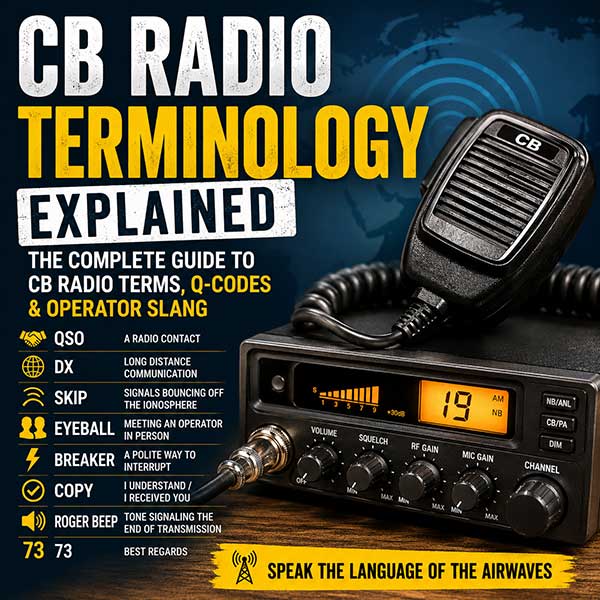
If you've spent any time listening to CB radio, you've probably heard operators using words and phrases that sound like a language of their own. Newcomers often tune into a conversation and hear terms such as QSO, DX, 73, or breaker without having the slightest idea what they mean.
The truth is that CB radio has developed its own unique vocabulary over decades of use. Some terms originated from professional radio communications, some came from amateur radio operators, and others evolved naturally among CB enthusiasts around the world. Understanding this language not only helps you follow conversations, but also makes it easier to become part of the wider CB community.
Whether you're a brand-new operator, returning to the hobby after many years away, or simply curious about the language of the airwaves, this guide explains the most common CB radio terminology you'll encounter.
QSO
A QSO is simply a radio contact or conversation between two or more stations.
The term comes from the international Q-Code system originally developed for Morse code communications. In CB radio, the term has become synonymous with any successful contact.
- "I had a nice QSO with Scotland this morning."
- "Thanks for the QSO, catch you again soon."
Many operators use the term when logging contacts in a logbook.
DX
DX refers to long-distance communication.
The term comes from telegraphy shorthand where "DX" represented "distance." In CB radio, a DX contact is generally considered any station significantly further away than your normal local coverage area.
- Talking from Derbyshire to Cornwall.
- Making contact with France from England.
- Speaking to operators in the United States during exceptional propagation conditions.
DXing is one of the most popular aspects of the hobby and often becomes addictive once operators experience it for the first time.
Skip
Skip describes radio signals that travel long distances by bouncing off layers of the Earth's ionosphere.
Under normal conditions, CB radio is often limited to local or regional communication. During periods of enhanced propagation, signals can travel hundreds or even thousands of miles.
This phenomenon is known as skip.
When skip is active, operators may hear stations from:
- Spain
- Italy
- Germany
- Poland
- United States
- South America
- "The skip is rolling today."
- "Loads of European stations coming through on the skip."
Eyeball
An eyeball occurs when two radio operators meet in person.
Many operators spend months or even years talking on-air before eventually meeting face-to-face at a rally, truck stop, campsite, radio event, or social gathering.
- "We finally had an eyeball at the radio rally."
- "I've spoken to him for years and only recently had an eyeball."
For many CB enthusiasts, eyeballs become lasting friendships.
Breaker
Breaker is a traditional CB term used to politely interrupt an ongoing conversation.
Instead of speaking over existing operators, a station might call:
"Breaker."
or
"Breaker one-nine."
This signals that somebody would like to join the conversation or pass a message.
While less common than it once was, the term remains a classic part of CB culture.
Copy
Copy means "I understand" or "I received your transmission."
- "Do you copy?"
- "Copy that."
- "I got a good copy on you."
A "good copy" means the signal was strong and easily understood.
Roger Beep
A Roger Beep is a short electronic tone transmitted after a station releases the microphone button.
The beep indicates that the operator has finished speaking and the channel is free for someone else to reply.
Roger beeps became extremely popular during the CB boom years and remain common today, although some operators love them while others dislike them.
- "He's running a Roger Beep."
- "Turn that beep off!"
73
73 means "Best regards."
The term originates from nineteenth-century telegraph operators and remains widely used across both CB and amateur radio.
- "73 from Ashlar 357."
- "Take care and 73."
It's often used at the end of a contact as a friendly sign-off.
88
88 means "Love and kisses."
Traditionally used between close friends, family members, or partners who share an interest in radio.
- "73 and 88."
- "Sending 88 to the family."
While less common than 73, it remains part of traditional radio culture.
Handle
A handle is your radio nickname.
Many operators choose memorable handles that become better known than their real names.
- Gandy
- Roadrunner
- Night Hawk
- Silver Fox
You'll often hear:
"What's your handle?"
rather than:
"What's your name?"
Callsign
A callsign is the unique identifier used by an operator.
- 26AT123
- 26UK873
- 26OP222
Many clubs and organisations issue callsigns to members.
QRM
QRM means interference caused by other radio operators.
- Multiple stations transmitting simultaneously.
- An overly busy channel.
Example usage:
"There's a lot of QRM today."
QRN
QRN refers to naturally occurring radio noise.
- Thunderstorms
- Lightning
- Atmospheric conditions
Example usage:
"The QRN is making it difficult to hear you."
Net
A net is a scheduled gathering of radio operators on a specific channel at a specific time.
- Social
- Regional
- Technical
- Emergency-preparedness focused
Nets provide a reliable way for operators to meet on-air.
Net Control
Net Control is the operator responsible for managing a net.
- Opens the net
- Takes check-ins
- Keeps order
- Directs traffic
Without Net Control, large nets can become chaotic.
Rag Chew
A rag chew is a relaxed, informal conversation.
No agenda. No competition. Just people enjoying a chat.
- "We had a two-hour rag chew last night."
- "Just looking for a rag chew."
SWR
Standing Wave Ratio (SWR) measures how efficiently power is transferred from your radio into your antenna.
- Reduce performance
- Cause signal loss
- Potentially damage equipment
Most CB operators become familiar with SWR very quickly after setting up their first station.
Key Up
To key up means to press the microphone transmit button.
- "Key up again."
- "When I keyed up, he came back immediately."
S-Meter
An S-Meter displays signal strength.
Most radios measure signals using S-units:
- S1 = Very weak
- S5 = Moderate
- S9 = Strong
Many operators will report:
"You're five and seven."
meaning approximately S7 signal strength.
RF Gain
RF Gain controls receiver sensitivity.
- Reduce background noise
- Help eliminate weaker stations
- Improve listening in busy conditions
Increasing RF gain allows weaker stations to be heard.
Sideband (SSB)
Single Sideband (SSB) is a more efficient transmission mode than AM.
- Greater range
- Better power efficiency
- Popular among DX operators
Many serious long-distance CB operators prefer SSB radios.
Shack
A shack is the room or location where an operator keeps their radio equipment.
- Spare bedroom
- Garden shed
- Home office
- Dedicated radio room
The term comes from early radio operators who often worked from small wooden huts.
Silent Key
A Silent Key is a respectful term used when a radio operator has passed away.
- "He became a Silent Key last year."
- "Remembering our Silent Keys."
The phrase is widely used across the radio community.
Channel 19
Channel 19 is perhaps the most famous CB channel in the world.
Traditionally associated with:
- Truck drivers
- Traffic information
- Road reports
- Mobile operators
Even today, many drivers monitor Channel 19 while travelling.
Final Thoughts
CB radio terminology is part of what makes the hobby unique. Words such as QSO, DX, skip, breaker, eyeball and 73 have survived for decades because they provide a shared language understood by operators around the world.
The more time you spend on-air, the more these terms become second nature. Before long, you'll find yourself signing off with "73", discussing the latest DX conditions, checking into nets, and logging QSOs without even thinking about it.
And that's when you know you've truly become part of the CB radio community.
Related articles
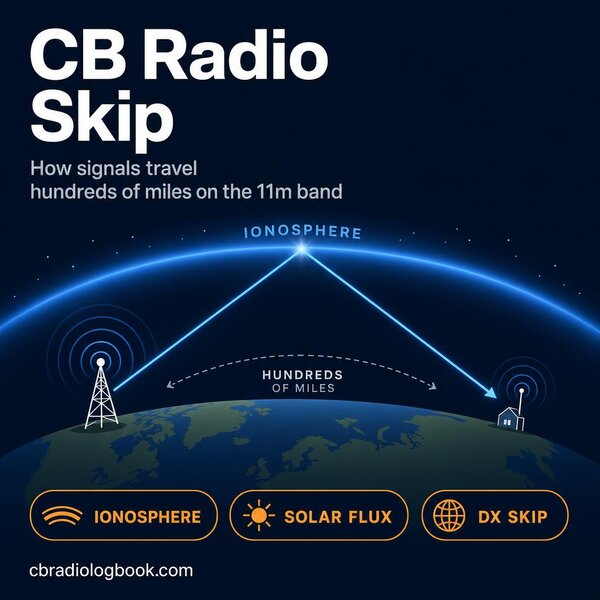
CB Radio Skip: The Fascinating Science Behind Long-Distance Communication on the 11 Metre Band
Discover the science behind CB radio skip on the 11 metre band — how the ionosphere, solar activity and Sporadic E let your signal travel hundreds or thousands of miles.

CB Radio Frequencies: The Complete UK, European & US Channel Guide
Discover all CB radio frequencies used in the UK, Europe and the USA. Complete CB channel frequency charts, the difference between UK and CEPT channels, and the best frequencies for local contacts, truckers and DX.

Understanding the Net System: How Scheduled CB Nets Work and Why They're Worth Joining
Discover how the Net system in CB Radio Logbook works — from recurring schedules and timezone-aware times to public and invite-only sessions — and the real benefits of joining or hosting scheduled CB radio nets.
Join the CB Radio Logbook
Track every QSO, map your contacts, and connect with operators near you. Create your free account and get on the air.
Create your account