CB Radio Skip: The Fascinating Science Behind Long-Distance Communication on the 11 Metre Band
Few things capture the imagination of a CB radio operator quite like hearing a station from another country suddenly appear on a channel that was quiet only moments before. One minute you're listening for local operators around your town, and the next you're hearing voices from Spain, Italy, Poland, or even across the Atlantic. For many people, this experience is what transforms CB radio from a simple means of communication into a genuinely fascinating hobby.
This phenomenon is known as skip, and it is one of the defining characteristics of the 11 metre CB band. Unlike local ground-wave communications, which are limited by terrain, antenna height and the curvature of the Earth, skip allows radio signals to travel vast distances by interacting with the upper layers of the atmosphere.
What Is Skip?
In CB radio terms, skip refers to radio signals that travel well beyond their normal expected range by being reflected or refracted by the ionosphere. Under ordinary circumstances, a CB radio signal follows the surface of the Earth for a relatively limited distance. Mobile stations might communicate over a few miles, while well-equipped base stations may achieve considerably greater coverage depending on local geography and antenna performance.
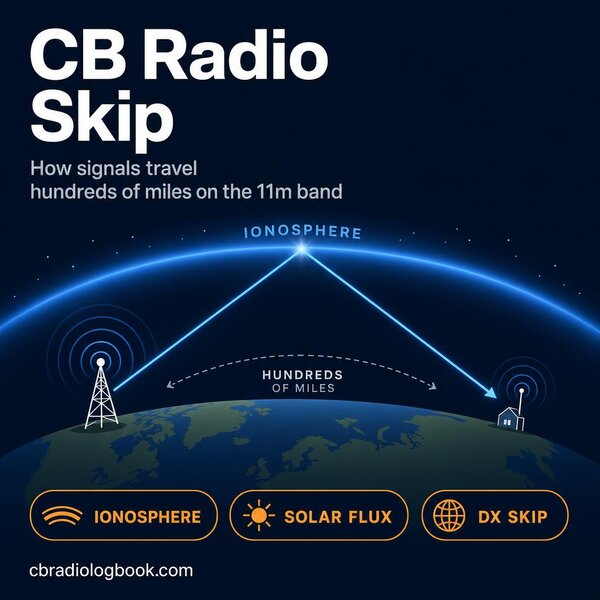
When skip conditions develop, however, those same signals can travel hundreds or even thousands of miles. The signal leaves the transmitting antenna, travels upward into the atmosphere, interacts with ionised layers high above the Earth, and is redirected back towards the ground.
The Role of the Ionosphere
High above the weather systems that affect our daily lives lies a region known as the ionosphere. This area contains particles that have been electrically charged by radiation from the Sun. These charged particles interact with radio waves in complex ways, sometimes allowing certain frequencies to be bent back towards Earth rather than continuing into space.
For CB operators, the ionosphere acts like a gigantic natural mirror in the sky. When conditions are favourable, signals transmitted on the 11 metre band can bounce off this mirror and return to Earth hundreds or thousands of miles from their point of origin.
Why the 11 Metre Band Is So Interesting
The frequencies used by CB radio occupy a unique position within the radio spectrum. At around 27 MHz, the 11 metre band sits in a range where both local communication and long-distance propagation are possible. This balance is one of the reasons CB radio has remained popular for decades.
For many operators, this means that every time they switch on their radio there is an element of unpredictability. The next contact could be a station a few streets away or somebody operating from the other side of Europe.
How Solar Activity Influences Skip
The Sun is the ultimate driving force behind skip conditions. As solar radiation reaches the Earth's atmosphere, it creates the charged particles that form the ionosphere. When solar activity increases, the ionosphere often becomes more capable of supporting long-distance propagation on frequencies around 27 MHz.
One of the most commonly discussed indicators of solar activity is the sunspot cycle. Sunspots are temporary regions of intense magnetic activity on the Sun's surface, and their numbers rise and fall over a cycle lasting approximately eleven years.
During periods of high sunspot activity, the 11 metre band often comes alive with long-distance signals. Operators frequently notice that channels become crowded with stations from across Europe during these periods.
Sporadic E: The Summer Surprise
Another phenomenon known as Sporadic E regularly excites CB operators. Sporadic E occurs when dense patches of ionisation form within the E layer of the ionosphere.
These patches can appear with little warning and create exceptionally strong signal paths over distances typically ranging from a few hundred to around fifteen hundred miles.
The most active Sporadic E season generally occurs during late spring and summer, although a secondary season often appears around December and January. During these periods, operators may experience sudden openings where signals from continental Europe arrive at remarkable strength.
Chasing DX on CB Radio
The term DX has long been used in radio communication to describe long-distance contacts. For many CB enthusiasts, making DX contacts is one of the most rewarding aspects of the hobby.
Every successful DX contact represents a combination of equipment performance, operating skill and favourable propagation conditions. It is often impossible to predict exactly which countries will be heard on any given day, which adds an element of excitement whenever conditions begin to improve.
Many operators maintain detailed logs of their DX contacts, recording information such as callsigns, locations, signal reports, channels used and estimated distances.
Improving Your Chances of Working Skip
Although nobody can control propagation conditions, there are several ways operators can maximise their chances of taking advantage of them when they occur.
A well-installed antenna remains the single most important part of any CB radio station. Improvements to antenna quality, positioning and tuning often provide greater benefits than upgrading the radio itself.
A properly tuned antenna with a low standing wave ratio helps ensure that transmitted power is radiated efficiently while also improving reception.
Patience is equally important. Experienced operators spend time listening to the band and learning to recognise the subtle signs that propagation is beginning to open.
Logging Skip Contacts
One of the most rewarding parts of CB radio skip is keeping a record of the contacts you make. A single opening can produce stations from several countries in a short space of time, and without a log it is easy to forget who you spoke to, where they were based and how far your signal travelled.
Logging contacts allows operators to track progress over time, compare propagation patterns and build a personal history of their activity on the 11 metre band.
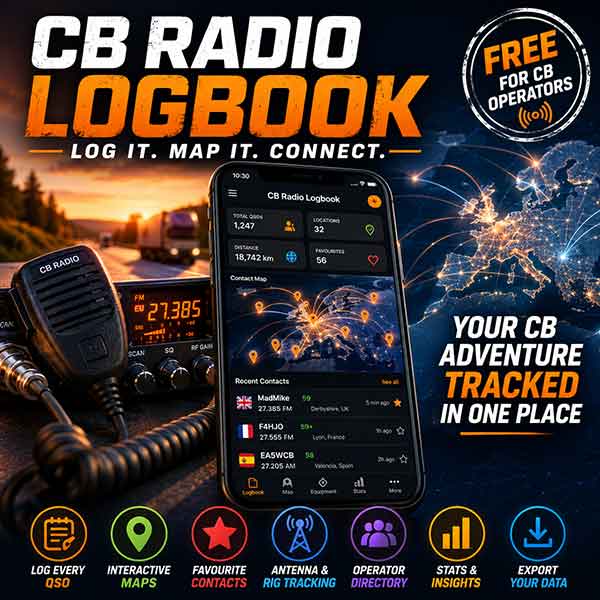
With CB Radio Logbook, operators can record contacts, map distances, track locations and keep a digital record of their CB radio activity.
Why Skip Continues to Fascinate Operators
Despite advances in internet communication and digital technology, skip remains one of the most captivating aspects of CB radio. There is something uniquely satisfying about speaking to someone hundreds or thousands of miles away using nothing more than a radio, an antenna and the natural behaviour of the Earth's atmosphere.
Every contact is slightly different. Conditions change from hour to hour, day to day and season to season. No two openings are ever exactly the same.
For many CB enthusiasts, skip represents the perfect blend of science, skill and luck. It turns an ordinary radio into a gateway to distant countries and cultures, making every transmission an opportunity for a new and unexpected connection.
Related articles

CB Radio Frequencies: The Complete UK, European & US Channel Guide
Discover all CB radio frequencies used in the UK, Europe and the USA. Complete CB channel frequency charts, the difference between UK and CEPT channels, and the best frequencies for local contacts, truckers and DX.
CB Radio Logbook – The Complete Companion App for CB Radio Operators
Join the CB Radio Logbook
Track every QSO, map your contacts, and connect with operators near you. Create your free account and get on the air.
Create your account