CB Divisions Explained: What They Are and Why They Matter
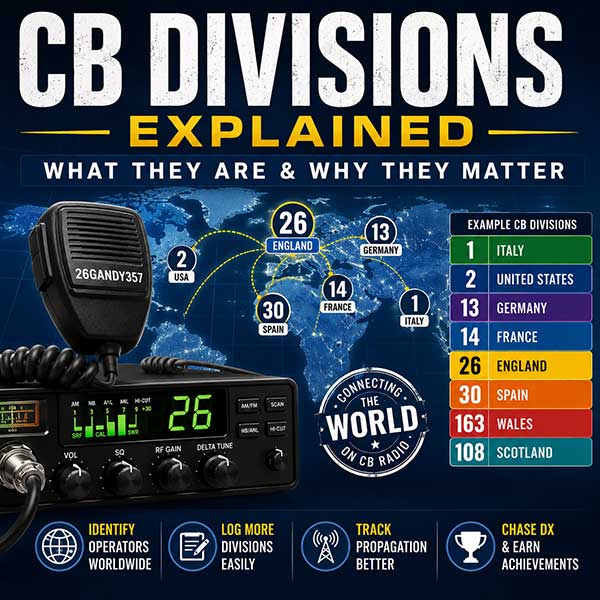
If you've spent any time listening to long-distance CB radio contacts or browsing online logbooks, you've almost certainly come across callsigns such as 26AT123, 14DX001, 163SD015, or 1RC456. At first glance they can seem confusing, but every part of these callsigns has a purpose.
One of the most important parts is the number at the beginning. This is known as the CB Division.
Whether you're interested in local contacts, chasing DX, or simply understanding how experienced operators identify themselves, knowing how CB divisions work is an essential part of learning the hobby.
What Is a CB Division?
A CB division is a numerical code that identifies the country or geographical area from which an operator is transmitting.
Think of it as the CB radio equivalent of an international dialling code or an amateur radio prefix. Rather than saying "I'm transmitting from England," operators simply include the division number as part of their callsign.
For example:
- 26 = England
- 14 = France
- 30 = Spain
- 1 = Italy
- 13 = Germany
So an operator using the callsign 26GANDY357 is immediately recognised by other operators as transmitting from England.
Why Were Divisions Introduced?
When CB radio first became popular, most communication was local.
Operators generally only spoke to people within a few miles of their location, so there was little need to identify which country they were in.
Everything changed once operators discovered that favourable propagation conditions could allow signals to travel hundreds—or even thousands—of miles.
Suddenly, dozens of operators from different countries could all be using similar callsigns.
Without some form of international identification, confusion quickly followed.
The division numbering system solved this problem by giving every participating country its own unique identifier.
Today, divisions are recognised by operators across the world and are used by most international CB DX groups.
How Does a Callsign Work?
Most DX callsigns follow a simple format:
Division + Club + Operator Number
For example:
26AT123
Breaking it down:
- 26 = England
- AT = The operator's DX club
- 123 = Their unique membership number
Another example:
14DX001
- 14 = France
- DX = DX Club
- 001 = Operator number
Some operators who are not members of a DX club simply use a personal handle after their division.
Examples include:
- 26GANDY357
- 26MAVERICK
- 30ALPHA
There is no universal standard outside organised DX clubs, although the division number remains widely recognised.
Do Divisions Match Political Borders?
Not always.
The CB division list has developed over many decades and includes:
- Sovereign nations
- Islands
- Territories
- Overseas dependencies
- Remote island groups
For example, islands that belong politically to one country may have their own separate CB division because they are considered separate DX entities.
This makes DX operating more interesting, as operators can work towards contacting every recognised division rather than simply every country.
Why Do DX Operators Care About Divisions?
For many operators, collecting divisions is one of the most enjoyable parts of CB radio.
Rather than simply making contacts, they aim to work as many different divisions as possible.
Each new division represents another part of the world added to their logbook.
Much like collecting countries in amateur radio, chasing divisions provides an ongoing challenge.
Some operators have confirmed contacts with well over 150 different divisions during periods of good propagation.
How Are Divisions Used During a Contact?
During a typical DX contact you might hear:
"26GANDY357 calling CQ DX."
A responding station could reply:
"14AT256 returning your call."
Immediately both operators know:
- Which country the other station is in.
- Whether they've worked that division before.
- Approximately where the signal has travelled from.
It makes logging contacts much easier and helps avoid confusion when several stations are calling at once.
Do You Need a Division to Use CB Radio?
Not at all.
For normal local CB use there is no requirement to use a division number.
Many operators simply use a handle such as:
- Gandy
- Night Owl
- Silver Fox
- Road Runner
However, if you begin making international contacts, adding your division helps other operators identify your location immediately.
Many UK operators therefore choose to prefix their handle with 26.
Are Division Numbers Official?
No.
Division numbers are not issued by governments or radio regulators.
Instead, they are an internationally recognised convention used by the CB DX community.
Different DX clubs generally follow the same division list, making it easy for operators from around the world to understand where a station is located.
While there may occasionally be minor differences between organisations, the vast majority use the same numbering system that has evolved over decades of international CB operation.
Some Common CB Divisions
| Division | Country |
|---|---|
| 1 | Italy |
| 2 | United States |
| 3 | Brazil |
| 13 | Germany |
| 14 | France |
| 16 | Belgium |
| 26 | England |
| 29 | Ireland |
| 30 | Spain |
| 31 | Portugal |
| 34 | Canary Islands |
| 108 | Scotland |
| 163 | Wales |
There are well over 300 recognised divisions covering countries, islands and territories around the globe.
Should You Include Your Division in Your Callsign?
If you're mainly chatting locally, it's entirely optional.
However, if you're interested in DX contacts, online logbooks or joining an international DX club, using your division is highly recommended.
It instantly tells other operators where you're transmitting from and makes your contacts easier to log.
For operators in England, adding 26 before your handle has become common practice during international contacts.
Logging Divisions in CB Radio Logbook
One of the most rewarding aspects of DX operating is looking back at all the different parts of the world you've contacted.
Recording the division alongside each QSO allows you to:
- Track how many unique divisions you've worked.
- Discover new countries during periods of strong propagation.
- Work towards collecting every recognised division.
- Analyse propagation patterns throughout the year.
- Celebrate milestone contacts with badges and achievements.
As the CB Radio Logbook community grows, division tracking helps build a fascinating picture of worldwide CB activity, showing just how far a 4-watt radio can reach when conditions are right.
Final Thoughts
CB divisions are one of the defining features of international CB radio. They provide a simple, universally recognised way of identifying where a station is transmitting from and have become an essential part of DX operating.
Whether you're making your first contact across the English Channel or chasing rare island divisions thousands of miles away, understanding division numbers adds another layer of enjoyment to the hobby.
The next time you hear a station call "26", "14" or "30", you'll know exactly what those numbers represent—and perhaps be inspired to add a few new divisions to your own logbook.
```Related articles
Join the CB Radio Logbook
Track every QSO, map your contacts, and connect with operators near you. Create your free account and get on the air.
Create your account