Are CB Radios Legal in the UK? The Definitive 2026 Guide
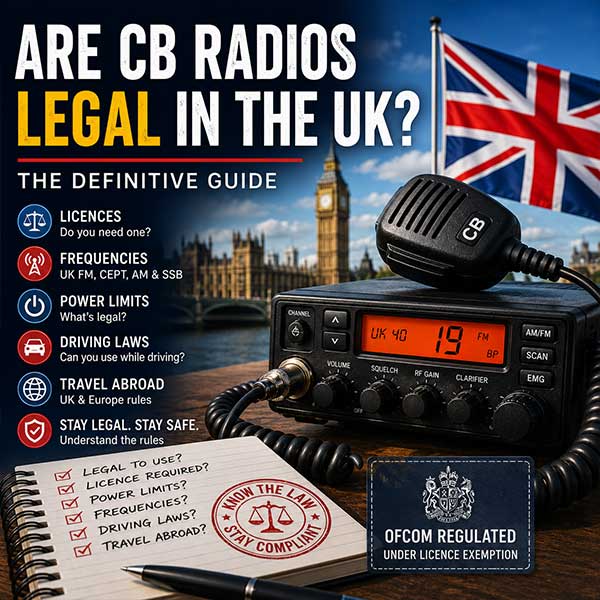
For anyone considering buying their first Citizens' Band (CB) radio, one question almost always comes first: Are CB radios legal in the UK?
The short answer is yes. CB radios are completely legal to own and use throughout the United Kingdom, and unlike amateur (ham) radio, you no longer need to apply for a licence before getting on the air. However, that simple answer only tells part of the story.
Modern CB radio operates under regulations set by Ofcom, the UK's communications regulator. Those regulations specify which frequencies may be used, what equipment is permitted, maximum power levels, and how operators should use the service responsibly. While today's rules are considerably more relaxed than they were during CB's early years, there are still important legal requirements that every operator should understand.
Whether you're installing a radio in your van, fitting an antenna to your car, building a home base station or simply wondering whether that second-hand radio you've found online is still legal, understanding the current regulations will help you stay compliant while getting the most from the hobby.
This guide explains everything you need to know about UK CB radio laws in plain English. We'll cover licences, frequencies, power limits, Ofcom regulations, driving laws, travelling abroad, export radios, modifications, older equipment and many of the myths that continue to circulate within the CB community decades after the rules changed.
Along the way we'll also highlight practical examples that real operators encounter every day, helping you understand not just what the regulations say, but how they affect everyday CB radio use.
Are CB Radios Legal in the UK?
Yes. CB radios are legal throughout the United Kingdom.
In fact, they have become considerably easier to use legally than at any other point in their history.
Today's operators can purchase an approved CB radio, install it in a vehicle or at home, connect an appropriate antenna and begin operating immediately without applying for a licence.
This wasn't always the case.
When CB first became popular during the late 1970s and early 1980s, many enthusiasts imported American equipment because there was no legal UK CB service. Thousands operated illegally while waiting for legislation to catch up with demand.
Eventually, the Government introduced a dedicated UK CB service with its own frequencies and equipment standards. Since then, the regulations have gradually evolved to become more aligned with European standards, allowing operators access to additional modes and frequencies while simplifying the licensing process.
Today, CB radio exists as a licence-exempt radio service regulated by Ofcom.
That means there is no paperwork to complete before transmitting, but operators must still comply with the licence exemption conditions.
Those conditions cover matters such as:
- Approved frequencies
- Maximum transmitter power
- Permitted operating modes
- Use of compliant equipment
- Avoiding harmful interference
Think of CB radio in much the same way as driving a car.
You don't need permission every time you drive somewhere, but you still have to follow the Highway Code. CB radio works similarly—the licence may have disappeared, but the rules remain.
Who Regulates CB Radio?
Responsibility for radio spectrum management in the UK lies with Ofcom, the Office of Communications.
Ofcom manages almost every part of the UK's radio spectrum, including:
- Television broadcasting
- Commercial radio
- Emergency services
- Mobile phone networks
- Satellite communications
- Maritime radio
- Aviation radio
- Amateur radio
- CB radio
The radio spectrum is a limited resource. Without regulation, different services would interfere with each other, making communications unreliable.
Ofcom therefore allocates different sections of the spectrum to different users.
CB radio occupies a relatively small allocation around 27 MHz, commonly referred to as the 11-metre band.
Operators are free to use that allocation provided they remain within the conditions laid out under the licence exemption regulations.
Do You Need a Licence to Use a CB Radio?
No.
You do not need a CB radio licence in the UK.
This is one of the biggest changes compared to earlier decades.
Many people still remember buying annual licences from the Post Office during the 1980s.
Those licences disappeared many years ago.
Today, CB radio is licence exempt.
Provided your equipment complies with UK regulations, you can legally begin transmitting immediately after installation.
This often surprises newcomers who assume every two-way radio service requires paperwork.
Fortunately, CB remains one of the simplest radio hobbies to enter.
Why Was the Licence Removed?
Originally, licensing generated revenue while allowing authorities to record who was operating radio equipment.
Over time, maintaining the licensing system became more expensive than the income it generated.
Meanwhile, modern equipment had become more reliable and easier to regulate through manufacturing standards.
Eventually the Government concluded that licensing individual CB users provided little practical benefit.
The service therefore became licence exempt.
Licence Exempt Doesn't Mean Rule Exempt
This is an important distinction.
You may not need a licence, but you are still expected to comply with the regulations.
For example, you cannot legally:
- Operate on unauthorised frequencies.
- Exceed permitted power levels.
- Cause deliberate interference.
- Use modified equipment that falls outside the exemption.
Understanding this difference helps avoid many of the misconceptions surrounding modern CB radio.
CB Radio vs Amateur Radio Licensing
People often confuse CB radio with amateur (ham) radio.
Although both involve two-way communication, they operate under completely different regulatory frameworks.
| CB Radio | Amateur Radio |
|---|---|
| No licence required | Licence required |
| No examination | Examination required |
| Fixed frequencies | Many frequency bands |
| Limited power | Higher permitted power |
| General public use | Technical hobby and experimentation |
CB radio was designed to provide a simple communications service for everyone.
Amateur radio was created for experimentation, technical learning and international communications.
Neither hobby is "better" than the other—they simply serve different purposes.
Why Were CB Radios Regulated?
To understand today's regulations, it helps to appreciate why CB radio became regulated in the first place.
During the late 1970s Britain experienced an explosion in interest in CB radio.
Inspired largely by American films, trucking culture and television programmes, thousands of people imported illegal American radios operating on frequencies that had never been allocated for UK CB use.
The Government became increasingly concerned.
Large numbers of imported radios meant thousands of transmitters were operating without coordination.
Some produced excessive harmonics.
Others drifted off frequency.
Poor-quality installations occasionally caused interference to televisions and household electronics.
Although many stories about widespread interference have since become exaggerated, there were genuine technical concerns.
The solution wasn't banning CB altogether.
Instead, the Government created an official UK service with equipment standards designed to minimise interference while giving enthusiasts a legal alternative.
The History of CB Radio Legislation in the UK
Before Legalisation
Before November 1981, CB radio was effectively illegal in Britain.
Enthusiasts imported American 40-channel AM radios, often from the United States or Europe.
Many operators accepted the legal risk because there simply wasn't an official British alternative.
This underground community developed its own culture, jargon and operating practices that still influence CB radio today.
1981 - Legal UK CB Begins
The UK Government finally legalised Citizens' Band radio in November 1981.
However, rather than adopting the American system, Britain introduced:
- 40 unique UK FM channels
- 27/81 channel allocation
- FM only
- 4 Watts maximum output
This became known as the UK 27/81 band.
For decades these remained the primary legal CB channels in Britain.
The European Influence
As Europe gradually harmonised radio regulations, pressure increased for Britain to adopt CEPT channels alongside the existing UK allocation.
Eventually operators gained access to the standard European 40-channel FM band.
This greatly improved compatibility with equipment sold throughout mainland Europe.
The Arrival of AM and SSB
Perhaps the most significant regulatory change came when Ofcom legalised AM and Single Sideband operation on approved CB frequencies.
Previously, these modes had often been associated with imported "export" equipment and grey-area operation.
Today, both AM and SSB are fully legal on the authorised frequencies when using compliant equipment.
This dramatically expanded the possibilities for DX contacts while bringing UK regulations closer to those used elsewhere in Europe.
How CB Radio Regulations Have Changed Over Time
One reason confusion still exists is that many experienced operators remember completely different rules.
Someone returning to CB after twenty or thirty years may understandably believe:
- Licences are still required.
- AM is illegal.
- SSB is prohibited.
- Only UK FM channels may be used.
- European channels are not permitted.
In reality, almost all of those statements are now outdated.
Modern CB regulations are significantly more flexible than those of the 1980s and 1990s.
Understanding that historical context helps explain why conflicting advice still appears online.
Some websites—and even some long-time operators—continue repeating regulations that disappeared years ago.
For that reason, it's always worth checking current Ofcom guidance rather than relying solely on decades-old memories or forum posts.
```htmlWhich Frequencies Are Legal to Use in the UK?
One of the biggest areas of confusion surrounding CB radio laws is frequency use. Ask ten operators which channels are legal in the UK and you may receive several different answers—especially if some of them last used CB radio during the 1980s or 1990s.
The reality is that modern UK operators have access to considerably more than the original 40 UK FM channels introduced in 1981. Over the years, Ofcom has gradually aligned UK regulations with the wider European CB standard, allowing additional frequencies and operating modes while maintaining sensible limits on transmitter power.
Understanding which channels you can legally use is one of the easiest ways to ensure you remain compliant.
The Original UK 27/81 Channels
When CB radio became legal in Britain during November 1981, the Government introduced a unique set of 40 FM channels rather than adopting the American system.
These channels became known as the UK 27/81 allocation.
Unlike the American 40-channel band, the UK frequencies sit slightly higher in the 27 MHz spectrum.
Many long-time operators still refer to these simply as the UK 40.
These channels remain fully legal today and continue to see regular use, particularly for local contacts, mobile operators and organised radio nets.
Some areas of the country primarily operate on UK channels, while others favour the European allocation. Many operators simply monitor both depending on activity.
The CEPT (European) Channels
As CB radio became increasingly standardised across Europe, the UK eventually adopted the 40 CEPT FM channels alongside the existing UK allocation.
This was a significant improvement for British operators.
It meant someone purchasing a modern CB radio from almost any reputable manufacturer could communicate with operators across much of mainland Europe without requiring special equipment.
Today, almost every modern CB radio sold in the UK includes:
- 40 UK FM channels
- 40 CEPT FM channels
- AM capability (where supported)
- SSB capability on suitable models
Rather than replacing the UK channels, the European allocation simply expanded the options available to operators.
UK FM, CEPT and AM/SSB Channels Explained
Modern CB radios often include multiple selectable bands or country settings, which can initially appear confusing to newcomers.
Fortunately, understanding the different channel groups is fairly straightforward.
UK FM
The UK FM allocation consists of 40 channels unique to Britain.
These are the frequencies introduced when CB became legal in 1981.
Many organised UK radio nets continue to use these channels because they have historically been associated with British CB operation.
If another operator tells you to "go to UK Channel 14", they're referring to this allocation.
CEPT FM
The CEPT allocation is the standard 40-channel European CB band.
This is often labelled:
- EU
- CEPT
- Mid Band
- EC
Different manufacturers use slightly different terminology, but they all refer to the same internationally recognised frequencies.
Many UK operators spend most of their time monitoring the CEPT channels because they provide compatibility with operators throughout Europe.
AM Operation
For many years, AM operation occupied something of a grey area within UK CB culture.
Imported American radios commonly used AM, while legal UK equipment was FM only.
Today, AM operation is legal on the approved European CB frequencies using compliant equipment.
This means you no longer need to avoid AM simply because older operators remember it being prohibited decades ago.
Single Sideband (SSB)
Single Sideband has become increasingly popular as more operators discover long-distance DX operating.
SSB is far more efficient than standard AM because it concentrates transmitter power into a narrower signal.
The result is greater effective communication distance under favourable propagation conditions.
Modern UK regulations permit SSB operation on approved CB frequencies using compliant radios.
If you're interested in DX contacts across Europe—or even much further during periods of favourable propagation—SSB is well worth exploring.
For a more detailed explanation, see our companion guide: Single Sideband (SSB) Explained.
Maximum Legal Power Limits
Every radio service has power limits, and CB radio is no exception.
Power restrictions exist for a simple reason: they reduce interference while ensuring fair access to the radio spectrum for everyone.
The permitted transmitter output depends on the operating mode.
FM
Maximum legal output:
- 4 Watts carrier power
AM
Maximum legal output:
- 4 Watts carrier power
SSB
Maximum legal output:
- 12 Watts Peak Envelope Power (PEP)
Many newcomers assume more power automatically means better performance.
In reality, antenna quality usually makes a far greater difference.
A properly installed antenna with a low SWR often outperforms a higher-powered station using a poor antenna.
This is why experienced operators typically recommend investing in a quality antenna before considering more advanced radios.
If you're unsure how Standing Wave Ratio affects performance, our guide to Understanding SWR explains everything in detail.
What Equipment Is Legal to Buy and Use?
Buying legal CB equipment in 2026 is considerably easier than it once was.
Most established retailers only sell radios designed to comply with current UK and European regulations.
Examples include equipment from manufacturers such as:
- President
- Midland
- CRT
- Thunderpole
- Albrecht
- Team
Modern radios typically include multiple country settings, allowing them to operate legally within various European nations.
When purchasing new equipment from a reputable UK dealer, there is generally little cause for concern.
Problems usually arise when buying:
- Very old equipment
- Imported radios
- Modified radios
- Export radios
- Equipment advertised as "opened up"
These situations require a little more care.
Buying Second-hand CB Radios
The second-hand market remains an excellent place to buy quality equipment.
Many classic CB radios are exceptionally well built and continue to perform reliably decades after manufacture.
However, buyers should ask several questions before handing over any money.
Has the Radio Been Modified?
This is perhaps the most important question.
Some radios have been altered to:
- Increase transmitter power
- Add extra frequency bands
- Enable export channels
- Unlock additional modes
While these modifications may appeal to certain collectors, they can also affect whether the equipment remains compliant when used on-air.
Does It Still Meet Current Standards?
Older UK FM-only radios remain perfectly usable on the UK 27/81 channels.
However, they will lack features found on modern equipment, including:
- CEPT channels
- AM
- SSB
- Noise reduction
- Modern filtering
- Digital displays
There's nothing illegal about using an older compliant radio—it simply has fewer capabilities.
Are Export Radios Legal?
This is probably the single most misunderstood subject within CB radio.
The phrase export radio covers a huge range of equipment.
Some models are designed primarily for markets outside Europe.
Others are capable of transmitting well beyond the frequencies allocated to CB radio.
Many also support significantly higher power outputs than permitted under UK CB regulations.
Simply owning an export radio is not generally the issue.
The important question is how it is configured and used.
Why Do People Buy Export Radios?
Export radios often include:
- Multiple frequency bands
- Higher transmit power
- Wide frequency coverage
- Amateur radio compatibility
- Advanced receiver performance
These features make them attractive to experienced radio enthusiasts.
However, they also make it easier to operate outside the legal CB allocation if the user is not careful.
Can They Be Used Legally?
Some export radios can be configured to operate entirely within legal UK CB frequencies and power limits.
Others cannot.
Before purchasing an export radio, it's important to understand exactly what the equipment is capable of and whether it complies with current UK regulations.
If your primary interest is ordinary CB operation, purchasing a modern CE-approved CB radio is usually the simplest option.
Can You Modify a CB Radio?
Technically, almost any radio can be modified.
The more important question is whether those modifications remain lawful when the radio is used on-air.
Common modifications include:
- Power increases
- Expanded frequency coverage
- Clarifier modifications
- Microphone upgrades
- Cooling fans
- Display changes
- Internal audio adjustments
Safe Modifications
Not every modification creates legal issues.
Replacing:
- a microphone,
- a mounting bracket,
- the speaker,
- power wiring,
- or fitting an external SWR meter
generally has no effect on the legality of the radio itself.
Potentially Problematic Modifications
Changing transmitter characteristics is very different.
Increasing output power beyond legal limits or enabling frequencies outside the authorised CB allocation may result in equipment no longer complying with the licence exemption conditions.
If in doubt, leave the transmitter circuitry alone.
A well-installed legal CB station will usually outperform a poorly installed modified one.
Practical Example: Installing a CB Radio in Your Van
Imagine you've just bought a new President McKinley II or Thunderpole T-800 and want to install it in your work van.
Provided:
- the radio is compliant,
- it's connected correctly,
- your antenna is properly tuned,
- you remain within legal frequencies and power limits,
there is nothing unlawful about using it during your journeys.
Many tradespeople, recovery operators, off-road enthusiasts and hobbyists legally operate mobile CB stations every day throughout the UK.
If you're planning your first installation, our guide to How to Install a CB Radio walks through antenna placement, power wiring, SWR tuning and mounting options in detail.
```htmlCan You Use a CB Radio While Driving?
One of the most frequently asked legal questions is whether using a CB radio while driving is permitted in the UK. The answer is generally yes, but there are some important legal and practical considerations.
Unlike holding a handheld mobile phone while driving, there is no blanket prohibition on using a legally installed CB radio. However, drivers remain responsible for maintaining proper control of their vehicle at all times.
The relevant legislation focuses on careless or dangerous driving rather than specifically targeting CB radios. If operating your radio causes you to become distracted to the point where your driving falls below the expected standard, you could still be prosecuted.
Practical Example
Imagine you're travelling along the M1 with a CB radio installed in your dashboard.
You briefly pick up the microphone, respond to another operator and return the microphone to its holder while maintaining full control of the vehicle.
In most circumstances, this is entirely lawful.
However, if you begin scrolling through menus, repeatedly adjusting settings, searching frequencies or attempting to tune an antenna while driving, your attention is no longer focused on the road. Even though the CB radio itself remains legal, your manner of driving may not be.
Best Practice for Mobile Operation
- Mount the radio where it can be reached safely.
- Position the microphone close to your normal driving position.
- Set your channel before beginning your journey.
- Avoid lengthy conversations in busy traffic.
- Never attempt to tune an antenna while driving.
- If adjustments are needed, pull over somewhere safe.
Many experienced operators treat CB radio much like changing a vehicle's heating controls: short, infrequent interactions are usually manageable, while prolonged distraction should always be avoided.
Operating from Home Versus Mobile
From a legal perspective, there is very little difference between operating a CB radio from your home and operating one in a vehicle.
The same regulations regarding frequencies, power limits and equipment compliance apply regardless of where the station is located.
Home Base Stations
Operating from home allows several advantages:
- Larger antennas.
- Greater antenna height.
- Better receive performance.
- More comfortable operating conditions.
- Stable power supplies.
A higher antenna often produces much better results than increasing transmitter power, which is one reason experienced operators invest heavily in quality antenna systems.
Mobile Stations
Vehicle installations provide portability and convenience.
Modern magnetic mount and fixed mount antennas make it relatively easy to build an excellent mobile station without making permanent modifications to the vehicle.
Provided the installation complies with road safety requirements and the radio itself meets current regulations, mobile operation is entirely legal.
Can You Take a CB Radio Abroad?
Many British operators travel throughout Europe in motorhomes, caravans, commercial vehicles and private cars. Naturally, they often ask whether their CB radio can accompany them.
The answer is usually yes—but there are a few things worth checking before crossing the Channel.
Different Countries, Different Rules
Although many European nations now share harmonised CB standards, individual countries may still have slight differences regarding permitted frequencies, power limits or operating modes.
Fortunately, most modern multi-standard CB radios allow users to select the appropriate country setting.
This enables the radio to operate within that country's legal configuration.
Check Before Travelling
Before travelling internationally, it is sensible to confirm:
- Which country setting should be selected.
- Whether AM, FM and SSB are all permitted.
- Applicable power limits.
- Any local restrictions.
Most reputable manufacturers include country configuration information within the operating manual.
Driving Across Europe
For example, imagine driving from the UK through France, Belgium, Germany and into Italy.
Your radio may remain physically unchanged, but you should ensure the selected operating standard matches the country you're currently visiting.
This is one of the reasons modern multi-standard radios have become so popular among touring operators.
Are CB Radios Legal in Europe?
Yes. CB radio is legal in most European countries, although the exact regulations vary slightly.
The European Conference of Postal and Telecommunications Administrations (CEPT) has worked for many years to harmonise CB radio operation across member states.
As a result, today's regulations are significantly more consistent than they once were.
Nevertheless, operators should avoid assuming every country follows identical rules.
Areas that may differ include:
- Maximum transmitter power.
- Permitted operating modes.
- Channel availability.
- National implementation of CEPT recommendations.
If you're planning an extended European road trip, spending a few minutes researching each country's current regulations is time well spent.
What Happens If You Break the Rules?
Fortunately, the overwhelming majority of CB radio users never encounter any legal difficulties.
Most operators simply enjoy chatting with friends, participating in organised nets, experimenting with propagation and logging interesting contacts.
However, deliberately ignoring the regulations can have consequences.
Examples might include:
- Using frequencies allocated to other services.
- Operating excessively powerful transmitters.
- Causing harmful interference.
- Using non-compliant transmitting equipment.
- Intentionally disrupting other radio users.
Ofcom possesses enforcement powers where significant interference or unlawful operation occurs.
In practice, enforcement generally focuses on serious or persistent misuse rather than genuine mistakes made by new hobbyists.
The easiest way to remain compliant is simply to:
- Use approved equipment.
- Stay on legal frequencies.
- Respect power limits.
- Operate courteously.
Common Myths About CB Radio Laws
Myth: You Still Need a Licence
False.
CB radio has been licence exempt for many years.
Myth: AM Is Illegal
False.
AM is legal on the authorised CB frequencies using compliant equipment.
Myth: SSB Is Illegal
False.
Single Sideband is also legal under current UK regulations when used within the permitted frequency allocation and power limits.
Myth: Bigger Power Equals Bigger Range
Usually false.
A properly installed antenna often delivers far greater improvements than simply increasing transmitter power.
Myth: Older Radios Are Automatically Illegal
No.
Many older UK CB radios remain perfectly legal to operate provided they continue to comply with the applicable regulations.
Myth: Export Radios Are Always Illegal
No.
The legality depends upon how the equipment is configured and used, not simply its model name.
Practical Tips for Staying Legal
- Buy radios from established UK CB retailers.
- Read the manufacturer's manual.
- Use the correct country setting.
- Tune your antenna correctly.
- Keep your transmitter within legal power limits.
- Avoid unnecessary modifications.
- Respect other operators.
- Learn proper operating etiquette.
Common Mistakes New Operators Make
- Assuming all radios are configured correctly from the factory.
- Ignoring SWR measurements.
- Buying modified second-hand equipment without understanding the changes.
- Using poor-quality antennas.
- Confusing American CB advice with UK regulations.
- Believing outdated information from the 1980s still applies.
Recording Your Contacts Responsibly
One of the most enjoyable aspects of CB radio is building a record of your operating history.
Many operators keep traditional paper logbooks, while others now use digital systems.
CB Radio Logbook provides an easy way to record contacts, track DX, participate in organised radio nets, earn community badges and build a personal history of your time on the air. While keeping a log is not a legal requirement, it can become one of the most rewarding parts of the hobby, particularly as your contact list grows over the years.
Related Articles
If you're new to the hobby, these guides provide an excellent next step:
- CB Radio Frequencies Explained
- CB Radio for Beginners
- How to Install a CB Radio
- Single Sideband (SSB) Explained
- Understanding SWR
- CB Radio Antennas Explained
Frequently Asked Questions
Are CB radios legal in the UK?
Yes. CB radios are completely legal to own and use in the UK provided you use compliant equipment within the authorised frequencies and power limits.
Do I need a CB radio licence?
No. CB radio is licence exempt in the UK.
Can I use a CB radio while driving?
Yes, provided you remain in proper control of the vehicle and do not drive carelessly or dangerously.
Is AM legal on CB?
Yes, on the approved frequencies using compliant equipment.
Is SSB legal in the UK?
Yes. SSB operation is permitted under current UK CB regulations.
Can I use an old 1980s CB radio?
Yes, provided it remains compliant and is operated within the current regulations.
Can I buy a second-hand CB radio?
Absolutely. Simply ensure it hasn't been modified in a way that makes it non-compliant.
Can I fit a CB radio to my van?
Yes. Thousands of UK operators legally use mobile CB installations every day.
Can I talk to Europe from the UK?
Yes. During favourable propagation conditions, particularly when using SSB, contacts across mainland Europe are common.
Can I increase my transmitter power?
Not beyond the legal limits applicable to CB radio operation.
Who regulates CB radio?
Ofcom regulates CB radio and manages the UK radio spectrum.
Can I use my UK CB radio abroad?
Usually yes, but always check the regulations of the country you're visiting and configure your radio appropriately.
Is CB radio different from amateur radio?
Yes. Amateur radio requires a licence and examination, whereas CB radio is licence exempt.
What's the best way to stay legal?
Purchase compliant equipment, use authorised frequencies, stay within power limits and follow current Ofcom regulations.
Related articles
Join the CB Radio Logbook
Track every QSO, map your contacts, and connect with operators near you. Create your free account and get on the air.
Create your account