The History of CB Radio: From the Airwaves of the 1940s to the Modern Revival
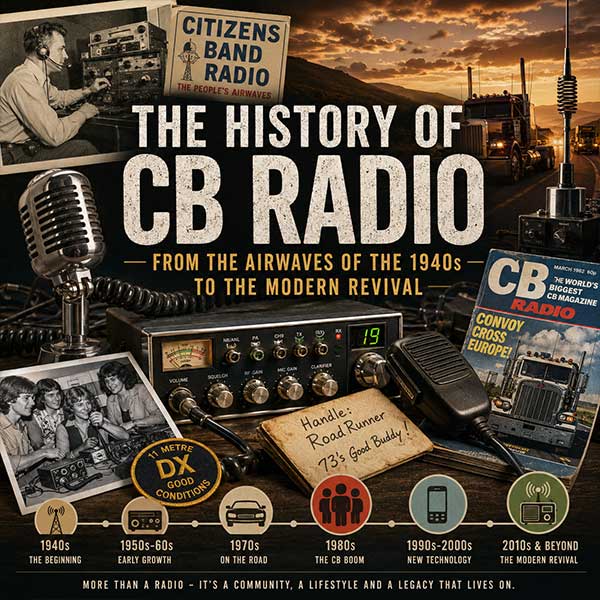
The history of CB radio is one of the most fascinating stories in modern communications. What began as a practical means of short-distance communication for businesses and tradespeople eventually evolved into one of the largest social hobbies the world had ever seen. During its peak, millions of people around the globe owned Citizens' Band radios. Entire communities formed on the airwaves, new language entered everyday conversation, films and songs celebrated CB culture, and ordinary people suddenly found themselves connected to complete strangers from towns, cities and even countries hundreds of miles away.
For many people, CB radio represents far more than a box with a microphone attached. It represents friendships, adventures, late-night conversations, family road trips, the excitement of hearing distant stations during favourable propagation conditions, and an era before mobile phones made instant communication commonplace. While technology has changed dramatically since the first CB operators began talking across local neighbourhoods, the spirit of Citizens' Band radio has endured remarkably well.
Today, CB radio is enjoying something of a renaissance. New operators continue to discover the hobby, experienced breakers are returning after decades away, and modern online communities such as CB Radio Logbook allow operators to record contacts, organise radio nets and remain connected between QSOs without replacing the simple pleasure of talking over the air.
This guide explores the complete history of CB radio, beginning with its earliest origins during the 1940s before following its extraordinary rise through the decades. Along the way we'll discover why CB became so popular, how Britain embraced the hobby during the famous 1980s CB boom, the influence of Hollywood and popular music, the evolution of radio equipment, and why CB continues to thrive today.
What Is Citizens' Band Radio?
Citizens' Band Radio—almost universally shortened to CB radio—is a licence-exempt two-way radio service designed for short-range communication between members of the public. Unlike amateur radio, which requires examinations and licensing in many countries, CB was intended to provide an accessible communications service that almost anyone could use.
Operating on frequencies around 27 MHz within the 11-metre band, CB radio allows individuals to communicate directly without relying on telephone networks, mobile masts or internet infrastructure. Every transmission is broadcast over the air, meaning anyone tuned to the same channel can hear and participate in conversations.
This open nature fundamentally shaped the culture of CB radio. Operators were never simply making private calls. Instead, they joined an ongoing shared conversation where friendships developed naturally and local communities formed around familiar voices.
Unlike modern messaging applications, CB required no subscriptions, contracts or infrastructure. Once you owned a radio and an aerial, you could simply switch on and begin listening.
The Origins of CB Radio
The origins of Citizens' Band radio stretch back considerably further than many people realise. Although most people associate CB with the colourful culture of the 1970s and 1980s, its foundations were laid during the Second World War.
Post-War America and the Need for Personal Radio
During World War II, radio technology advanced at an astonishing rate. Military demand accelerated the development of compact transmitters, improved receivers, portable communications equipment and more efficient manufacturing techniques. By the end of the war, governments and manufacturers possessed both the knowledge and the capability to produce affordable radio equipment on a scale previously unimaginable.
Thousands of engineers returned to civilian life bringing valuable experience in radio communications. At the same time, businesses increasingly recognised the advantages of instant wireless communication for delivery vehicles, farms, construction companies and utility organisations.
The problem was that most available radio services were tightly regulated, expensive or reserved for commercial operators.
There was a growing demand for a simple communications system that ordinary citizens and small businesses could legally operate without needing specialist knowledge.
Why Citizens' Band Radio Was Created
Recognising this need, the United States Federal Communications Commission (FCC) introduced the Citizens Radio Service in 1945.
The idea was remarkably forward-thinking. Rather than reserving every useful radio frequency for government or commercial purposes, certain frequency bands would be allocated specifically for members of the public.
The Citizens Radio Service was divided into several classes:
- Class A
- Class B
- Class C
- Class D
It was Class D that eventually became what we know today as CB radio.
Initially, uptake was relatively slow. Early equipment remained expensive, valve-based radios were bulky, and the average household had little practical reason to install two-way radio equipment. Nevertheless, the foundations had been laid for something that would eventually become a worldwide communications phenomenon.
Early CB Radio in the United States
The earliest CB radios bore little resemblance to the compact transceivers familiar today. Many were large, heavy units built using vacuum tubes, requiring substantial power supplies and external speakers. Mobile installations often occupied significant space inside vehicles, while home stations resembled pieces of laboratory equipment.
Operating procedures were also much more formal. Early users consisted primarily of:
- Farmers
- Small businesses
- Taxi operators
- Construction companies
- Utility firms
- Delivery fleets
- Local authorities
CB radio was viewed primarily as a business tool rather than a hobby.
The concept of chatting casually with strangers over the air would come much later.
Technology Begins to Improve
The 1950s and early 1960s saw enormous advances in electronics. The invention and widespread adoption of the transistor revolutionised radio design.
Compared with fragile vacuum tubes, transistors offered numerous advantages:
- Smaller size
- Lower power consumption
- Greater reliability
- Reduced manufacturing costs
- Improved portability
These improvements transformed CB radio from specialist equipment into something increasingly affordable for ordinary families.
Manufacturers began producing attractive radios that could be installed neatly inside cars or placed proudly on living room shelves. Chrome microphones, illuminated signal meters and polished control knobs made many early sets look almost futuristic.
Owning a CB radio gradually became aspirational rather than purely practical.
The Expansion of CB Radio Around the World
As American manufacturers refined their equipment, interest spread internationally. Different countries approached Citizens' Band radio in different ways depending on existing spectrum allocations and regulatory philosophies.
Some governments embraced the concept relatively quickly, recognising its value for local communications and public convenience. Others remained cautious, concerned about interference, spectrum management and the possibility of uncontrolled public broadcasting.
Throughout the 1960s and early 1970s, CB equipment manufacturers began exporting radios across Europe, Australia and other parts of the world.
Enthusiasts often imported American equipment long before official services existed in their own countries.
This created an unusual situation where thousands of people were fascinated by the technology but lacked legal frameworks allowing them to operate openly.
In Britain especially, this tension would eventually contribute to one of the largest grassroots communications movements the country had ever experienced.
The Arrival of CB Radio in the UK
Unlike the United States, Britain was comparatively slow to introduce a legal Citizens' Band service.
During the 1970s, many British enthusiasts became aware of CB radio through imported American films, magazine articles and stories from travellers returning from North America.
The idea captured the imagination.
Here was an affordable radio that ordinary people could use to speak with complete strangers across towns and counties. It required no expensive infrastructure, no telephone operator and no monthly bills.
Unfortunately, there was one significant obstacle.
CB radio was not yet legal.
Despite this, thousands of imported American 23-channel radios found their way into Britain. Operators often modified equipment, imported antennas from overseas and established unofficial local communities long before legislation finally caught up with public demand.
This underground period helped create an air of excitement around CB radio. It wasn't simply another gadget; it became something enthusiasts passionately campaigned for.
Clubs formed, petitions gathered support and campaign groups argued that Britain should follow the example already set elsewhere.
By the late 1970s, pressure on the Government had become impossible to ignore.
Why Britain Was Ready for CB Radio
Several social changes coincided perfectly to prepare Britain for the arrival of legal CB radio.
Car ownership was increasing rapidly. Families travelled further than ever before. Long-distance lorry transport continued expanding, creating growing communities of professional drivers spending days away from home. Meanwhile, telecommunications remained relatively expensive.
Making long-distance telephone calls was still a costly luxury for many households. Public telephone boxes were commonplace, but they offered little convenience while travelling.
A technology that allowed motorists, families, hobbyists and neighbours to communicate instantly without call charges seemed almost revolutionary.
By the time legislation finally arrived in the early 1980s, Britain wasn't merely ready for CB radio.
It was eagerly waiting for it.
```htmlWhy CB Radio Became So Popular
When people look back at the history of CB radio, one question appears time and again: why did CB radio become so popular? It is tempting to credit a single event, such as a successful Hollywood film or the legalisation of CB in Britain, but the reality is far more interesting. The extraordinary popularity of Citizens' Band radio was the result of several social, economic and technological changes all arriving at exactly the right moment.
By the late 1970s, the public had become increasingly mobile. Families owned more cars than ever before, businesses relied heavily on road transport, and people travelled greater distances for work and leisure. Yet communication while travelling remained remarkably difficult. There were no smartphones, no satellite navigation systems, no instant messaging applications and certainly no social media.
If you broke down on a motorway, became delayed in traffic or wanted to warn another driver about an accident ahead, your options were limited. Public telephone boxes might be several miles away, and many rural roads offered no convenient means of contacting anyone.
CB radio filled that gap perfectly.
Suddenly, ordinary motorists could speak to one another instantly. Drivers warned each other about congestion, poor weather, road closures and hazards. Friends travelling separately could remain in contact throughout long journeys, while local communities discovered they could keep in touch every evening without paying telephone charges.
For many operators, the practical advantages were only the beginning. CB quickly evolved into something far more valuable: a genuine social network built entirely over the airwaves.
A New Kind of Community
One of the defining characteristics of CB radio was that conversations were almost always public. Anyone listening on the same channel could hear what was being discussed and, where appropriate, join in.
This created an unusually welcoming environment. Unlike a telephone conversation between two individuals, CB encouraged wider participation. New operators were greeted by experienced breakers, local friendships developed naturally, and regular voices soon became familiar within towns and cities.
Entire evening routines emerged around switching on the radio after work. Some operators would spend only a few minutes checking who was about. Others would remain chatting well into the early hours.
Long before the phrase "online community" existed, CB radio had already demonstrated how complete strangers could build lasting friendships through shared interests and regular conversation.
The 1970s Oil Crisis and the Rise of Mobile Communications
The oil crisis of the 1970s had an unexpected influence on the growth of CB radio, particularly in North America.
As fuel shortages and rising prices affected motorists, professional drivers became increasingly important to national supply chains. Lorry drivers needed efficient ways to exchange information about fuel availability, traffic delays, police activity, weather conditions and alternative routes.
CB radio became an invaluable tool.
Unlike commercial radio broadcasts, information exchanged over Citizens' Band was immediate. Drivers travelling only a few miles ahead could report accidents long before official traffic bulletins reached local radio stations.
This real-time information dramatically improved journey planning and safety.
The trucking industry embraced CB radio enthusiastically, and the image of the professional driver with a microphone permanently within reach became one of the defining symbols of the decade.
This association between CB radio and life on the open road would later become central to popular culture.
The Legalisation of CB Radio in Britain
For British enthusiasts, perhaps no event in the history of CB radio generated greater excitement than legalisation.
Throughout the late 1970s, pressure mounted on the Government to introduce an official Citizens' Band service. Campaign groups argued that many other countries already enjoyed licence-free personal radio communications and that Britain risked being left behind.
Although imported American CB radios were already being used unofficially, operators wanted a legal framework that would allow the hobby to flourish openly.
After years of debate, consultation and technical planning, the Government announced that Citizens' Band radio would finally become legal.
The chosen system differed from the American service in several important respects.
- Forty dedicated UK channels were introduced.
- Frequency Modulation (FM) was selected rather than AM.
- Power limits were established.
- Type-approved equipment became mandatory.
Official operation began during November 1981.
For many people, this date remains one of the defining moments in British CB radio history.
Long Queues to Buy the First Legal CB Radios
Few consumer electronics launches have generated the excitement that surrounded the arrival of legal CB radio equipment in Britain.
Across the country, enthusiasts queued outside electronics retailers from the early hours of the morning. Newspapers published photographs of customers waiting patiently for shops to open, hoping to secure one of the first officially approved radios.
Many retailers underestimated demand.
Stock disappeared almost immediately.
Waiting lists quickly developed, with customers placing deposits weeks in advance for the next deliveries.
For many families, purchasing a CB radio represented a major investment. Radios, aerials, coaxial cable, mounting brackets, power supplies and SWR meters all added to the overall cost.
Nevertheless, thousands considered the expense worthwhile.
Owning one of the first legal CB radios became a badge of honour.
The Rise of Specialist CB Shops
Legalisation transformed the retail landscape almost overnight.
New CB radio shops appeared in towns and cities throughout Britain, while existing electronics retailers expanded rapidly to meet unprecedented demand.
Shops stocked an extraordinary variety of products including:
- Home base stations.
- Mobile transceivers.
- Power microphones.
- Standing wave ratio (SWR) meters.
- Roof-mounted aerials.
- Magnetic mount antennas.
- Coaxial cable.
- Power supplies.
- External speakers.
- Linear amplifiers (where legally permitted or intended for export markets).
Knowledgeable shop owners became local experts, advising newcomers on antenna installation, tuning, grounding and interference reduction.
Many operators still remember spending entire Saturday mornings browsing shelves filled with gleaming radios from manufacturers whose names became legendary within the hobby.
The 1980s CB Radio Boom in Britain
If there was ever a golden age of British CB radio, it undoubtedly arrived during the first half of the 1980s.
Demand exceeded even the most optimistic expectations.
Within a remarkably short period, hundreds of thousands of people had purchased equipment, and local channels became alive with activity from morning until late at night.
Some urban areas supported dozens of active operators within only a few miles.
Calling CQ or simply asking whether anyone was listening almost guaranteed an immediate reply.
Children, parents, tradespeople, taxi drivers, farmers, office workers and retired operators all shared the same channels.
CB radio became one of the few hobbies that comfortably crossed age groups, occupations and social backgrounds.
Every Street Seemed to Have an Antenna
The boom transformed the appearance of many neighbourhoods.
Tall vertical antennas began appearing on chimney stacks, television masts and garden poles.
Mobile aerials became common on family saloons, delivery vans, four-wheel drives and heavy goods vehicles.
Visitors driving through towns could often identify enthusiastic CB operators simply by spotting large whip antennas mounted proudly on vehicles parked outside homes.
For a time, owning a CB aerial became almost as common as owning a television aerial.
Handles, Callsigns and the Birth of CB Culture
One of the features that made CB radio feel different from ordinary communication was the widespread adoption of handles.
Rather than using their real names, operators typically chose memorable nicknames that reflected their personalities, interests or sense of humour.
Examples included names such as:
- Roadrunner
- Night Owl
- Silver Fox
- Rubber Duck
- Bluebird
- Big Ben
- Moonraker
These handles quickly became far better known than operators' real identities.
Many local breakers knew one another for months before finally learning each other's actual names.
Alongside handles came informal callsigns. Some clubs allocated local numbers, while others adopted regional prefixes that later evolved into the internationally recognised division numbering systems used by DX operators today.
The use of distinctive identities helped strengthen the feeling that CB radio was more than simply another communications tool.
It had developed its own culture.
Home Base Stations
Not every CB operator used their radio while driving.
Many enthusiasts built impressive home stations capable of providing reliable coverage across their local area.
A typical base station might include:
- A dedicated transceiver.
- A regulated power supply.
- An external speaker.
- An SWR meter.
- A desktop microphone.
- A rooftop vertical antenna.
Some enthusiasts installed substantial masts in their gardens, carefully positioning antennas above surrounding rooftops to maximise performance.
Even modest increases in antenna height often produced noticeable improvements in coverage.
Base stations frequently became evening gathering points, with family members taking turns speaking to familiar local operators.
Mobile Installations
Installing a CB radio inside a vehicle quickly became something of an art.
Operators experimented endlessly with mounting locations, microphone clips, cable routing and antenna positioning.
Some installations appeared almost factory fitted, while others reflected a wonderfully improvised approach using homemade brackets and creative engineering.
The aerial often became the most recognisable part of the installation.
Magnetic mount antennas proved extremely popular because they required no permanent modifications, while more committed operators drilled bodywork to install fixed mounts that offered improved electrical grounding and performance.
Debates about antenna length, positioning and tuning became staple conversations on local channels—topics that continue to inspire discussion among operators today.
Magazine Culture and Printed Frequency Guides
Long before websites, YouTube tutorials and discussion forums existed, CB enthusiasts relied heavily upon printed magazines.
Monthly publications became essential reading for serious operators.
They featured:
- Equipment reviews.
- Propagation reports.
- Installation guides.
- Reader letters.
- Technical modifications.
- Club news.
- DX reports.
- Classified advertisements.
Many operators eagerly awaited each new issue, often discovering emerging equipment months before it reached local retailers.
Fold-out frequency charts were carefully stored beside radios, while handwritten notes gradually accumulated in the margins as operators added useful information gathered from experience.
For countless enthusiasts, these magazines became an important part of the hobby itself, helping unite thousands of operators who would never meet in person.
Breakers' Yards, Aerial Shops and Truck Stops
As the hobby expanded, certain locations became natural meeting places for CB enthusiasts.
Independent radio retailers were obvious gathering points, but so too were vehicle accessory shops, truck stops and even local breakers' yards.
Many operators searched scrapyards for mounting brackets, power cables and vehicle fittings suitable for their latest installation.
Truck stops often hosted informal conversations between drivers who had only previously spoken over the air.
Friendships that began on Channel 19 or a local calling channel frequently continued over cups of tea in transport cafés, reinforcing the remarkably social nature of the hobby.
It was becoming increasingly clear that CB radio was no longer simply about equipment.
It was about people.
```htmlConvoy Culture and the Trucking Community
No account of the history of CB radio would be complete without exploring its close association with the trucking industry. Although Citizens' Band radio was originally created as a general-purpose communications service, professional drivers quickly recognised its enormous practical value. By the early 1970s, CB radio had become an almost essential piece of equipment in many American trucks, forever linking the image of the long-distance lorry driver with a microphone in one hand and miles of open road stretching ahead.
For truck drivers, CB radio was far more than entertainment. It was a lifeline.
Drivers could exchange real-time information about traffic congestion, accidents, severe weather, road closures and fuel availability. Long before satellite navigation systems or smartphone traffic apps existed, the quickest way to learn what lay around the next bend was simply to ask another driver who had already passed through.
The camaraderie that developed between drivers became legendary. Operators who had never met in person would happily spend hours chatting during overnight journeys, helping to combat the isolation that often accompanied long-distance driving.
This sense of community extended beyond practical information. Drivers celebrated birthdays over the air, exchanged jokes, offered encouragement during difficult weather conditions and even coordinated assistance when fellow operators experienced breakdowns.
The phrase "keep the shiny side up" became more than just a saying—it represented genuine concern for the safety and wellbeing of fellow road users.
How CB Radio Changed Road Travel
Before the arrival of CB radio, travelling long distances often meant complete isolation once you left home. If your vehicle broke down on a remote road, you might have to walk miles to find a telephone. If heavy traffic developed unexpectedly, there was little advance warning. Drivers simply accepted delays as part of the journey.
CB radio transformed this experience.
Families travelling in separate cars could remain in contact throughout holidays. Friends heading to the same destination no longer needed to stop regularly to check everyone was still together. Caravan clubs, motorcycle groups and off-road enthusiasts quickly embraced the technology.
Many motorists also appreciated the reassurance that someone was always listening.
A simple call for assistance on a busy channel often produced an immediate response from nearby operators willing to help.
In many rural communities, CB radio effectively became an informal neighbourhood watch, with operators reporting accidents, suspicious activity or urgent situations long before emergency services could be contacted by telephone.
The Social Side of CB Radio
Although the practical benefits attracted many newcomers, it was the social aspect that encouraged them to stay.
Every town developed its own collection of familiar voices. Some operators became well known for their humour, others for technical knowledge, while a few developed reputations simply because they seemed to be on the air every evening.
Regular meeting channels naturally emerged.
New operators quickly learned which frequencies their local community preferred and soon became recognised voices themselves.
It was not unusual for complete strangers to become lifelong friends after months of nightly conversations over the airwaves.
Many local groups organised charity events, treasure hunts, fundraising activities and family gatherings, all coordinated entirely by CB radio.
For younger operators, CB often represented a first taste of independence. They could communicate with friends across town without asking permission to use the household telephone or worrying about expensive call charges.
Parents frequently discovered that CB radio provided a surprisingly wholesome hobby, encouraging communication skills, technical curiosity and responsible behaviour on shared channels.
How Operators Arranged "Eyeballs" Before Smartphones
One of the most distinctive traditions within CB culture was the "eyeball."
An eyeball simply meant meeting another operator face-to-face after previously knowing them only through radio conversations.
Today, arranging such meetings might involve instant messaging, social media or location sharing. During the 1980s, things were rather different.
Operators agreed meeting places over the air.
Popular locations included transport cafés, motorway service stations, shopping centre car parks, local pubs and radio rallies. Once there, identifying fellow operators was usually straightforward.
The vehicle covered in aerials was normally an excellent clue.
Eyeballs often revealed amusing surprises. Operators who had spent months imagining the appearance of a familiar voice frequently discovered someone entirely different from what they had expected.
Many lifelong friendships—and more than a few marriages—began with conversations over CB radio before progressing to an eyeball.
The tradition remains part of CB culture today, although modern platforms such as CB Radio Logbook make organising local meet-ups, nets and community events considerably easier while preserving the same spirit of bringing operators together.
DXing Before the Internet
For many enthusiasts, one of the greatest thrills in CB radio came from hearing stations far beyond normal local range.
During favourable propagation conditions, particularly throughout periods of heightened solar activity, signals could travel hundreds or even thousands of miles by reflecting from layers within the Earth's atmosphere.
This phenomenon, known simply as "skip", transformed ordinary local radios into international communication devices.
Before the internet, these contacts felt almost magical.
An operator sitting in a semi-detached house in Derbyshire might suddenly hear voices from Italy, Spain, Germany or even North America booming through the speaker.
Many enthusiasts kept handwritten logbooks recording:
- Date and time.
- Channel or frequency.
- Operator's handle.
- Location.
- Signal report.
- Interesting conversation notes.
These paper logbooks became treasured personal records of extraordinary contacts.
Modern platforms such as CB Radio Logbook continue this tradition digitally, allowing operators to preserve contacts, calculate distances, earn achievement badges and participate in organised radio nets without changing the experience of making the contact itself.
Famous CB Radio Films and Television Shows
While the practical benefits of Citizens' Band radio certainly fuelled its growth, popular culture elevated the hobby into a worldwide phenomenon.
Few technologies have enjoyed such enthusiastic representation in films, television programmes and music.
Hollywood recognised that CB radio perfectly captured themes of freedom, adventure and independence.
The microphone became a symbol of life on the open road.
Smokey and the Bandit
Released in 1977, Smokey and the Bandit introduced millions of cinema-goers to CB radio culture.
Starring Burt Reynolds as the charismatic Bandit, the film centred around an outrageous challenge to transport a truckload of Coors beer across several American states while evading relentless pursuit from law enforcement.
Throughout the film, CB radio played a central role.
Drivers warned one another about police locations, coordinated movements and exchanged colourful banter using memorable handles and CB slang.
The chemistry between Bandit, Snowman and countless unseen operators helped demonstrate that CB radio was more than equipment—it represented a nationwide community prepared to help one another.
The success of the film dramatically increased public awareness of Citizens' Band radio and inspired countless viewers to purchase their own equipment.
Convoy (1978)
If Smokey and the Bandit introduced audiences to CB radio, Convoy firmly established it within popular culture.
Inspired by the enormously successful song of the same name, the 1978 film followed a group of truck drivers forming a massive convoy in protest against corrupt authority.
The film celebrated many themes already associated with CB radio:
- Freedom.
- Friendship.
- Mutual respect.
- Life on the open road.
- Standing together during adversity.
Once again, CB radio served as the glue that held the convoy together.
Although the film presented an exaggerated version of trucking life, it reinforced the romantic image of CB operators helping one another while travelling vast distances.
How Hollywood Helped Popularise CB Radio
The influence of Hollywood cannot be overstated.
Films depicting charismatic truck drivers communicating effortlessly over CB made the technology appear exciting, adventurous and accessible.
Children wanted microphones like their favourite film characters.
Adults imagined joining friendly conversations while travelling.
Even people with no intention of becoming truck drivers found themselves fascinated by the idea of instant communication with complete strangers.
These films also introduced CB slang into mainstream vocabulary, helping ordinary people become familiar with expressions they had never previously encountered.
Famous CB Radio Songs
Music proved equally influential.
Perhaps the most famous CB-related song of all was Convoy by C. W. McCall.
Released in 1975, it told the story of a massive convoy of truck drivers communicating entirely through CB radio while travelling across America.
The song featured authentic CB terminology throughout, exposing millions of listeners to expressions such as "breaker", "bear", "10-4" and numerous colourful handles.
It became an international hit and remains closely associated with Citizens' Band radio today.
Other country and trucking songs continued reinforcing the image of CB radio as an essential companion for life on the road, ensuring that even people who had never used a radio understood at least some of the language.
The Influence of Music on CB Culture
Music did more than simply reference CB radio.
It helped shape the identity of the hobby.
Truck driving, freedom, open roads and independent spirit became closely intertwined with the public perception of Citizens' Band radio.
Many operators adopted handles inspired by songs, films and country music performers.
The soundtrack of the late 1970s and early 1980s became inseparable from memories of evenings spent talking across local channels.
Even today, hearing Convoy or watching Smokey and the Bandit instantly transports many experienced operators back to the golden years of CB radio.
CB Radio Slang and Terminology
Every hobby develops its own language, but few have contributed as many memorable expressions to everyday conversation as CB radio.
Terms that once sounded mysterious gradually became widely understood, even by people who had never keyed a microphone.
Common expressions included:
- Breaker – requesting to join a conversation.
- Copy – message received.
- 10-4 – understood or acknowledged.
- Eyeball – meeting another operator in person.
- Handle – your chosen radio nickname.
- Skip – long-distance propagation.
- Rig – your radio equipment.
- Base station – a fixed home installation.
- Mobile – operating from a vehicle.
The shared vocabulary strengthened the sense of belonging and created an identity that remains immediately recognisable to operators decades later.
```htmlThe Introduction of FM, AM and SSB
One of the most interesting aspects of the history of CB radio is how the technology itself evolved over time. While many people simply think of CB as "27 MHz radio", the way those signals are transmitted has changed considerably over the decades. Improvements in modulation methods have increased reliability, improved audio quality and opened the door to long-distance communication that early operators could scarcely have imagined.
Today, most CB operators are familiar with three primary transmission modes:
- Frequency Modulation (FM)
- Amplitude Modulation (AM)
- Single Sideband (SSB)
Each has played an important role in the development of the hobby.
Amplitude Modulation (AM)
AM formed the backbone of early Citizens' Band radio, particularly in the United States. For decades it was the standard mode used on American CB equipment and remains popular today.
Its greatest advantage was simplicity. Radios were comparatively straightforward to manufacture, receivers were inexpensive and compatibility between operators was excellent.
Many of the classic American CB radios from the 1960s and 1970s transmitted exclusively on AM, making it the soundtrack of the golden age of convoy culture.
Frequency Modulation (FM)
Britain took a different approach when CB radio was legalised in 1981.
The Government chose FM rather than AM for the newly introduced UK 27/81 channel allocation. FM offered several advantages, including improved resistance to electrical interference and consistently clearer local audio.
For everyday communication between nearby operators, FM proved extremely effective.
Many British operators who entered the hobby during the 1980s still associate the distinctive sound of FM with the excitement of hearing their very first contact.
Single Sideband (SSB)
Single Sideband represented perhaps the biggest technological leap in CB radio.
Rather than transmitting a full AM signal, SSB removes the carrier and one sideband, concentrating available power into a much narrower signal.
The practical benefits are considerable:
- Greater transmission efficiency.
- Improved long-distance performance.
- Reduced bandwidth.
- More effective use of legal transmitter power.
For DX enthusiasts hoping to speak with operators hundreds or even thousands of miles away during favourable propagation conditions, SSB quickly became the preferred mode.
Its growing popularity has played a significant role in the modern revival of CB radio, with many newcomers specifically seeking radios capable of FM, AM and SSB operation.
The Evolution of Equipment Over the Decades
Looking back across the history of CB radio also reveals just how dramatically the equipment has improved.
The Valve Era
The earliest CB radios were large, heavy and generated considerable heat. Vacuum tubes dominated radio design, resulting in equipment that occupied significant space and required careful maintenance.
Although bulky by modern standards, these radios laid the foundations for everything that followed.
The Transistor Revolution
The arrival of transistor technology during the 1960s changed everything.
Radios became:
- Smaller.
- Lighter.
- More reliable.
- Far more affordable.
Manufacturers could now produce equipment suitable for installation in ordinary family cars rather than only commercial vehicles.
The Golden Age of the 1980s
During the British CB boom, manufacturers competed fiercely to produce increasingly sophisticated radios.
Popular features included:
- Large illuminated S-meters.
- Channel displays.
- PA (Public Address) functions.
- Roger beeps.
- Noise blankers.
- RF gain controls.
- Mic gain adjustments.
Owning the latest radio quickly became a source of pride, with enthusiasts constantly comparing equipment and discussing new releases.
Modern Equipment
Today's CB radios combine classic functionality with modern electronics.
Many current transceivers include:
- Multi-standard European operation.
- FM, AM and SSB in one unit.
- Digital signal processing.
- Automatic squelch systems.
- Excellent receiver sensitivity.
- Compact chassis suitable for modern vehicles.
Despite these technological improvements, the fundamental experience remains remarkably familiar. Press the microphone button, speak clearly and someone listening on the same channel can reply—exactly as operators did decades ago.
CB Radio During Emergencies
Although often viewed as a hobby, CB radio has repeatedly demonstrated its value during emergencies.
Because it operates independently of telephone exchanges, mobile networks and internet infrastructure, CB continues to function even when conventional communication systems fail.
Throughout its history, operators have assisted with:
- Vehicle breakdowns.
- Road traffic collisions.
- Extreme weather.
- Flooding.
- Search efforts.
- Local community support.
Professional drivers have frequently been among the first to report hazards affecting major roads, while rural communities have relied upon CB during severe weather when telephone services became unreliable.
The technology's resilience remains one of its greatest strengths.
The Decline Following the Rise of Mobile Phones
No discussion of CB radio history would be complete without acknowledging the changes brought about by mobile telecommunications.
During the 1990s, mobile phones gradually became more affordable. What had once been an expensive luxury reserved for business executives slowly evolved into an everyday consumer product.
Text messaging arrived.
Call charges fell.
Coverage improved.
Later, smartphones introduced internet access, mapping, instant messaging and social media into a single handheld device.
Many casual CB users naturally migrated towards these newer technologies.
The crowded local channels that had characterised the early 1980s became quieter in many areas.
Numerous specialist CB retailers closed, magazines ceased publication and aerials gradually disappeared from rooftops.
To some observers, it appeared that CB radio had reached the end of its story.
Why CB Radio Never Truly Disappeared
Despite predictions of its demise, CB radio never vanished.
The reason is simple.
People had not fallen in love with CB radio because it was the only way to communicate.
They loved it because of how it allowed them to communicate.
Speaking to complete strangers.
Helping fellow motorists.
Making unexpected DX contacts.
Building friendships.
Learning about radio propagation.
Experimenting with antennas.
Those experiences could not be replaced simply by sending a text message.
Throughout the quieter years, dedicated communities continued operating across Britain, Europe and North America.
Truck drivers maintained mobile installations.
Farmers continued using CB around agricultural land.
Off-road clubs relied upon it during organised events.
Experienced DX operators remained active whenever solar conditions produced exceptional propagation.
Far from disappearing, the hobby simply returned to its enthusiastic core.
The Modern Revival of CB Radio
Over the past decade, interest in Citizens' Band radio has begun growing once again.
Several factors have contributed to this revival.
A New Appreciation for Simplicity
Modern life is dominated by accounts, passwords, subscriptions and internet connectivity.
CB radio offers something refreshingly different.
There are no monthly fees.
No mobile signal is required.
No algorithms determine who you speak to.
You simply switch on the radio and join the conversation.
Better Equipment Than Ever Before
Modern radios combine decades of engineering improvements into compact, reliable units that outperform many classic sets while retaining the same operating experience.
High-quality antennas, improved receivers and multi-standard operation have made entering the hobby easier than ever.
The Return of Solar Activity
Recent increases in solar activity have produced exceptional 11-metre propagation, introducing a new generation of operators to the excitement of worldwide DX contacts.
For many newcomers, hearing stations hundreds or even thousands of miles away using modest equipment feels just as magical as it did during the golden years of CB.
How Social Media Has Helped Grow the Hobby
Ironically, the internet has helped strengthen CB radio rather than replace it.
Facebook groups, YouTube channels, online forums and messaging communities allow operators to exchange installation advice, discuss equipment, organise local meetings and announce favourable propagation conditions.
Rather than replacing conversations on-air, these platforms often encourage people to switch their radios on.
Many operators first discover CB through online videos before purchasing their first transceiver and experiencing live communication for themselves.
Digital Communities and Contact Logging
One of the most exciting developments in recent years has been the growth of dedicated online tools designed specifically for CB operators.
Platforms such as CB Radio Logbook demonstrate how modern technology can complement traditional radio operating rather than replacing it.
Operators can:
- Record contacts digitally.
- Track DX distances.
- Earn achievement badges.
- Join organised radio nets.
- Message fellow operators between QSOs.
- Build lasting communities.
The radio contact still happens over the air.
The online platform simply preserves those memories in ways that paper logbooks never could.
```htmlWhy Younger Operators Are Discovering CB Radio Again
One of the most encouraging developments in recent years is the growing number of younger people discovering Citizens' Band radio for the very first time. Many were born long after the original CB boom of the early 1980s and have no personal memories of seeing antennas on every other car or hearing familiar voices filling the local channels each evening. Instead, they are approaching the hobby with fresh eyes and discovering something that feels genuinely different from the always-connected world they have grown up in.
For younger operators, CB radio offers an experience that is increasingly rare. Conversations are live, unscripted and unpredictable. There are no algorithms deciding who you hear, no notifications demanding your attention and no requirement for an internet connection. Every contact feels earned, whether it is a local station a few streets away or a DX contact hundreds of miles across Europe.
The practical side of the hobby also appeals to a new generation. Learning about antennas, propagation, standing wave ratio (SWR) and radio theory provides hands-on experience that contrasts with the virtual nature of many modern hobbies. Building an efficient station, improving an installation and hearing the results immediately remains as satisfying today as it was forty years ago.
Younger operators are also helping to reshape the hobby. Many document their stations on YouTube, share antenna experiments on social media and encourage others to get involved through online communities. Rather than replacing traditional operating, this online content often inspires people to buy their first radio and experience CB for themselves.
The Future of CB Radio
Predicting the future of any technology is difficult, yet CB radio has already demonstrated remarkable resilience. Over the past eight decades it has survived enormous changes in society, from the arrival of affordable mobile telephones to the growth of the internet, satellite communications and smartphones. Each new technology was expected to replace CB completely, yet operators continue to meet on the air every day.
The future of CB radio is unlikely to resemble the extraordinary boom years of the early 1980s when entire neighbourhoods seemed to own a transceiver. Instead, it appears to be evolving into a mature hobby supported by enthusiastic communities, modern equipment and digital tools that complement rather than replace radio communication.
Several factors suggest a positive future:
- Continued availability of high-quality FM, AM and SSB radios.
- Growing interest in preparedness and independent communications.
- Renewed enthusiasm for outdoor activities, off-roading and overlanding.
- Increasing awareness of radio through YouTube and social media.
- Excellent propagation during periods of heightened solar activity.
- The growth of online communities dedicated to preserving CB culture.
While the reasons people first buy a CB radio may have changed, the reasons they remain active are remarkably similar to those of previous generations: conversation, friendship, technical curiosity and the excitement of never quite knowing who might answer your next call.
Timeline: Major Milestones in the History of CB Radio
| Year | Milestone |
|---|---|
| 1945 | The United States establishes the Citizens Radio Service, laying the foundations for modern CB radio. |
| 1958 | Class D Citizens' Band develops into the service recognised today as CB radio. |
| 1960s | Transistor technology makes CB radios smaller, cheaper and more reliable. |
| Early 1970s | CB becomes increasingly popular among American motorists and truck drivers. |
| 1973–1974 | The oil crisis accelerates CB use for road information and transport communications. |
| 1975 | The song Convoy becomes an international hit, bringing CB terminology into mainstream culture. |
| 1977 | Smokey and the Bandit popularises CB culture worldwide. |
| 1978 | The film Convoy reinforces the image of CB as the voice of the open road. |
| 1981 | CB radio becomes legal in the UK with the introduction of the 27/81 FM service. |
| 1981–1983 | Britain experiences the famous CB radio boom, with hundreds of thousands of new operators joining the hobby. |
| 1990s | Mobile phones contribute to a decline in casual CB use. |
| 2000s | Dedicated enthusiasts keep the hobby alive while equipment continues to improve. |
| 2010s | Social media, online forums and YouTube introduce CB radio to a new generation. |
| 2020s | Renewed interest in SSB, DXing and digital communities contributes to a modern revival. |
Frequently Asked Questions
When was CB radio invented?
The Citizens Radio Service was established in the United States in 1945. Modern Class D Citizens' Band, the service recognised as CB radio today, developed during the 1950s.
Why was CB radio created?
CB radio was created to provide ordinary citizens and small businesses with an affordable two-way radio service that could be used without the technical requirements associated with amateur radio.
Why did CB radio become so popular?
Its popularity came from a combination of affordable equipment, growing car ownership, the need for mobile communication, trucking culture, Hollywood films and the social communities that developed on local channels.
When did CB radio become legal in the UK?
CB radio became legal in the United Kingdom in November 1981 with the introduction of the UK 27/81 FM channel allocation.
Why did people queue to buy CB radios?
Demand following legalisation greatly exceeded supply. Many retailers sold out quickly, leading to long queues and waiting lists for approved equipment.
What is a CB radio handle?
A handle is the nickname an operator uses instead of their real name while communicating on-air.
What is an eyeball?
An eyeball is a face-to-face meeting between CB operators who first became acquainted over the radio.
Did truck drivers really use CB radio?
Yes. CB radio became an essential communication tool for many truck drivers, allowing them to share information about traffic, hazards and road conditions.
What made the 1980s CB boom so special?
The legalisation of CB radio in Britain coincided with affordable equipment, widespread public interest and a cultural fascination with radio communication, resulting in one of the country's largest hobby booms.
Is CB radio still used today?
Absolutely. Thousands of operators remain active throughout the UK and around the world using FM, AM and SSB equipment for local communication, DXing and organised radio nets.
Does CB radio work without the internet?
Yes. CB radio is completely independent of mobile networks and internet services.
Can you still buy CB radios?
Yes. Modern multi-standard radios supporting FM, AM and SSB are widely available from specialist retailers.
Why are people interested in CB radio again?
Modern operators appreciate its independence, simplicity, community spirit and the excitement of making contacts without relying on internet infrastructure.
Related Articles
If you've enjoyed learning about the history of CB radio, these in-depth guides will help you explore the hobby further:
- Are CB Radios Legal in the UK?
- CB Radio Frequencies Explained
- CB Radio Terminology Explained
- Understanding Skip on 11 Metres
- Single Sideband (SSB) Explained
- How Radio Nets Strengthen the CB Community
Keeping the Tradition Alive
The history of CB radio is ultimately the history of people. Radios, antennas and microphones have changed dramatically since the first Citizens' Band operators took to the airwaves during the 1940s, but the reasons people continue to switch on their radios remain remarkably familiar. They are looking for conversation, companionship, technical challenge and the thrill of hearing a distant voice respond to their call.
Today's digital tools make it easier than ever to support those traditions without replacing them. Platforms such as CB Radio Logbook allow operators to record QSOs, organise radio nets, track DX contacts, earn community badges and stay connected between operating sessions while preserving the authentic spirit of talking over the air.
Whether your first memories involve queuing outside a radio shop in 1981, spending evenings chatting from a home base station, chasing skip across Europe on SSB or buying your very first transceiver today, you are part of a story that has been unfolding for more than eighty years.
And judging by the voices still calling on Channel 19, the growing number of modern operators joining the hobby and the communities continuing to form around the world, the history of CB radio is still being written.
Join the CB Radio Logbook
Track every QSO, map your contacts, and connect with operators near you. Create your free account and get on the air.
Create your account