DX & Skip Explained: The Complete Guide to Long-Distance CB Radio Communication
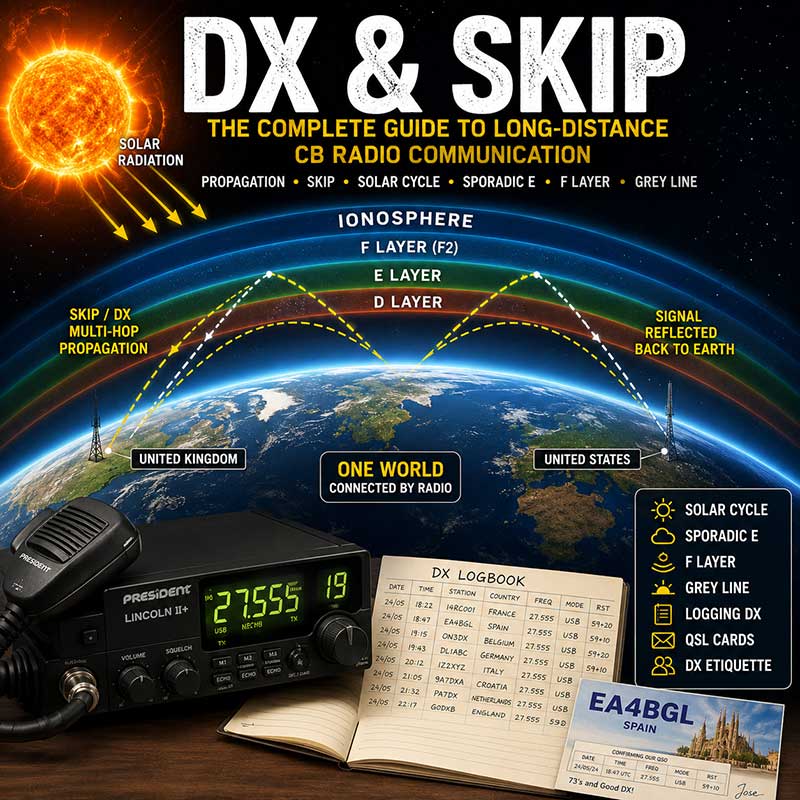
One of the most exciting aspects of CB radio is that, under the right conditions, a signal transmitted with only a few watts of power can travel hundreds or even thousands of miles. An operator sitting in a car park in Derbyshire could suddenly find themselves chatting to stations in Spain, Italy, Scandinavia or even North America without changing equipment or increasing power.
This phenomenon is known as DX, and it is made possible by a process commonly referred to as skip. While local CB communication typically covers anywhere from a few miles to several dozen miles depending on terrain and equipment, skip allows signals to travel vast distances by interacting with the Earth's upper atmosphere.
Understanding how skip works not only makes the hobby more fascinating but also helps operators recognise when conditions are likely to improve, choose the right equipment and operating mode, and make the most of those rare days when the 11-metre band comes alive.
In this guide, we'll explore the science behind skip propagation, explain the role of the ionosphere and solar activity, and provide practical advice for anyone wanting to experience the thrill of making genuine long-distance contacts on CB radio.
What Is DX?
The term DX is shorthand for distance and has been used in radio communications for well over a century. Originally adopted by telegraph operators, the abbreviation simply meant communication over a long distance. Today, DX is used by CB operators, amateur radio enthusiasts and shortwave listeners around the world.
There is no universally agreed minimum distance that qualifies as DX, as it largely depends on the radio service being used.
- For CB radio, many operators consider contacts over 100 miles to be DX.
- Others reserve the term for contacts made through atmospheric propagation rather than normal ground-wave communication.
- International contacts are almost always regarded as DX.
Ultimately, DX is less about the exact mileage and more about achieving communication well beyond the normal range expected from a CB radio.
For many operators, the first successful DX contact becomes one of the defining moments in their CB journey. Hearing a station from another country suddenly appear on an otherwise quiet channel is an experience that continues to attract people to the hobby decades after CB radio first became popular.
Why Operators Love DX
Unlike many modern forms of communication, DX contacts are never guaranteed. They depend on natural conditions that nobody can control. One day the band may appear completely silent, while the next it could be filled with operators from across Europe calling CQ.
This unpredictability is part of the appeal.
Many operators spend hours listening for changing propagation conditions, searching for rare stations or hoping to complete contacts with countries they have never worked before. Every successful DX contact feels like an achievement because it relies on patience, timing and understanding of propagation rather than simply owning expensive equipment.
What Is Skip?
Skip is the informal name given to a type of radio propagation where signals are reflected—or more accurately, refracted—by charged layers high in the Earth's atmosphere. Instead of travelling in a straight line until they disappear over the horizon, radio waves are bent back towards the Earth's surface.
This allows signals to "skip" over areas where they would normally be impossible to hear before returning to Earth hundreds or even thousands of miles away.
Imagine throwing a flat stone across a lake.
Rather than sinking immediately, the stone bounces repeatedly across the water. Radio signals behave in a broadly similar way when atmospheric conditions are favourable. They leave the transmitting antenna, travel upwards, interact with the ionosphere and return to Earth much further away than would otherwise be possible.
Sometimes the signal returns once. Under excellent conditions it may bounce several times between the Earth and the ionosphere, creating what operators call multi-hop propagation.
This is why stations in the UK may suddenly hear operators from:
- France
- Spain
- Portugal
- Italy
- Germany
- Eastern Europe
- North Africa
- North America
- South America
All while using the same legal CB equipment they use for local conversations.
How Skip Works
Understanding skip begins with understanding that radio waves do not all behave in the same way.
Local CB communication generally relies on ground wave propagation. The signal travels close to the Earth's surface and gradually weakens as distance increases. Hills, buildings and the curvature of the Earth all limit how far these signals can travel.
When atmospheric conditions are favourable, however, another type of propagation becomes possible.
Step 1 – The Signal Leaves the Antenna
Every transmission begins at the antenna.
As you press the transmit button, your CB radio converts electrical energy into radio waves. These waves are launched into the surrounding environment by the antenna.
Some energy travels horizontally, supporting local communications.
Some energy also leaves the antenna at higher angles, travelling upwards into the atmosphere.
Step 2 – The Signal Reaches the Ionosphere
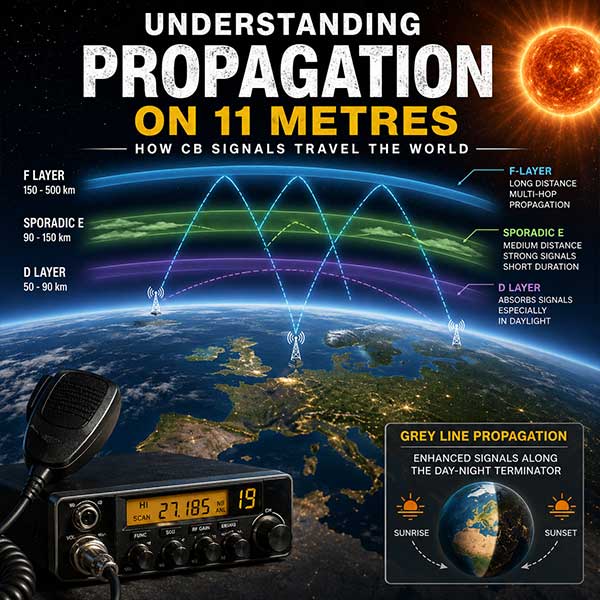
Approximately 60 to 1,000 kilometres above the Earth lies the ionosphere, a region filled with electrically charged particles created by radiation from the Sun.
This layer is constantly changing throughout the day and night as solar radiation increases and decreases.
Different parts of the ionosphere affect different radio frequencies, which is why some bands are open while others remain quiet.
Step 3 – Refraction Occurs
Although people often describe skip as the signal "bouncing" off the atmosphere, that isn't technically what happens.
The charged particles gradually bend the radio wave back towards the Earth through a process known as refraction.
This bending effect is similar to how light changes direction when passing through water or glass.
The stronger and more suitable the ionisation, the further the signal can travel.
Step 4 – The Signal Returns to Earth
Eventually the refracted wave reaches the Earth's surface, where it can be received by another CB operator hundreds or even thousands of miles away.
If conditions remain favourable, part of that signal may reflect from the ground back into the ionosphere, allowing another skip to occur.
This process can repeat several times, creating incredibly long communication paths around the globe.
Why Doesn't Skip Happen Every Day?
This is one of the questions every new operator asks.
The answer lies in the constantly changing nature of the ionosphere.
The amount of ionisation in the upper atmosphere depends on numerous factors, including:
- Solar activity
- The eleven-year solar cycle
- Time of day
- Season of the year
- Geomagnetic disturbances
- Atmospheric conditions affecting Sporadic E propagation
Some days the ionosphere simply isn't capable of bending 27 MHz signals back towards Earth.
On other days it becomes highly reflective, opening communication paths across entire continents.
This is why experienced operators regularly monitor propagation forecasts and space weather reports. They know today's silent band could become tomorrow's worldwide DX event.
The Skip Zone Explained
An interesting effect of skip propagation is the creation of what operators call the skip zone or dead zone.
This is an area between the limit of normal ground-wave communication and the point where the first skip signal returns to Earth.
For example:
- You may easily communicate with stations within 30 miles.
- You might hear nothing between 30 and 300 miles.
- Stations 800 miles away could be arriving at full signal strength.
This surprises many beginners because stronger distant signals can often be heard while stations much closer remain completely inaudible.
The skip zone constantly changes depending on propagation conditions and is one of the many reasons DX remains such a fascinating aspect of CB radio.
Why 11 Metres Is So Special
The CB radio band occupies frequencies around 27 MHz, commonly referred to as the 11-metre band.
This frequency range sits in a unique position where it is highly influenced by changes in the ionosphere.
Unlike VHF or UHF services, which are generally limited to line-of-sight communication, or lower HF frequencies that behave differently throughout the day, 11 metres often produces spectacular propagation during periods of increased solar activity.
This makes CB radio one of the most accessible ways for ordinary enthusiasts to experience worldwide radio communication without requiring expensive equipment or complex installations.
Even a legal UK CB radio running only 4 watts on FM or AM—or 12 watts PEP on SSB where permitted—can occasionally communicate across oceans when propagation conditions align perfectly.
Understanding why this happens begins with understanding the Earth's atmosphere, which we'll explore in the next section covering the ionosphere, the solar cycle, Sporadic E and the F layer.
```htmlDX & Skip Explained: The Complete Guide to Long-Distance CB Radio Communication
One of the most exciting aspects of CB radio is that, under the right conditions, a signal transmitted with only a few watts of power can travel hundreds or even thousands of miles. An operator sitting in a car park in Derbyshire could suddenly find themselves chatting to stations in Spain, Italy, Scandinavia or even North America without changing equipment or increasing power.
This phenomenon is known as DX, and it is made possible by a process commonly referred to as skip. While local CB communication typically covers anywhere from a few miles to several dozen miles depending on terrain and equipment, skip allows signals to travel vast distances by interacting with the Earth's upper atmosphere.
Understanding how skip works not only makes the hobby more fascinating but also helps operators recognise when conditions are likely to improve, choose the right equipment and operating mode, and make the most of those rare days when the 11-metre band comes alive.
In this guide, we'll explore the science behind skip propagation, explain the role of the ionosphere and solar activity, and provide practical advice for anyone wanting to experience the thrill of making genuine long-distance contacts on CB radio.
What Is DX?
The term DX is shorthand for distance and has been used in radio communications for well over a century. Originally adopted by telegraph operators, the abbreviation simply meant communication over a long distance. Today, DX is used by CB operators, amateur radio enthusiasts and shortwave listeners around the world.
There is no universally agreed minimum distance that qualifies as DX, as it largely depends on the radio service being used.
- For CB radio, many operators consider contacts over 100 miles to be DX.
- Others reserve the term for contacts made through atmospheric propagation rather than normal ground-wave communication.
- International contacts are almost always regarded as DX.
Ultimately, DX is less about the exact mileage and more about achieving communication well beyond the normal range expected from a CB radio.
For many operators, the first successful DX contact becomes one of the defining moments in their CB journey. Hearing a station from another country suddenly appear on an otherwise quiet channel is an experience that continues to attract people to the hobby decades after CB radio first became popular.
Why Operators Love DX
Unlike many modern forms of communication, DX contacts are never guaranteed. They depend on natural conditions that nobody can control. One day the band may appear completely silent, while the next it could be filled with operators from across Europe calling CQ.
This unpredictability is part of the appeal.
Many operators spend hours listening for changing propagation conditions, searching for rare stations or hoping to complete contacts with countries they have never worked before. Every successful DX contact feels like an achievement because it relies on patience, timing and understanding of propagation rather than simply owning expensive equipment.
What Is Skip?
Skip is the informal name given to a type of radio propagation where signals are reflected—or more accurately, refracted—by charged layers high in the Earth's atmosphere. Instead of travelling in a straight line until they disappear over the horizon, radio waves are bent back towards the Earth's surface.
This allows signals to "skip" over areas where they would normally be impossible to hear before returning to Earth hundreds or even thousands of miles away.
Imagine throwing a flat stone across a lake.
Rather than sinking immediately, the stone bounces repeatedly across the water. Radio signals behave in a broadly similar way when atmospheric conditions are favourable. They leave the transmitting antenna, travel upwards, interact with the ionosphere and return to Earth much further away than would otherwise be possible.
Sometimes the signal returns once. Under excellent conditions it may bounce several times between the Earth and the ionosphere, creating what operators call multi-hop propagation.
This is why stations in the UK may suddenly hear operators from:
- France
- Spain
- Portugal
- Italy
- Germany
- Eastern Europe
- North Africa
- North America
- South America
All while using the same legal CB equipment they use for local conversations.
How Skip Works
Understanding skip begins with understanding that radio waves do not all behave in the same way.
Local CB communication generally relies on ground wave propagation. The signal travels close to the Earth's surface and gradually weakens as distance increases. Hills, buildings and the curvature of the Earth all limit how far these signals can travel.
When atmospheric conditions are favourable, however, another type of propagation becomes possible.
Step 1 – The Signal Leaves the Antenna
Every transmission begins at the antenna.
As you press the transmit button, your CB radio converts electrical energy into radio waves. These waves are launched into the surrounding environment by the antenna.
Some energy travels horizontally, supporting local communications.
Some energy also leaves the antenna at higher angles, travelling upwards into the atmosphere.
Step 2 – The Signal Reaches the Ionosphere
Approximately 60 to 1,000 kilometres above the Earth lies the ionosphere, a region filled with electrically charged particles created by radiation from the Sun.
This layer is constantly changing throughout the day and night as solar radiation increases and decreases.
Different parts of the ionosphere affect different radio frequencies, which is why some bands are open while others remain quiet.
Step 3 – Refraction Occurs
Although people often describe skip as the signal "bouncing" off the atmosphere, that isn't technically what happens.
The charged particles gradually bend the radio wave back towards the Earth through a process known as refraction.
This bending effect is similar to how light changes direction when passing through water or glass.
The stronger and more suitable the ionisation, the further the signal can travel.
Step 4 – The Signal Returns to Earth
Eventually the refracted wave reaches the Earth's surface, where it can be received by another CB operator hundreds or even thousands of miles away.
If conditions remain favourable, part of that signal may reflect from the ground back into the ionosphere, allowing another skip to occur.
This process can repeat several times, creating incredibly long communication paths around the globe.
Why Doesn't Skip Happen Every Day?
This is one of the questions every new operator asks.
The answer lies in the constantly changing nature of the ionosphere.
The amount of ionisation in the upper atmosphere depends on numerous factors, including:
- Solar activity
- The eleven-year solar cycle
- Time of day
- Season of the year
- Geomagnetic disturbances
- Atmospheric conditions affecting Sporadic E propagation
Some days the ionosphere simply isn't capable of bending 27 MHz signals back towards Earth.
On other days it becomes highly reflective, opening communication paths across entire continents.
```htmlThe Best Time for DX
One of the most common questions new DX operators ask is, "When is the best time to work long-distance stations?" Unfortunately, there is no single answer. Propagation depends on a combination of solar activity, the time of year, the time of day and the current state of the ionosphere.
However, understanding these patterns will greatly improve your chances of being on the air when conditions are favourable.
Summer
Late spring and summer are generally regarded as the best months for European DX thanks to Sporadic E propagation.
Between May and August, it is common for UK operators to hear stations from across mainland Europe, sometimes for several hours each day.
During particularly active periods, almost every channel may contain operators from different countries.
Autumn and Winter
Although Sporadic E becomes less common, autumn and winter can still produce excellent DX, particularly during periods of increased solar activity.
Worldwide F-layer propagation often becomes more noticeable during solar maximum, allowing contacts far beyond Europe.
Morning or Evening?
Propagation changes throughout the day.
- Morning often brings improving European conditions.
- Midday can produce strong Sporadic E openings during summer.
- Late afternoon frequently provides excellent continental DX.
- Around sunrise and sunset, Grey Line propagation may produce unexpected openings.
The only reliable way to learn your local propagation patterns is to spend time listening. Experienced operators know that the band can change dramatically within minutes.
Recognising When the Band Is Opening
One of the skills experienced operators develop is recognising the signs that skip conditions are improving.
Rather than relying solely on propagation forecasts, many operators simply listen carefully to the band.
Typical signs include:
- A sudden increase in background noise.
- Weak foreign voices appearing beneath local conversations.
- Stations fading in and out.
- Several languages becoming audible on adjacent channels.
- Strong signals arriving unexpectedly from hundreds of miles away.
These are usually indications that propagation is beginning to develop.
When this happens, it often pays to remain on the air. Conditions may improve significantly over the next few minutes.
Why Single Sideband (SSB) Is Preferred for DX
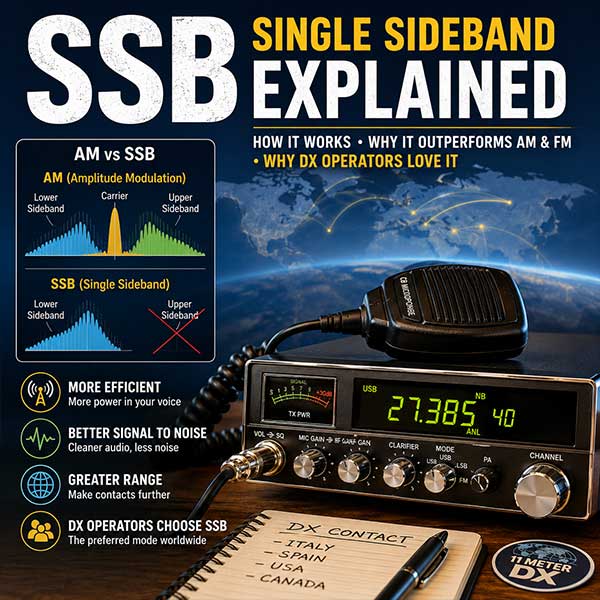
Although DX can be worked using FM and AM, most experienced long-distance operators prefer Single Sideband (SSB), particularly USB on 27.555 MHz.
There are several reasons for this.
Greater Efficiency
Unlike AM, SSB concentrates the transmitter's power into a much narrower signal.
This means more of your available power reaches the receiving station.
The result is:
- Improved signal strength.
- Greater effective range.
- Better intelligibility.
- Less wasted energy.
Reduced Interference
SSB occupies less bandwidth than AM, allowing more stations to operate without overlapping.
This becomes particularly important during busy DX openings when hundreds of operators may be active simultaneously.
Better Weak Signal Performance
One of the greatest advantages of SSB is its ability to recover weak signals.
Stations that may be unreadable on FM often become perfectly understandable on SSB.
This is why most serious DX operators monitor USB during major skip openings.
Choosing the Right Antenna for DX
If there's one lesson experienced operators repeat time and again, it's this:
Your antenna is more important than your radio.
A modest CB radio connected to a well-installed antenna will almost always outperform an expensive radio connected to a poor antenna.
Height Matters
For base stations, antenna height is usually the single biggest improvement you can make.
A higher antenna generally:
- Produces a lower take-off angle.
- Reduces nearby obstructions.
- Improves both transmit and receive performance.
Even raising an antenna by a few metres can make a noticeable difference.
Mobile Antennas
Mobile operators are naturally more limited, but excellent DX is still possible.
Popular choices include:
- Sirio Performer series
- Sirio 5000
- President Texas
- Other full-size quarter-wave mobile antennas
The longer the antenna (within practical limits), the more efficient it generally becomes.
Mobile DX vs Base Station DX
Many newcomers assume only large home stations can work DX.
In reality, thousands of operators enjoy long-distance contacts from cars, vans and trucks every year.
Advantages of Mobile Operation
- Ability to move to higher ground.
- Reduced local electrical noise.
- Large vehicle body acting as a ground plane.
- Opportunity to stop whenever conditions improve.
Advantages of Base Stations
- Higher antennas.
- Larger aerial options.
- More comfortable operating position.
- Dedicated equipment.
- Better long-term performance.
Neither is inherently better. Excellent operators can be found using both.
How to Call CQ DX
When propagation opens, many operators begin calling CQ DX.
This simply means they are looking specifically for long-distance contacts rather than local conversations.
A typical call might sound like:
"CQ DX, CQ DX, this is Gandy in the United Kingdom calling CQ DX and standing by."
There is no need to shout or repeat endlessly.
Speak clearly, leave pauses between calls and allow other stations time to reply.
If nobody answers immediately, try again after a short interval rather than transmitting continuously.
Working Pile-Ups
During major openings, particularly when rare countries appear, several stations may respond simultaneously.
This is known as a pile-up.
Good operators remain calm and patient.
Rather than transmitting repeatedly over other stations, they:
- Listen carefully.
- Wait for gaps.
- Call once.
- Allow the DX station to choose who to respond to.
Patience nearly always produces better results than trying to overpower everyone else.
Improving Your Chances of Working DX
Many people assume successful DX requires expensive equipment or illegal power amplifiers.
In reality, experienced operators know that good operating practice is far more important.
You can improve your chances significantly by:
- Keeping your antenna correctly tuned.
- Maintaining a low SWR.
- Using quality coaxial cable.
- Positioning your antenna as high as practical.
- Operating on SSB when appropriate.
- Monitoring propagation regularly.
- Learning to recognise changing band conditions.
- Listening more than transmitting.
Perhaps most importantly, spend time on the air.
The best DX operators are rarely those with the most expensive stations—they are simply the ones who understand propagation and know when to be listening.
Monitoring Propagation
Today's operators have access to tools that previous generations could only dream about.
Propagation websites, solar weather forecasts and live DX cluster reports provide valuable clues about changing conditions.
However, no website is as useful as your own receiver.
Conditions can change quickly and local variations often occur that aren't reflected in forecasts.
Develop the habit of checking the band regularly, even if reports suggest conditions are poor.
You may be pleasantly surprised.
Patience Is the Most Valuable DX Tool
DXing rewards patience more than almost any other aspect of CB radio.
There will be days when the band seems completely dead, only for Europe to appear unexpectedly an hour later.
There will also be times when propagation favours stations just beyond your reach.
Rather than becoming frustrated, experienced operators simply keep listening.
Every major opening eventually begins with a single distant voice appearing out of the background noise.
Those who are already monitoring the band are the ones most likely to make the first contacts.
```This is why experienced operators regularly monitor propagation forecasts and space weather reports. They know today's silent band could become tomorrow's worldwide DX event.
The Skip Zone Explained
An interesting effect of skip propagation is the creation of what operators call the skip zone or dead zone.
This is an area between the limit of normal ground-wave communication and the point where the first skip signal returns to Earth.
For example:
- You may easily communicate with stations within 30 miles.
- You might hear nothing between 30 and 300 miles.
- Stations 800 miles away could be arriving at full signal strength.
This surprises many beginners because stronger distant signals can often be heard while stations much closer remain completely inaudible.
The skip zone constantly changes depending on propagation conditions and is one of the many reasons DX remains such a fascinating aspect of CB radio.
Why 11 Metres Is So Special
The CB radio band occupies frequencies around 27 MHz, commonly referred to as the 11-metre band.
This frequency range sits in a unique position where it is highly influenced by changes in the ionosphere.
Unlike VHF or UHF services, which are generally limited to line-of-sight communication, or lower HF frequencies that behave differently throughout the day, 11 metres often produces spectacular propagation during periods of increased solar activity.
This makes CB radio one of the most accessible ways for ordinary enthusiasts to experience worldwide radio communication without requiring expensive equipment or complex installations.
Even a legal UK CB radio running only 4 watts on FM or AM—or 12 watts PEP on SSB where permitted—can occasionally communicate across oceans when propagation conditions align perfectly.
Understanding why this happens begins with understanding the Earth's atmosphere, which we'll explore in the next section covering the ionosphere, the solar cycle, Sporadic E and the F layer.
```htmlThe Best Time for DX
One of the most common questions new DX operators ask is, "When is the best time to work long-distance stations?" Unfortunately, there is no single answer. Propagation depends on a combination of solar activity, the time of year, the time of day and the current state of the ionosphere.
However, understanding these patterns will greatly improve your chances of being on the air when conditions are favourable.
Summer
Late spring and summer are generally regarded as the best months for European DX thanks to Sporadic E propagation.
Between May and August, it is common for UK operators to hear stations from across mainland Europe, sometimes for several hours each day.
During particularly active periods, almost every channel may contain operators from different countries.
Autumn and Winter
Although Sporadic E becomes less common, autumn and winter can still produce excellent DX, particularly during periods of increased solar activity.
Worldwide F-layer propagation often becomes more noticeable during solar maximum, allowing contacts far beyond Europe.
Morning or Evening?
Propagation changes throughout the day.
- Morning often brings improving European conditions.
- Midday can produce strong Sporadic E openings during summer.
- Late afternoon frequently provides excellent continental DX.
- Around sunrise and sunset, Grey Line propagation may produce unexpected openings.
The only reliable way to learn your local propagation patterns is to spend time listening. Experienced operators know that the band can change dramatically within minutes.
Recognising When the Band Is Opening
One of the skills experienced operators develop is recognising the signs that skip conditions are improving.
Rather than relying solely on propagation forecasts, many operators simply listen carefully to the band.
Typical signs include:
- A sudden increase in background noise.
- Weak foreign voices appearing beneath local conversations.
- Stations fading in and out.
- Several languages becoming audible on adjacent channels.
- Strong signals arriving unexpectedly from hundreds of miles away.
These are usually indications that propagation is beginning to develop.
When this happens, it often pays to remain on the air. Conditions may improve significantly over the next few minutes.
Why Single Sideband (SSB) Is Preferred for DX
Although DX can be worked using FM and AM, most experienced long-distance operators prefer Single Sideband (SSB), particularly USB on 27.555 MHz.
There are several reasons for this.
Greater Efficiency
Unlike AM, SSB concentrates the transmitter's power into a much narrower signal.
This means more of your available power reaches the receiving station.
The result is:
- Improved signal strength.
- Greater effective range.
- Better intelligibility.
- Less wasted energy.
Reduced Interference
SSB occupies less bandwidth than AM, allowing more stations to operate without overlapping.
This becomes particularly important during busy DX openings when hundreds of operators may be active simultaneously.
Better Weak Signal Performance
One of the greatest advantages of SSB is its ability to recover weak signals.
Stations that may be unreadable on FM often become perfectly understandable on SSB.
This is why most serious DX operators monitor USB during major skip openings.
Choosing the Right Antenna for DX
If there's one lesson experienced operators repeat time and again, it's this:
Your antenna is more important than your radio.
A modest CB radio connected to a well-installed antenna will almost always outperform an expensive radio connected to a poor antenna.
Height Matters
For base stations, antenna height is usually the single biggest improvement you can make.
A higher antenna generally:
- Produces a lower take-off angle.
- Reduces nearby obstructions.
- Improves both transmit and receive performance.
Even raising an antenna by a few metres can make a noticeable difference.
Mobile Antennas
Mobile operators are naturally more limited, but excellent DX is still possible.
Popular choices include:
- Sirio Performer series
- Sirio 5000
- President Texas
- Other full-size quarter-wave mobile antennas
The longer the antenna (within practical limits), the more efficient it generally becomes.
Mobile DX vs Base Station DX
Many newcomers assume only large home stations can work DX.
In reality, thousands of operators enjoy long-distance contacts from cars, vans and trucks every year.
Advantages of Mobile Operation
- Ability to move to higher ground.
- Reduced local electrical noise.
- Large vehicle body acting as a ground plane.
- Opportunity to stop whenever conditions improve.
Advantages of Base Stations
- Higher antennas.
- Larger aerial options.
- More comfortable operating position.
- Dedicated equipment.
- Better long-term performance.
Neither is inherently better. Excellent operators can be found using both.
How to Call CQ DX
When propagation opens, many operators begin calling CQ DX.
This simply means they are looking specifically for long-distance contacts rather than local conversations.
A typical call might sound like:
"CQ DX, CQ DX, this is Gandy in the United Kingdom calling CQ DX and standing by."
There is no need to shout or repeat endlessly.
Speak clearly, leave pauses between calls and allow other stations time to reply.
If nobody answers immediately, try again after a short interval rather than transmitting continuously.
Working Pile-Ups
During major openings, particularly when rare countries appear, several stations may respond simultaneously.
This is known as a pile-up.
Good operators remain calm and patient.
Rather than transmitting repeatedly over other stations, they:
- Listen carefully.
- Wait for gaps.
- Call once.
- Allow the DX station to choose who to respond to.
Patience nearly always produces better results than trying to overpower everyone else.
Improving Your Chances of Working DX
Many people assume successful DX requires expensive equipment or illegal power amplifiers.
In reality, experienced operators know that good operating practice is far more important.
You can improve your chances significantly by:
- Keeping your antenna correctly tuned.
- Maintaining a low SWR.
- Using quality coaxial cable.
- Positioning your antenna as high as practical.
- Operating on SSB when appropriate.
- Monitoring propagation regularly.
- Learning to recognise changing band conditions.
- Listening more than transmitting.
Perhaps most importantly, spend time on the air.
The best DX operators are rarely those with the most expensive stations—they are simply the ones who understand propagation and know when to be listening.
Monitoring Propagation
Today's operators have access to tools that previous generations could only dream about.
Propagation websites, solar weather forecasts and live DX cluster reports provide valuable clues about changing conditions.
However, no website is as useful as your own receiver.
Conditions can change quickly and local variations often occur that aren't reflected in forecasts.
Develop the habit of checking the band regularly, even if reports suggest conditions are poor.
You may be pleasantly surprised.
Patience Is the Most Valuable DX Tool
DXing rewards patience more than almost any other aspect of CB radio.
There will be days when the band seems completely dead, only for Europe to appear unexpectedly an hour later.
There will also be times when propagation favours stations just beyond your reach.
Rather than becoming frustrated, experienced operators simply keep listening.
Every major opening eventually begins with a single distant voice appearing out of the background noise.
Those who are already monitoring the band are the ones most likely to make the first contacts.
```html id="r4n7qx"DX Etiquette
When skip conditions are good, dozens or even hundreds of operators may be trying to use the same frequencies. Good operating etiquette becomes even more important than during normal local operation.
The best DX operators are not necessarily those with the loudest signals—they are the ones who are patient, courteous and easy to work.
Listen Before Transmitting
Always spend a few moments listening before calling. Determine whether another station is already using the frequency and avoid transmitting over an existing conversation.
Many beginners make the mistake of immediately calling CQ on a busy frequency, causing unnecessary interference.
Keep Calls Short
During busy openings, long transmissions reduce everyone's opportunity to make contacts.
When calling CQ or replying to another station:
- State your handle or callsign.
- Give your location.
- Exchange signal reports.
- Allow others an opportunity to call.
Lengthy conversations are better left until conditions become quieter.
Respect Pile-Ups
If several operators are calling the same station:
- Call once.
- Listen carefully.
- Wait for your turn.
- Avoid repeatedly transmitting over other stations.
Good operators know that persistence and patience usually achieve better results than shouting continuously.
Use Appropriate Power
There can be a temptation to use excessive transmitter power when chasing DX.
However, good propagation usually makes this unnecessary.
Operating within legal limits using a properly installed antenna is often more effective than relying on additional power. Excessive power can also create interference for other operators and may result in distorted transmissions if equipment is not correctly configured.
Logging DX Contacts
One of the most rewarding aspects of long-distance CB operation is keeping a detailed record of your contacts.
A logbook provides far more than a list of stations worked—it becomes a record of your own operating history and allows you to identify propagation patterns over time.
Many experienced operators can look back over years of logs to see:
- When skip first appeared each season.
- Which countries were worked.
- Which equipment produced the best results.
- How solar activity influenced propagation.
What Should You Record?
A good DX log should include:
- Date.
- Time (preferably UTC).
- Frequency or channel.
- Mode (FM, AM or USB).
- Station worked.
- Operator's handle.
- Country or location.
- Signal report.
- Your equipment.
- Any interesting notes.
Even brief notes such as "first contact with Portugal" or "excellent Sporadic E opening" become enjoyable reminders of memorable operating sessions.
Digital Logbooks
While many operators still enjoy keeping handwritten notebooks, digital logging offers significant advantages.
Online platforms such as CB Radio Logbook allow operators to:
- Record contacts from any device.
- Map DX locations.
- Track operating statistics.
- Build a permanent history of their radio activity.
- Participate in community challenges and achievements.
For active DX enthusiasts, a searchable online log quickly becomes an invaluable resource.
QSL Cards Explained
Long before email or social media existed, radio operators confirmed successful contacts by exchanging QSL cards.
A QSL card is essentially a postcard confirming that communication took place between two stations.
They often include:
- Operator name or handle.
- Location.
- Date and time of contact.
- Frequency.
- Signal report.
- Equipment used.
- A photograph or personalised design.
For many operators, collecting QSL cards became almost as enjoyable as making the contacts themselves.
Traditional Paper Cards
Printed QSL cards remain popular among collectors and dedicated DX operators.
Many feature photographs of the operator's station, local scenery or customised artwork and are exchanged by post following a successful contact.
Receiving a card from another country provides a lasting reminder of a memorable QSO.
Digital QSL Cards
Modern technology has introduced electronic alternatives.
Digital confirmations are quicker, cheaper and easier to organise while still preserving the tradition of confirming long-distance contacts.
Many operators now use a mixture of traditional cards and digital confirmations depending on personal preference.
Common Myths About Skip
"You Need Hundreds of Watts to Work DX"
False.
Many impressive DX contacts are made every year using legal UK CB equipment. Propagation conditions are almost always more important than transmitter power.
"An Expensive Radio Guarantees Better DX"
Not necessarily.
A high-quality antenna, correct installation and good operating technique usually have a far greater impact than the price of the radio itself.
"Skip Happens Because of the Weather"
No.
Rain, wind and cloud have very little influence on HF propagation.
Skip is driven primarily by activity within the ionosphere, which is controlled by the Sun rather than everyday weather.
"If Europe Is Loud, America Will Be Too"
Different propagation mechanisms affect different regions.
You may hear stations across Europe while North America remains completely absent—or vice versa.
This is one of the reasons DX remains so fascinating.
Frequently Asked Questions
What does DX mean on CB radio?
DX refers to long-distance communication beyond normal local operating range, often involving stations hundreds or thousands of miles away.
What causes skip on CB radio?
Skip is caused by radio signals being refracted by charged layers within the Earth's ionosphere, allowing them to travel far beyond the horizon.
When is the best time for DX?
Late spring and summer are excellent for Sporadic E propagation across Europe, while periods around solar maximum offer increased opportunities for worldwide DX.
Can I work DX using a legal UK CB radio?
Yes. Many operators regularly work stations across Europe and occasionally much further using legal CB equipment when propagation conditions are favourable.
Is SSB better than FM for DX?
Generally, yes. Single Sideband is more efficient, performs better with weak signals and is the preferred mode for most serious DX operators.
Should I keep a log of my DX contacts?
Absolutely. Logging contacts allows you to track your achievements, monitor propagation patterns and build a permanent record of your operating history.
Related Articles
Continue learning with these in-depth guides:
- Single Sideband (SSB) Explained
- CB Radio Antennas Explained
- How Far Can a CB Radio Reach?
- CB Radio Frequencies Explained
- Radio Nets Explained
- Why Every Operator Should Keep a Logbook
- CB Radio Etiquette: The Unwritten Rules
- CB Radio for Beginners
Whether you're chasing your first contact across the English Channel or hoping to hear stations on another continent, DX is one of the most rewarding aspects of CB radio. Every opening is different, every contact tells a story, and every successful QSO is a reminder that, even with modest equipment, the atmosphere can connect people separated by thousands of miles. With patience, a well-installed station and an understanding of propagation, you'll soon discover why generations of operators have become captivated by the ever-changing world of skip on 11 metres.
Related articles
Join the CB Radio Logbook
Track every QSO, map your contacts, and connect with operators near you. Create your free account and get on the air.
Create your account