Understanding Propagation on 11 Metres: How CB Signals Travel Around the World
For many newcomers to CB radio, the first time they hear a station hundreds or even thousands of miles away can be a confusing experience. One moment Channel 27 sounds almost empty, and the next it is filled with operators from Spain, Italy, France, Germany, North America, or even further afield. It can seem almost magical.
The reality is that these long-distance contacts are made possible by a fascinating branch of radio science known as propagation.
Understanding propagation is one of the keys to becoming a better CB operator. Once you learn how radio waves interact with the Earth's atmosphere, you begin to understand why some days local communication is all you can achieve, while on other days the world seems to arrive on your antenna.
In this guide, we’ll explore the major forms of propagation that affect the 11-metre band, including the F-layer, Sporadic E, solar activity, and the highly sought-after Grey Line effect.
What Is Radio Propagation?
Radio propagation refers to the way radio signals travel from one location to another.
On CB radio, signals can travel in several different ways:
- Ground wave propagation
- Line-of-sight propagation
- Skywave propagation
- Sporadic E propagation
- F-layer propagation
- Grey Line propagation
For local contacts, most CB operators rely on ground wave propagation. These signals travel along the Earth's surface and typically provide communication over distances ranging from a few miles to perhaps 50 miles under favourable conditions.
Long-distance communication, commonly known as DX, occurs when radio signals are reflected or refracted by layers of the ionosphere high above the Earth.
It is this interaction with the ionosphere that creates some of the most exciting moments in CB radio.
Understanding the Ionosphere
To understand propagation, you first need to understand the ionosphere.
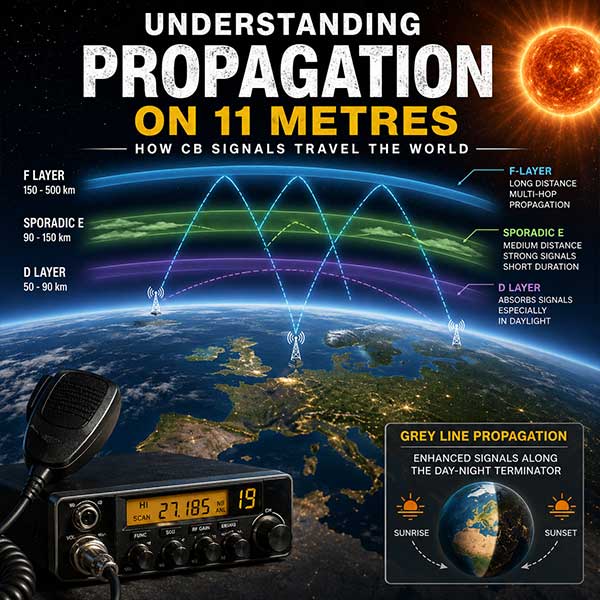
The ionosphere is a region of the upper atmosphere extending roughly from 50 kilometres to over 1,000 kilometres above the Earth's surface.
This region contains charged particles created when solar radiation strikes atmospheric gases.
The ionosphere is typically divided into several layers:
- D Layer
- E Layer
- F1 Layer
- F2 Layer
Each layer affects radio waves differently.
During daylight hours, solar radiation continually changes the density and behaviour of these layers. At night, some layers weaken or disappear entirely.
These changes directly influence how well CB signals travel.
The D Layer: The DX Killer
The D Layer sits approximately 50 to 90 kilometres above the Earth.
While it does not usually reflect 11-metre signals, it does absorb them.
During daylight hours, particularly around midday, the D Layer becomes stronger and can significantly reduce long-distance propagation.
This is one reason why some operators notice DX conditions improving dramatically during the evening.
As the Sun sets, the D Layer weakens and eventually disappears, allowing signals to pass more easily into the higher ionospheric layers.
F-Layer Propagation
When most CB operators talk about “the skip being in”, they are often referring to F-layer propagation.
The F Layer sits roughly between 150 and 500 kilometres above the Earth and is responsible for many of the longest-distance contacts made on 11 metres.
During daylight hours, it often splits into two regions:
- F1 Layer
- F2 Layer
At night these usually merge into a single F Layer.
How F-Layer Propagation Works
When a CB signal reaches the F Layer, it can be bent back towards the Earth rather than escaping into space.
The signal returns to Earth hundreds or thousands of miles away.
If conditions are favourable, the signal may bounce repeatedly between the Earth and ionosphere.
This process is known as:
- Multi-hop propagation
- Skywave propagation
A single hop can often cover:
- 1,000 to 2,500 miles
Multiple hops can allow signals to travel:
- Across continents
- Across oceans
- Around the world
This is why operators in the UK can sometimes work stations in North America, South America, Australia, New Zealand, and Africa using only a few watts of power.
Why F-Layer Propagation Matters
F-layer propagation is the primary reason the 11-metre band becomes so active during periods of high solar activity.
When the F2 layer becomes highly ionised, signals on 27 MHz can travel extraordinary distances.
Many of the longest DX contacts ever made on CB radio rely on this mechanism.
Sporadic E Propagation
While F-layer propagation often dominates during periods of high solar activity, another phenomenon frequently surprises operators.
This is known as Sporadic E.
Sporadic E occurs when dense clouds of ionised particles suddenly form within the E Layer approximately 90 to 150 kilometres above the Earth.
Unlike the more predictable F Layer, Sporadic E can appear suddenly and without warning.
Characteristics of Sporadic E
Sporadic E contacts are often characterised by:
- Extremely strong signals
- Sudden openings
- Rapidly changing conditions
- Shorter skip distances
Typical Sporadic E distances include:
- 500 miles
- 800 miles
- 1,200 miles
- 1,500 miles
Occasionally longer paths occur when multiple Sporadic E clouds interact.
When Sporadic E Occurs
The strongest Sporadic E seasons usually occur in spring, summer, and sometimes winter.
The most active months are often:
- May
- June
- July
- December
- January
Many UK operators find June and July particularly productive for European DX.
During strong Sporadic E openings, stations across Europe can arrive at S9+ levels, sounding almost local despite being hundreds or thousands of miles away.
Why Operators Love Sporadic E
Unlike F-layer propagation, Sporadic E does not require high solar activity.
Even during relatively poor solar conditions, Sporadic E can provide excellent DX opportunities.
Many operators make their first international contacts through Sporadic E openings.
Solar Activity and the 11-Metre Band
If there is one factor that has the greatest influence on long-distance CB communication, it is the Sun.
The Sun constantly emits ultraviolet radiation, X-rays, and charged particles. These emissions directly affect ionisation within the ionosphere.
The Solar Cycle
Solar activity follows an approximately 11-year cycle.
This cycle moves between:
- Solar Minimum
- Solar Maximum
During Solar Minimum, F-layer propagation is less frequent, DX opportunities are reduced, and long-distance contacts become harder.
During Solar Maximum, higher ionisation levels occur, F2 propagation becomes common, and worldwide DX opportunities increase dramatically.
Sunspots
Sunspots are dark regions on the Sun associated with intense magnetic activity.
Higher sunspot numbers often indicate better conditions for 11-metre DX.
Experienced operators frequently monitor:
- Sunspot Number, often abbreviated to SSN
- Solar Flux Index, often abbreviated to SFI
- K Index
- A Index
These figures help predict likely propagation conditions.
Solar Flux Index
The Solar Flux Index is particularly useful for CB operators.
Generally speaking:
- Below 100 usually means limited F-layer DX
- 100 to 150 suggests improving conditions
- 150 to 200 suggests strong DX potential
- Above 200 can indicate exceptional conditions
Although these numbers are not guarantees, they provide useful indicators of likely band performance.
What Causes Skip?
The term “skip” is one of the most commonly used phrases in CB radio.
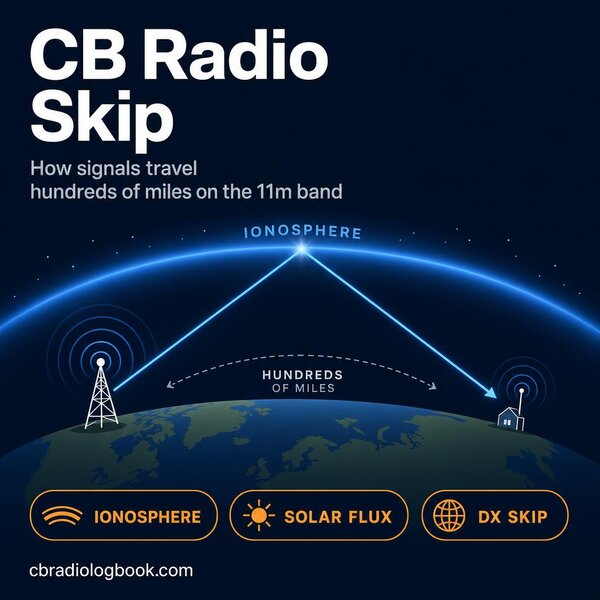
Skip occurs whenever a radio signal is reflected or refracted by the ionosphere and returns to Earth some distance away.
Interestingly, skip creates a phenomenon known as the skip zone.
This is an area where stations are too far away for ground wave, but too close for ionospheric return.
As a result, an operator may hear stations 1,500 miles away while being unable to contact someone 100 miles away.
This apparent contradiction often confuses newcomers but is a completely normal aspect of propagation.
Grey Line Propagation
Grey Line propagation is one of the most fascinating phenomena in radio.
It occurs along the moving boundary between daylight and darkness on Earth.
This boundary is known as the terminator line.
Why Grey Line Occurs
As sunrise or sunset approaches, the D Layer weakens rapidly while higher ionospheric layers can remain ionised.
This creates a useful situation where signal absorption decreases while reflection remains effective.
The result can be enhanced long-distance propagation along the grey line path.
Best Times for Grey Line DX
Grey Line propagation is usually strongest around local sunrise and local sunset.
Operators often notice surprising openings to locations that sit along the same sunrise or sunset line.
Why DX Operators Watch Grey Line
Grey Line conditions can produce:
- Stronger signals
- Lower noise levels
- Unexpected openings
- Rare DX opportunities
Some operators specifically plan operating sessions around sunrise and sunset because of the potential advantages.
For serious DX enthusiasts, Grey Line can be one of the most productive propagation modes available.
Reading the Signs of an Opening
Experienced operators learn to recognise the early signs of propagation.
Common indicators include:
Rising Background Noise
A quiet band suddenly develops a low hiss or roar.
Foreign Voices
Stations from other countries begin appearing unexpectedly.
Strong European Signals
Operators from Spain, Italy, France, Germany, Poland, or the Netherlands arrive with unusually strong signals.
Rapid Signal Changes
Signals rise and fall dramatically within seconds.
Clustered Activity
Multiple channels suddenly become busy at the same time.
These signs often indicate that an opening is developing.
How to Make the Most of Good Propagation
When conditions open up, successful operators tend to:
- Monitor multiple channels
- Listen before calling
- Use clear phonetics
- Keep transmissions concise
- Record contacts in a logbook
- Watch propagation forecasts
A good opening can last a few minutes, several hours, or occasionally an entire day.
Conditions can change rapidly, so being prepared helps maximise opportunities.
Why Propagation Makes CB Radio Special
Modern communication technology allows instant contact with virtually anyone on Earth. Yet there is something uniquely rewarding about making a long-distance contact using nothing more than a radio, an antenna, and favourable atmospheric conditions.
Propagation transforms the 11-metre band from a local communication tool into a worldwide playground.
One day you may be chatting to another operator a few miles down the road. The next day you could be exchanging signal reports with stations thousands of miles away across oceans and continents.
That unpredictability is part of what keeps operators returning to the airwaves year after year.
Understanding F-layer propagation, Sporadic E, solar activity, and Grey Line effects allows you to recognise these opportunities and make the most of them when they appear.
The next time the band suddenly comes alive with distant voices, you’ll know exactly what is happening above your head — and why the 11-metre band remains one of the most fascinating places in radio.
Related articles
What Is RF Gain and When Should You Use It?
CB Radio Skip: The Fascinating Science Behind Long-Distance Communication on the 11 Metre Band
Discover the science behind CB radio skip on the 11 metre band — how the ionosphere, solar activity and Sporadic E let your signal travel hundreds or thousands of miles.
Join the CB Radio Logbook
Track every QSO, map your contacts, and connect with operators near you. Create your free account and get on the air.
Create your account