What Is RF Gain and When Should You Use It?
If you've spent any time looking at the controls on a CB radio, you've probably come across a knob labelled RF Gain. Many operators leave it fully clockwise and never touch it again. Others constantly adjust it depending on conditions. For newcomers, it can be one of the most misunderstood controls on the radio.
The confusion usually comes from the fact that RF Gain doesn't make your signal stronger when you transmit. It doesn't increase your power output, improve your antenna, or magically extend your range. Instead, RF Gain affects what happens when you're listening.
Understanding how RF Gain works can dramatically improve your CB radio experience, particularly during periods of heavy skip, in busy urban environments, or when operating mobile from a vehicle.
Let's take a closer look at what RF Gain actually does and when you should use it.
What Does RF Gain Mean?
RF stands for Radio Frequency.
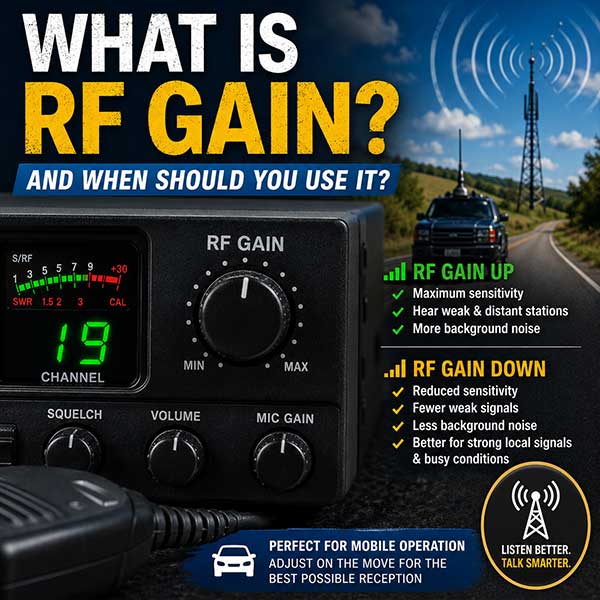
The RF Gain control adjusts the sensitivity of your receiver.
In simple terms, it controls how much incoming signal your radio is willing to listen to.
When RF Gain is turned fully up:
- The receiver is at maximum sensitivity.
- Weak stations can be heard more easily.
- Distant signals become audible.
- Background noise is generally higher.
When RF Gain is turned down:
- Receiver sensitivity is reduced.
- Weak stations disappear.
- Only stronger nearby signals are heard.
- Background noise is reduced.
Think of it like adjusting the sensitivity of a microphone.
A highly sensitive microphone picks up every sound in the room. A less sensitive microphone ignores quiet noises and focuses only on louder sounds.
RF Gain works in a very similar way.
RF Gain Is Receive Only
One of the biggest misconceptions among new operators is that RF Gain somehow affects transmission.
It doesn't.
Changing RF Gain has absolutely no impact on:
- Transmit power
- Audio quality
- Antenna performance
- SWR
- How far your signal travels
If you're calling out and nobody is responding, increasing RF Gain won't help because it only affects what you hear, not what others hear.
This is important to remember because many operators mistakenly treat RF Gain as a "range" control.
It isn't.
Why Most Operators Leave It Fully Up
Under normal conditions, most CB operators run RF Gain at maximum.
This gives the receiver its best possible sensitivity and allows weak stations to be heard.
When conditions are quiet, there is little downside to doing this.
For example:
- Local operators are easy to hear.
- Background noise remains manageable.
- Skip conditions are low.
- The channel isn't overcrowded.
In these situations, maximum RF Gain makes perfect sense.
The trouble starts when the airwaves become busy.
Understanding Receiver Overload
Imagine standing in a crowded pub trying to hold a conversation.
One person speaking nearby is easy to hear.
Fifty people shouting at once becomes difficult.
Your CB receiver experiences something similar.
When strong signals arrive from multiple directions simultaneously, particularly during periods of skip, the receiver can become overwhelmed.
You may notice:
- Constant noise
- Stations talking over each other
- Difficulty identifying local operators
- Rapid changes in signal strength
This is where RF Gain becomes useful.
Reducing receiver sensitivity allows you to filter out some of the weaker clutter and focus on stronger stations.
Practical Example: Local Conversation
Let's imagine you're parked at a service station and chatting with another operator three miles away.
Your friend is giving you a solid signal.
Suddenly a skip opening develops and stations from Spain, Italy, Germany and Poland all begin appearing on the channel.
The frequency becomes chaotic.
Although your local contact is still strong, they're now competing with dozens of DX stations.
By reducing RF Gain slightly:
- Many weaker skip stations disappear.
- Your local operator remains strong.
- The conversation becomes easier to follow.
In this scenario RF Gain acts almost like a noise filter.
Practical Example: Heavy Summer Skip
Every experienced CB operator has encountered a summer afternoon when the entire band seems alive.
Signals are arriving from all over Europe.
The S-meter rarely drops below S7 or S8.
Stations are talking continuously.
Many operators instinctively reach for the squelch control.
Unfortunately excessive squelch can hide useful signals.
A better approach is often:
- Leave squelch relatively low.
- Reduce RF Gain gradually.
- Find a balance where local stations remain audible.
This can make the radio significantly easier to use.
Practical Example: Mobile Operation
RF Gain becomes especially useful when operating mobile.
As you drive, signal conditions constantly change.
You might move through:
- Town centres
- Industrial estates
- Open countryside
- Motorways
- Hills and valleys
Each environment produces different signal strengths and noise levels.
When approaching a busy urban area, you might encounter:
- Electrical interference
- Strong nearby stations
- Commercial radio noise
- Industrial equipment
If a nearby operator is booming in at S9+20, reducing RF Gain slightly can make listening more comfortable without affecting your ability to communicate.
Likewise, if you're trying to hear a distant station while parked at a campsite using a larger mobile antenna setup, you'll probably want RF Gain fully open to maximise receiver sensitivity.
RF Gain Versus Squelch
These controls are often confused.
Although they can appear to achieve similar results, they work very differently.
Squelch
Squelch hides signals below a chosen threshold.
Anything weaker than that level remains silent.
RF Gain
RF Gain reduces receiver sensitivity itself.
Signals are not merely hidden; they become weaker because the receiver is listening less aggressively.
Many experienced operators prefer adjusting RF Gain first and using squelch only for fine tuning.
Using RF Gain for Strong Nearby Stations
Sometimes a nearby station can be excessively strong.
Perhaps another operator is parked beside you.
Perhaps a base station is transmitting from only a few streets away.
The signal may be:
- Distorted
- Uncomfortably loud
- Driving the S-meter into the red
Reducing RF Gain can help tame these signals and improve listening comfort.
It won't reduce the station's transmit power, but it will reduce how hard your receiver is being driven.
The Relationship Between RF Gain and DX Hunting
Interestingly, RF Gain can help both local operators and DX enthusiasts.
When searching for weak DX stations:
- RF Gain should normally remain fully open.
- Maximum sensitivity is desirable.
- Weak signals become easier to detect.
However, once a major skip opening develops, reducing RF Gain slightly can sometimes make individual stations easier to isolate from the crowd.
Many experienced DX operators constantly adjust RF Gain throughout a session.
It becomes part of the operating technique.
What About Modern DSP Radios?
Many modern CB radios include:
- NRC, or Noise Reduction Circuit
- DSP filtering
- Automatic noise reduction
- Digital signal processing
These technologies help reduce unwanted noise.
However, they don't replace RF Gain.
Even with advanced filtering, receiver overload can still occur when conditions become crowded.
RF Gain remains a valuable manual control that gives the operator direct influence over receiver sensitivity.
A Simple Experiment
If you've never used RF Gain before, try this:
- Find a busy channel.
- Set squelch low.
- Turn RF Gain fully clockwise.
- Listen carefully.
- Slowly reduce RF Gain.
You'll notice:
- Weak stations disappear first.
- Background noise reduces.
- Strong stations remain audible.
- The channel often becomes easier to follow.
This simple exercise demonstrates exactly what RF Gain is doing.
Common Mistakes
Turning RF Gain Down Too Far
Many newcomers reduce RF Gain excessively and then wonder why nobody can be heard.
Remember that you're reducing receiver sensitivity.
Too much reduction means weak stations vanish completely.
Using RF Gain Instead of Fixing Noise Problems
RF Gain should not be used to compensate for:
- Poor antenna installation
- High SWR
- Faulty coax
- Vehicle electrical interference
These issues should be corrected at their source.
Assuming It Improves Transmission
This remains the most common misunderstanding.
RF Gain affects reception only.
Your transmitted signal remains unchanged.
Final Thoughts
RF Gain is one of the most useful yet underappreciated controls on a CB radio. It doesn't increase power, improve range, or make your antenna perform better. What it does do is give you control over how sensitive your receiver is.
Most of the time you'll probably leave it fully open and enjoy maximum sensitivity. But when the band becomes crowded, skip starts rolling in across Europe, or strong local stations begin dominating the channel, RF Gain can transform a chaotic listening experience into a manageable one.
For mobile operators especially, learning when to adjust RF Gain is a valuable skill. Conditions can change dramatically between town centres, motorways, campsites and rural locations. Knowing how to tame an overloaded receiver while still hearing the stations you want is part of becoming a more capable operator.
Like many aspects of CB radio, the best way to understand RF Gain is simply to experiment with it. Spend some time adjusting it during different conditions and you'll quickly discover why experienced operators keep a hand close to that control when the airwaves get busy.
Related articles
CB Radio Terminology Explained: The Complete Guide to CB Radio Lingo, Q-Codes and Operator Slang
SWR Explained: The Hidden Number That Can Make or Break Your CB Radio Station
What SWR really means, why it matters, and how to measure and tune your CB or amateur radio antenna for the best possible performance.
Join the CB Radio Logbook
Track every QSO, map your contacts, and connect with operators near you. Create your free account and get on the air.
Create your account