
SWR Explained: The Hidden Number That Can Make or Break Your CB Radio Station
When most people get into CB radio, their attention naturally goes towards the exciting parts of the hobby. They spend hours researching radios, comparing antennas, looking at mounting options and dreaming about the contacts they’ll make once everything is installed. The radio arrives, the antenna goes onto the vehicle or mast, the coax is routed neatly, and before long they’re calling out on the air for the very first time.
Then comes the confusion.
The radio seems to work. The display lights up. The transmit indicator appears. Nearby operators occasionally hear them. Yet somehow the station doesn’t perform as well as expected. Signals are weaker than they should be. Contacts seem difficult to make. Stations that should be easy to reach either don’t hear them or report poor audio. Before long someone asks a question that every CB operator will hear sooner or later:
“What’s your SWR?”
For newcomers, those three letters can seem mysterious. They’re discussed endlessly in radio circles. Some operators obsess over them. Others claim they’re overrated. Entire forum discussions have been known to descend into arguments over whether a reading of 1.2:1 is meaningfully better than 1.5:1.
The truth lies somewhere in the middle.
SWR is one of the most important measurements in radio communications. Understanding it can improve your station’s performance, help protect your equipment and save you from countless hours of frustration. At the same time, many myths surround SWR, and operators who don’t fully understand what it represents can end up chasing numbers that make very little practical difference.
Whether you’re running a simple mobile CB setup, a high-powered amateur radio station or anything in between, understanding SWR is a fundamental skill that will make you a better operator.
What Does SWR Actually Mean?
SWR stands for Standing Wave Ratio.
At first glance, that doesn’t really help. In fact, it usually raises more questions than it answers.
To understand SWR properly, we need to follow a radio signal on its journey from the transmitter to the antenna.
Imagine you’re transmitting on a CB radio. The moment you key the microphone, radio frequency energy leaves the transmitter and begins travelling along the coaxial cable towards the antenna.
In an ideal world, every watt of that energy would reach the antenna and be launched into the atmosphere as radio waves.
If that happened, your SWR would be perfect.
Unfortunately, radio systems rarely exist in a perfect world.
Antennas have physical limitations. Vehicles create strange electrical environments. Mounting locations affect performance. Nearby objects influence resonance. Connectors introduce losses. Coaxial cable can become damaged or poorly installed.
As a result, some of the energy travelling towards the antenna often fails to leave the antenna efficiently. Instead, a portion of that energy is reflected back down the coax towards the radio.
Think of it like shouting into a tunnel.
Part of your voice travels forwards, but some of it echoes back towards you.
Radio frequency energy behaves in a surprisingly similar way.
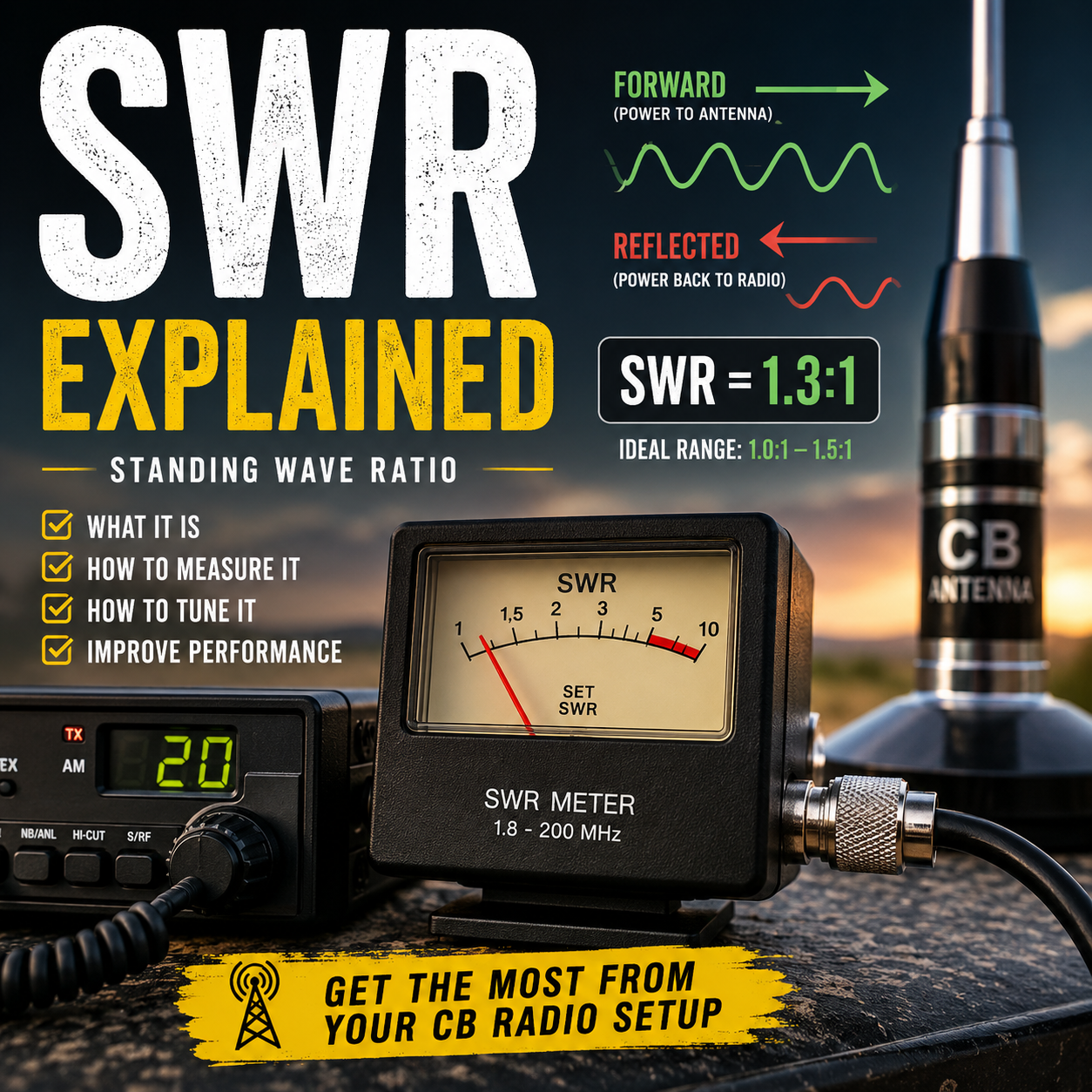
The signal heading towards the antenna is known as the forward wave. The signal returning towards the radio is known as the reflected wave.
When those two waves interact inside the coaxial cable, they create a pattern of peaks and valleys called standing waves.
The Standing Wave Ratio is simply a measurement of how severe those standing waves have become.
The greater the amount of reflected energy, the higher the SWR reading.
Why Radio Equipment Is Designed Around 50 Ohms
One of the concepts that confuses many newcomers is impedance.
Most CB radios, amateur radios, coaxial cables and antennas are designed to operate around a characteristic impedance of 50 ohms.
This isn’t a coincidence.
Decades of radio engineering have shown that 50 ohms represents an excellent compromise between power handling and efficiency.
When a radio designed for 50 ohms is connected to an antenna system that also presents 50 ohms, power transfer is highly efficient. Energy leaves the transmitter, travels through the coax and reaches the antenna with minimal reflection.
Problems begin when the antenna system no longer presents that expected impedance.
The further away the system moves from the desired value, the more energy is reflected back towards the transmitter.
This reflected energy is what creates elevated SWR readings.
A useful analogy is water flowing through pipes.
Imagine connecting a large water pipe to a much smaller one. Water doesn’t flow smoothly through the transition. Turbulence occurs because the system is mismatched.
Radio frequency energy behaves in a similar manner.
When impedance is mismatched, energy no longer flows efficiently through the system.
Instead, some of it is sent back in the opposite direction.
The Biggest Myth About SWR
One of the most common misconceptions in CB radio is that a low SWR automatically means a good antenna.
This simply isn’t true.
An antenna can have an excellent SWR and still perform poorly.
Likewise, an antenna with a slightly higher SWR may outperform it dramatically.
Consider a dummy load.
A dummy load is a device designed to absorb radio frequency energy without radiating it into the air. Many dummy loads present an almost perfect 50-ohm match to the transmitter.
As a result, they often show an SWR reading extremely close to 1:1.
From the radio’s perspective, everything looks perfect.
Yet virtually no signal is being radiated.
You could transmit into that dummy load all day and nobody would hear you.
This demonstrates an important principle.
SWR measures how well your radio is matched to the antenna system.
It does not directly measure how efficiently the antenna radiates.
Think of SWR as a health check rather than a performance score.
A low SWR tells you that the radio and antenna are working together efficiently. It does not guarantee that the antenna itself is the best design or located in the best position.
How Much Difference Does SWR Really Make?
Spend enough time around CB operators and you’ll eventually encounter somebody proudly announcing that they’ve achieved a perfect 1:1 SWR reading.
The reality is a little more nuanced.
A perfect 1:1 SWR is certainly desirable, but it isn’t always necessary, and the practical difference between a very good SWR and a perfect SWR is often much smaller than people imagine.
A station with an SWR of 1.5:1 is still delivering the overwhelming majority of its power to the antenna. In fact, the difference in radiated power between 1.2:1 and 1.5:1 is so small that it would be virtually impossible to notice during normal CB operation.
This is why experienced operators often smile when they see somebody spending hours adjusting an antenna by fractions of a millimetre in pursuit of a mathematically perfect reading.
Once you’re comfortably below 1.5:1, you’re usually into the territory of diminishing returns.
The truth is that antenna height, antenna design, location, ground plane quality and propagation conditions will often have a far greater effect on your signal than shaving a few tenths from an already excellent SWR reading.
What Happens When SWR Becomes Too High?
Most operators first learn about SWR because somebody warns them that high SWR can damage a radio.
That warning is absolutely true.
When reflected energy returns towards the transmitter, it has to go somewhere.
Older radio equipment often had little protection against excessive reflected power. The returning energy could place significant stress on the output stage of the transmitter, causing components to run hotter than intended.
Given enough time, excessive heat can damage output transistors and lead to costly repairs.
Modern radios are generally much smarter.
Many CB and amateur radio transceivers continuously monitor reflected power. If SWR rises beyond a safe level, the radio automatically reduces output power to protect itself.
While this prevents damage, it also reduces your ability to communicate effectively.
The risk becomes even greater when linear amplifiers are introduced.
Amplifiers generate significantly more RF energy than a standard CB radio. If large amounts of that power are reflected back due to a poor antenna match, damage can occur very quickly.
For this reason, experienced operators always verify SWR before transmitting at high power.
The SWR Meter: Every Operator’s First Diagnostic Tool
Long before sophisticated antenna analysers became affordable, radio operators relied on a simple device known as an SWR meter.
Even today, despite advances in technology, the humble SWR meter remains one of the most useful tools a radio enthusiast can own.
The meter sits between the radio and antenna and measures two things:
The power travelling towards the antenna and the power returning from it.
Using those values, it calculates the Standing Wave Ratio.
The process may feel intimidating at first, but it’s actually straightforward.
Connect the meter between the radio and antenna, select a channel, calibrate the meter if required, and take a reading while transmitting.
Within seconds you’ll have a clear indication of how well your antenna system is matched.
Why Measuring on One Channel Isn’t Enough
One of the biggest mistakes beginners make is checking SWR on a single channel and assuming everything is fine.
For CB radio, experienced operators typically check:
- Channel 1
- Channel 20
- Channel 40
These readings reveal how the antenna behaves across the band.
Imagine these readings:
- Channel 1: 1.2
- Channel 20: 1.4
- Channel 40: 1.8
As frequency increases, SWR increases.
This generally indicates that the antenna is slightly too long.
Now consider:
- Channel 1: 1.8
- Channel 20: 1.4
- Channel 40: 1.2
Here the SWR improves as frequency rises.
This usually indicates that the antenna is too short.
Understanding this simple relationship removes much of the mystery surrounding antenna tuning.
Tuning a Mobile Antenna
Most mobile CB antennas include some form of adjustment mechanism.
Depending on the design, this may involve an adjustable whip, grub screw, tunable tip or cut-to-length whip section.
The goal is simple.
Adjust the antenna until the lowest SWR occurs near the centre of the frequencies you intend to use.
The important thing to remember is that very small changes can produce surprisingly large results.
A few millimetres can make a noticeable difference.
If SWR is higher at the top end of the band, the antenna is generally too long.
If SWR is higher at the lower end of the band, the antenna is generally too short.
Make small adjustments and re-test after each one.
Patience almost always produces better results than guesswork.
The Vehicle Is Part of the Antenna
This is one of the most overlooked aspects of mobile CB installations.
Many operators think they’re only tuning the antenna.
In reality, they’re tuning the antenna and vehicle together as a system.
The metal bodywork of the vehicle acts as a ground plane or counterpoise.
This explains why an antenna may behave differently when mounted on:
- The centre of the roof
- The edge of the roof
- A mirror bracket
- A rear door
- A roof rack
From an RF perspective, these locations are not equal.
An antenna mounted centrally on a large metal roof often produces the most predictable results.
Move the same antenna elsewhere and both SWR and performance may change.
Why Mag Mounts Usually Work Better Than People Expect
Magnetic mount antennas often receive criticism from operators who assume they cannot perform as well as permanently mounted antennas.
In reality, many magnetic mount systems work remarkably well.
The capacitive coupling between the magnetic base and vehicle body can provide an effective RF ground connection.
A quality magnetic mount positioned correctly on a vehicle roof can achieve excellent SWR readings and strong performance.
For many operators, the difference between a good mag mount and a permanent mount is far smaller than expected.
When SWR Isn’t the Problem
One of the most valuable lessons a radio operator can learn is that not every communication problem is caused by SWR.
Imagine an operator struggling to make contacts.
They immediately assume the antenna is poorly tuned.
An SWR meter is connected.
The reading comes back at 1.3:1.
Excellent.
Yet the communication problems remain.
The issue may be:
- Poor propagation conditions
- High local noise levels
- Difficult terrain
- Lack of active operators
- A compromised antenna location
SWR is only one piece of the puzzle.
A well-performing station requires the entire system to work together.
When SWR Refuses to Cooperate
Every CB operator eventually encounters an installation that simply refuses to tune properly.
This is often where frustration begins.
The temptation is to keep adjusting the antenna endlessly, but in many cases the antenna itself isn’t the real problem.
One of the most common culprits is coaxial cable.
A cable trapped in a vehicle door can become internally damaged.
Sharp bends can affect performance.
Water ingress can completely alter the behaviour of an antenna system.
A small amount of moisture inside a connector can produce surprisingly high SWR readings.
Whenever SWR suddenly changes after months of stable operation, connectors and coax should be inspected before making major antenna adjustments.
The Connector Nobody Thinks About
The PL-259 connector has been part of radio installations for generations.
Most operators barely think about it.
Yet poorly fitted connectors remain one of the most common causes of antenna problems.
A poorly soldered centre pin, loose connection or stray strand of shielding can create intermittent faults and elevated SWR.
Many operators spend hours adjusting an antenna when the real problem is hiding inside a connector.
The Mystery of the Perfectly Tuned Antenna That Performs Poorly
Imagine two operators.
One is running a large, efficient antenna mounted centrally on a vehicle roof.
The other is using a much shorter compromise antenna mounted in a poor location.
Both achieve an SWR of 1.2:1.
From the meter’s perspective, both installations appear excellent.
On the air, however, the larger antenna may outperform the smaller antenna significantly.
This highlights an important lesson.
Antenna efficiency and SWR are related, but they are not the same thing.
The ultimate goal is communication performance, not simply achieving the lowest possible SWR reading.
Base Station Antennas and SWR
The same principles apply to base station antennas, but fixed installations introduce additional variables.
Height becomes a factor.
Nearby buildings influence radiation patterns.
Trees affect tuning.
Metal structures interact with the antenna.
Even the route taken by the coaxial cable can influence performance.
Many operators discover that an antenna tuned successfully at ground level behaves differently once installed on a mast.
The surrounding environment has changed.
For this reason, final tuning should ideally be performed with the antenna installed in its intended operating position.
SWR on SSB
Single Sideband operation doesn’t change the laws of physics.
SWR behaves exactly the same way.
However, SSB operators often become more focused on antenna performance because they are regularly attempting longer-distance contacts.
When you’re chasing stations hundreds or thousands of miles away, every part of the station becomes more important.
This is one reason why antenna discussions are so common among DX enthusiasts.
Modern Antenna Analysers
Today’s operators have access to tools that previous generations could only dream of.
Devices such as the NanoVNA and professional antenna analysers provide an extraordinary amount of information.
Rather than simply displaying SWR, they can reveal:
- Resonant frequency
- Impedance
- Reactance
- Bandwidth
- Return loss
- SWR across an entire frequency range
Instead of checking a handful of channels manually, operators can view the behaviour of an antenna across an entire band in seconds.
For many enthusiasts, using an antenna analyser for the first time completely changes how they approach antenna tuning.
Common SWR Myths
SWR is surrounded by myths.
One of the oldest is the belief that changing coax length fixes SWR.
While changing coax length can sometimes alter what the meter displays, it does not correct the underlying mismatch.
Another myth is that every antenna should achieve a perfect 1:1 reading.
Many excellent antenna systems operate perfectly with readings around 1.3:1 or 1.5:1.
A third misconception is that SWR directly determines transmission range.
In reality, range depends on many factors including antenna efficiency, terrain, propagation conditions, height and local noise levels.
SWR is important, but it is only one part of the equation.
A Practical Troubleshooting Process
When faced with high SWR, experienced operators tend to follow a logical process.
First, verify the meter.
Then inspect every connector carefully.
Check the coax for damage.
Confirm the antenna mount is secure and correctly grounded where required.
Ensure the antenna whip hasn’t moved.
Only then should significant tuning adjustments begin.
This systematic approach often identifies faults much faster than endless antenna adjustments.
The Real Goal
It’s easy to become obsessed with numbers.
Many radio enthusiasts have spent entire afternoons chasing tiny improvements in SWR.
There is nothing wrong with striving for excellence, but it’s important to remember the true purpose of antenna tuning.
The goal is not to achieve a perfect reading.
The goal is to communicate effectively.
If your antenna shows a healthy SWR, your radio is operating safely and you’re making the contacts you want to make, then your station is doing exactly what it was designed to do.
Final Thoughts
Standing Wave Ratio is one of the most important concepts in CB radio and amateur radio, yet it is often misunderstood.
At its heart, SWR is simply a measure of how efficiently power is being transferred between your radio and antenna system.
A low SWR helps ensure transmitter power reaches the antenna rather than being reflected back towards the radio. It protects equipment, improves efficiency and provides confidence that the station is operating correctly.
However, SWR should never be viewed in isolation.
Antenna design, mounting position, ground plane quality, coaxial cable condition and operating environment all contribute to overall performance.
For new operators, learning to measure and interpret SWR is one of the most valuable skills you can develop. It transforms antenna tuning from guesswork into a logical process and provides a deeper understanding of how radio systems actually work.
Whether you’re running a compact mobile CB installation, a home base station or experimenting with amateur radio bands, understanding SWR will help you get the very best from your equipment and enjoy the hobby with greater confidence.
The next time somebody asks, “What’s your SWR?”, you’ll know exactly why the question matters
Related articles
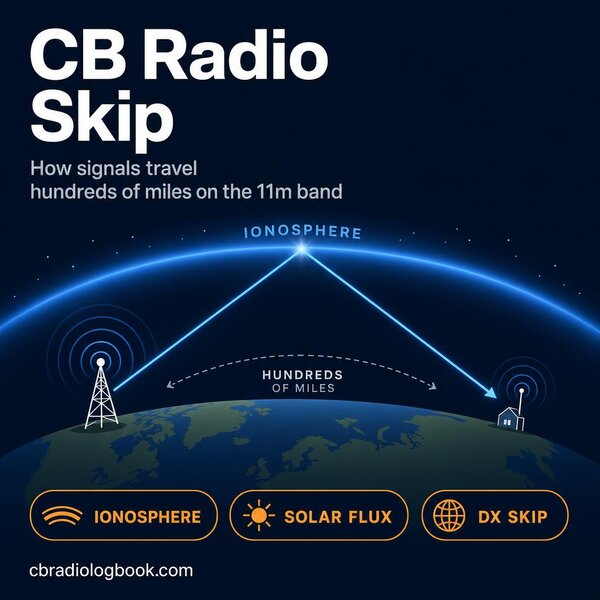
CB Radio Skip: The Fascinating Science Behind Long-Distance Communication on the 11 Metre Band
Discover the science behind CB radio skip on the 11 metre band — how the ionosphere, solar activity and Sporadic E let your signal travel hundreds or thousands of miles.

CB Radio Frequencies: The Complete UK, European & US Channel Guide
Discover all CB radio frequencies used in the UK, Europe and the USA. Complete CB channel frequency charts, the difference between UK and CEPT channels, and the best frequencies for local contacts, truckers and DX.
Join the CB Radio Logbook
Track every QSO, map your contacts, and connect with operators near you. Create your free account and get on the air.
Create your account