Single Sideband (SSB) Explained: Why Serious DX Operators Choose It
For many CB radio operators, the journey starts on FM or AM. These modes are simple, easy to use, and available on almost every CB radio sold in the UK and Europe. They work well for local communication, mobile operation, and everyday conversations.
Eventually, however, most operators hear people talking about another mode entirely: Single Sideband, usually shortened to SSB.
Suddenly conversations appear on channels that seemed quiet moments before. Operators are making contacts hundreds or even thousands of miles away with relatively modest equipment. During periods of strong propagation, stations from across Europe, North America, South America, and beyond can be heard calling one another on frequencies that sound almost empty to FM users.
For many enthusiasts, discovering SSB is the moment CB radio transforms from a local hobby into a worldwide one.
Understanding why requires a look at how SSB actually works.
What Is Single Sideband?
Single Sideband is a type of radio transmission mode derived from AM, or Amplitude Modulation.
To understand SSB properly, it helps to understand what happens when a traditional AM signal is transmitted.
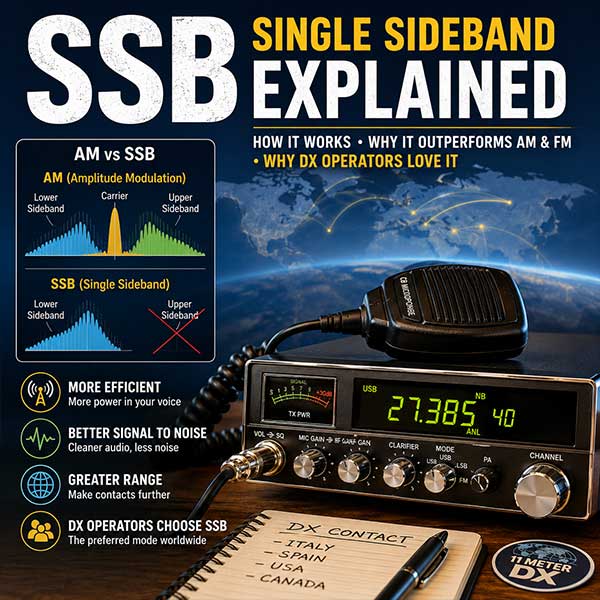
A standard AM transmission consists of three components:
- A carrier signal
- An upper sideband
- A lower sideband
The carrier sits in the centre frequency and acts as a reference point. The two sidebands contain identical copies of the voice information being transmitted.
In other words, AM sends the same audio information twice while also transmitting a carrier that contains no voice information at all.
This approach works well and makes reception simple, but it is highly inefficient.
Single Sideband removes the waste.
Instead of transmitting all three components, SSB removes the carrier and one of the sidebands, leaving only a single sideband carrying the voice information.
This dramatically reduces the bandwidth required while concentrating transmitter power into the remaining signal.
The result is a mode that can travel significantly further using the same power output.
Upper Sideband and Lower Sideband
There are actually two forms of SSB:
- USB — Upper Sideband
- LSB — Lower Sideband
Both contain the same voice information.
The only difference is which sideband remains after the carrier and opposite sideband are removed.
On CB radio, most SSB operators typically use USB, especially for 11 metre DX activity.
For practical CB operation, USB is the standard mode you are most likely to encounter.
How SSB Sounds
The first time you listen to an SSB transmission without selecting the correct mode, it sounds strange.
Voices may sound:
- High-pitched
- Warbling
- Distorted
- Robotic
- Completely unintelligible
This is because SSB receivers must recreate the missing carrier signal.
When the receiver is correctly tuned, the voice becomes natural and clear.
Because of this requirement, SSB radios usually include a Clarifier or Fine Tune control.
This allows operators to make small frequency adjustments until the received audio sounds correct.
During DX conditions, you will often hear operators saying things such as:
You’re slightly off frequency.
or:
Give your clarifier a tweak.
These are normal parts of SSB operation.
Why SSB Is More Efficient
The main advantage of SSB is efficiency.
Imagine two operators each using the same power output.
Operator A transmits on AM.
Operator B transmits on SSB.
The AM station must divide its power between:
- The carrier
- The upper sideband
- The lower sideband
The SSB station places almost all available power into a single sideband carrying voice information.
As a result, the SSB signal is often considerably stronger at the receiving end.
This increased efficiency allows operators to achieve longer-range contacts without increasing transmitter power.
It is one of the reasons SSB became the preferred mode for long-distance communication worldwide.
Better Signal-to-Noise Performance
Anyone who has spent time listening to weak signals knows that noise is often the enemy.
Static, electrical interference, atmospheric noise, vehicle electronics and power supplies can all reduce readability.
Because SSB uses a narrower bandwidth than AM, less noise enters the receiver.
This means weak stations can often remain readable when AM signals disappear into the background noise.
For DX operators trying to pull distant stations out of crowded conditions, this advantage is enormous.
Greater Effective Range
One of the most noticeable benefits of SSB is increased range.
Even under ordinary conditions, SSB typically allows communication over greater distances than FM or AM using identical equipment and power levels.
A station that is barely readable on AM may be perfectly workable on SSB.
This does not mean SSB magically creates power.
Instead, it uses available power far more effectively.
The practical result is the same: more successful contacts.
Why DX Operators Love SSB
If you have spent time around the DX community, you will quickly notice that most serious long-distance operators favour SSB.
There are several reasons.
Improved Weak Signal Performance
DX contacts are often weak.
Signals may travel hundreds or thousands of miles through the ionosphere before reaching your antenna.
Every bit of efficiency matters.
SSB helps preserve intelligibility where other modes struggle.
More Contacts During Skip Conditions
When propagation opens up, stations from across the world can appear on the band simultaneously.
The improved efficiency of SSB means operators can often work stations that AM users cannot.
Many memorable DX contacts are only possible because SSB provides enough signal strength and clarity to complete the conversation.
Reduced Interference
When skip is active, channels can become crowded.
Hundreds of stations may be calling simultaneously.
SSB’s narrower bandwidth helps reduce overlap and interference, making it easier to separate stations.
International Standard for DX
Across the global CB community, SSB has become the preferred mode for serious DX work.
Most experienced DX operators naturally migrate towards SSB channels when conditions are favourable.
If your goal is worldwide contacts, SSB is where much of the action happens.
What Is Skip and Why Does SSB Excel At It?
Skip occurs when radio signals bounce off ionised layers in the atmosphere and return to Earth hundreds or thousands of miles away.
During periods of strong solar activity, the 11 metre CB band can become extremely active.
Operators in the UK may suddenly hear stations from:
- Spain
- Italy
- France
- Germany
- Poland
- Scandinavia
- North America
- South America
Under exceptional conditions, contacts spanning several thousand miles become possible.
SSB thrives in these conditions because it maximises the effectiveness of every watt transmitted.
When signals are weak after travelling enormous distances, efficiency becomes critical.
Is SSB Harder to Use?
Not really.
There is a slight learning curve compared to FM.
New operators need to become familiar with:
- USB mode
- Clarifier adjustments
- Fine tuning signals
- Operating etiquette during DX pile-ups
Most users become comfortable within a few hours of operation.
After that, using SSB becomes second nature.
In fact, many operators who buy an SSB-capable radio find themselves spending most of their time on sideband once they experience successful DX contacts.
Do You Need a Special Radio?
Yes.
A standard FM-only CB radio cannot transmit or receive SSB signals.
To operate on SSB, you need a radio that specifically supports:
- USB — Upper Sideband
- LSB — Lower Sideband
Popular examples include:
- President McKinley
- President George II
- President Lincoln II+
- CRT SS 9900 V
Many operators regard an SSB radio as the natural upgrade once they become interested in DX operation.
Antennas Matter More Than Ever
While SSB offers significant advantages, it cannot compensate for a poor antenna system.
The best results come from:
- A properly tuned antenna
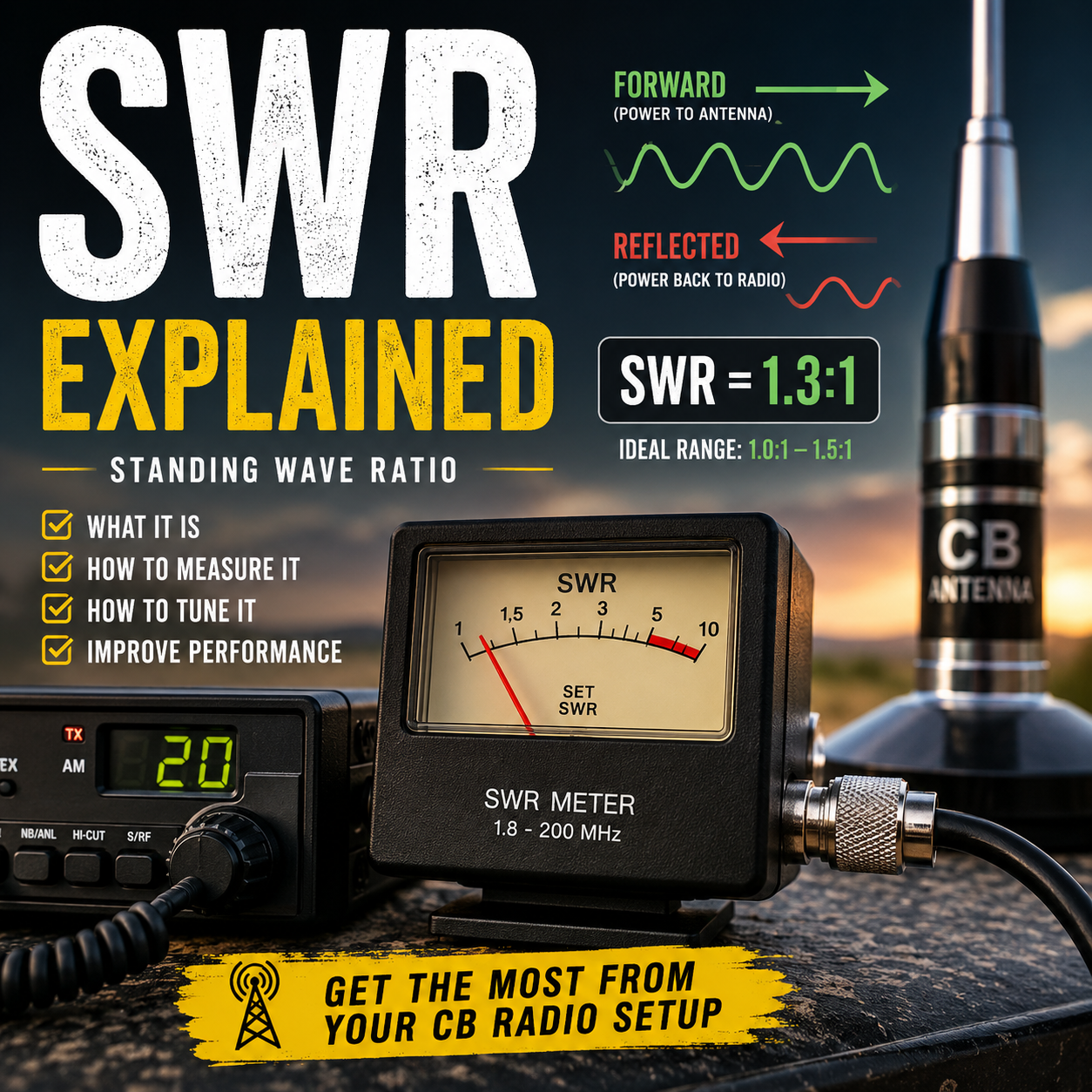
- Low SWR
- Good coaxial cable
- Effective grounding where appropriate
- Careful installation
Many operators discover that upgrading their antenna provides even greater benefits than upgrading their radio.
SSB allows you to take full advantage of those improvements.
Common SSB Terminology
When listening to sideband operators, you will often hear phrases such as:
QSL?
Did you receive my transmission?
You’re 5 and 9
This means the station is giving you an excellent signal and readability report.
Stand by
Wait a moment.
QRZ?
Who is calling me?
DX Station
A long-distance station.
Pile-Up
Multiple operators attempting to contact the same station simultaneously.
Understanding these terms makes participation much easier.
The Moment Most Operators Get Hooked
Almost every SSB enthusiast has a story.
Perhaps it was hearing Italy from a driveway in Derbyshire.
Maybe it was making a first contact into North America.
Or perhaps it was simply hearing dozens of countries on a band that seemed quiet the previous day.
That first successful DX contact often changes how operators view CB radio forever.
The hobby suddenly becomes much bigger than local conversations.
Instead of speaking to operators a few miles away, you are exchanging signal reports with stations hundreds or thousands of miles distant using equipment that fits comfortably in a vehicle or home shack.
Final Thoughts
Single Sideband is one of the most important developments in radio communication. By removing unnecessary components from a traditional AM signal, SSB uses transmitter power far more efficiently, delivers better weak-signal performance, and significantly improves long-distance communication potential.
For local contacts, FM remains simple and reliable. For traditional operation, AM still has its place. But when the goal is chasing distant stations and taking advantage of favourable propagation conditions, SSB stands in a class of its own.
It is no coincidence that when the skip starts rolling and DX operators begin filling the airwaves, the majority of them are reaching for the USB button.
For many CB enthusiasts, SSB is not simply another mode.
It is where the real DX adventure begins.
Related articles
Join the CB Radio Logbook
Track every QSO, map your contacts, and connect with operators near you. Create your free account and get on the air.
Create your account