
How CB Radio Helped Before Mobile Phones
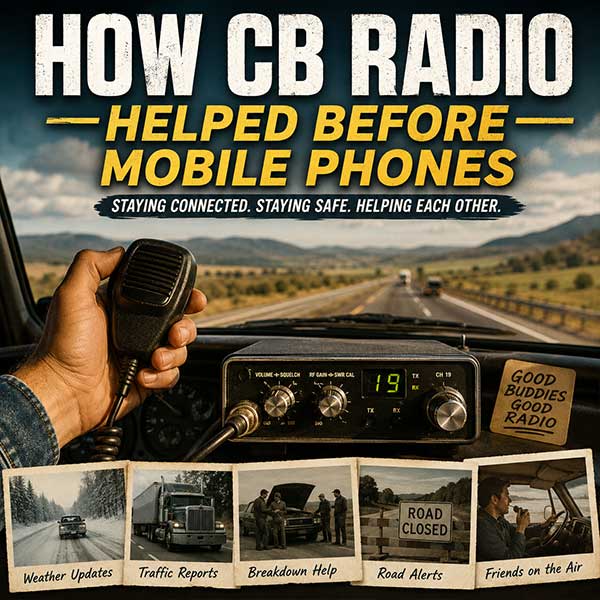
Before smartphones, mobile internet, satellite navigation, and instant messaging, staying connected while travelling was far more difficult than it is today. If you broke down on a remote road, became stuck in traffic, encountered severe weather, or simply wanted to know what was happening further ahead on your route, there was no quick search on Google Maps and no WhatsApp message to a friend.
For millions of people around the world, Citizens Band radio, better known as CB radio, filled that communication gap.
Long before mobile phones became affordable and reliable, CB radio created one of the first truly mobile social networks. It allowed drivers, travellers, businesses, hobbyists, and emergency responders to communicate instantly over the airwaves. In many situations, it was not simply a convenience. It was a vital lifeline.
Today CB radio is often viewed as a hobby, but its historical role in transport, safety, and emergency communications is impossible to overstate.
Life Before Mobile Communication
To understand why CB radio became so important, it is worth remembering how communication worked before the digital age.
If someone left home in their vehicle, they effectively became unreachable. Once they drove away, there was usually no practical way to contact them until they reached their destination and found a landline telephone.
If a vehicle broke down, the options were limited:
- Walk to the nearest phone box.
- Flag down a passing motorist.
- Wait for assistance.
- Hope somebody could help.
For long-distance drivers this could become a serious problem. Many routes passed through rural areas where telephones were scarce and traffic could be light, especially overnight.
CB radio changed everything.
By installing a radio and antenna in a vehicle, drivers suddenly gained the ability to speak with other operators nearby. Communication became immediate, mobile, and available almost anywhere road users travelled.
The Rise of CB Radio
CB radio was originally developed as a short-range personal radio service.
By the 1970s and 1980s, CB radio exploded in popularity across many countries, particularly in the United States and later in the United Kingdom.
Millions of people installed radios in:
- Cars
- Lorries
- Vans
- Motorhomes
- Agricultural vehicles
- Boats
- Home stations
For the first time, ordinary people could communicate over radio without needing an amateur radio licence.
The result was a vast network of operators who could share information, assistance, and companionship wherever they happened to be.
The Original Road Information Network
Today most drivers rely on navigation apps for live traffic updates.
Before these systems existed, CB radio performed much of the same role.
Drivers routinely exchanged information about:
- Traffic jams
- Road closures
- Accidents
- Diversions
- Vehicle breakdowns
- Dangerous weather
- Flooded roads
- Police activity
- Fuel shortages
A driver encountering a major traffic incident could immediately warn others travelling in the same direction.
Messages often spread rapidly from vehicle to vehicle, allowing information to travel dozens or even hundreds of miles through relayed reports.
Many professional drivers relied on these updates every day.
Helping Stranded Motorists
One of the most valuable uses of CB radio was assisting motorists who became stranded.
Imagine a family travelling across the country in the early 1980s.
Their vehicle develops a fault on a remote road.
There is no mobile phone. No internet. No roadside assistance app. No GPS location sharing.
With a CB radio, they could simply call for help.
Nearby operators might:
- Provide directions.
- Contact local assistance.
- Relay messages.
- Offer mechanical advice.
- Physically stop to help.
Countless stories emerged of operators helping complete strangers recover from breakdowns and emergencies.
Many CB communities developed a reputation for looking after one another, regardless of whether they had met before.
Emergency Communications
Although CB radio was never designed to replace emergency services, it frequently played a role in emergencies.
Operators used CB radio to report:
- Vehicle collisions
- Medical emergencies
- Severe weather events
- Missing persons
- Fires
- Flooding incidents
Before widespread mobile phone ownership, CB operators often acted as communication intermediaries.
A typical situation might involve:
- An operator witnesses an accident.
- They call nearby stations for assistance.
- Another operator closer to a telephone contacts emergency services.
- Information is relayed back over the radio.
This process may seem slow by modern standards, but at the time it could significantly reduce response times compared with waiting for someone to find a telephone.
The Trucking Community
No group embraced CB radio more enthusiastically than professional drivers.
Lorry drivers quickly recognised its value for daily operations.
Drivers could share information about:
- Traffic conditions
- Loading delays
- Roadworks
- Weather hazards
- Fuel availability
- Parking locations
Long hours behind the wheel could also be isolating.
CB radio provided companionship during overnight journeys and lengthy motorway runs.
Many friendships formed entirely through conversations conducted over the airwaves.
Regular operators became familiar voices even if they never met face-to-face.
For some drivers, the radio became as important as the vehicle itself.
Building Communities on the Air
CB radio was never solely about practical communication.
It also became a social phenomenon.
Operators adopted handles or nicknames and spent hours chatting with friends across their local area.
Local groups formed naturally around popular channels.
Many communities organised:
- Meetups
- Convoys
- Charity events
- Social gatherings
- Club nights
The term “eyeball” became popular for meeting someone in person after first knowing them only through radio conversations.
In many ways, CB radio created social networks decades before the internet arrived.
The difference was that these communities existed entirely through voice communication over the air.
CB Radio During Severe Weather
Severe weather often disrupted traditional communications and travel.
Snowstorms, flooding, and high winds could isolate communities and create dangerous driving conditions.
CB operators frequently became informal information hubs during these events.
Drivers would report:
- Impassable roads
- Snow drifts
- Flooded routes
- Fallen trees
- Vehicle accidents
This information allowed others to make safer travel decisions.
In some cases, CB radio remained operational even when telephone services were disrupted.
Rural Areas Benefited Most
The value of CB radio was particularly noticeable in rural areas.
Remote villages and countryside roads often had limited access to telephones.
If a problem occurred miles from the nearest town, CB radio could provide the fastest way to reach somebody capable of helping.
Farmers, contractors, delivery drivers, and local residents often relied on radio communication long before mobile networks provided reliable coverage.
Even today, some rural areas still experience mobile signal issues, reminding operators why radio communication remains relevant.
Family Travel and Holiday Convoys
CB radio became extremely popular among families travelling together.
Multiple vehicles could remain in constant contact throughout a journey.
Parents could:
- Coordinate fuel stops.
- Warn of hazards.
- Discuss route changes.
- Check on other vehicles.
Holiday convoys became far easier to manage.
Rather than relying on hand signals or hoping nobody took a wrong turn, drivers could simply talk to one another in real time.
This use case remains popular among caravan owners, motorhome enthusiasts, and organised vehicle groups today.
The Arrival of Mobile Phones
The widespread adoption of mobile phones during the 1990s and early 2000s inevitably reduced CB radio's importance as an emergency communication tool.
Suddenly drivers could:
- Call roadside assistance directly.
- Contact family instantly.
- Use GPS navigation.
- Access traffic reports online.
Many people assumed CB radio would disappear entirely.
Instead, it evolved.
The hobby shifted from being primarily a necessity to becoming a blend of communication, community, and technical interest.
Why CB Radio Still Matters
Modern smartphones are incredibly powerful, but they depend upon infrastructure.
They require:
- Mobile phone towers
- Internet connectivity
- Network availability
- Sufficient battery power
CB radio works differently.
Two nearby stations can communicate directly without relying on any external network.
This independence remains one of radio's greatest strengths.
During network outages, remote travel, outdoor activities, or major events, radio communication can still provide valuable backup capability.
Lessons From the Past
Looking back at the history of CB radio reveals something remarkable.
What many people now view as a hobby was once an essential communication tool that helped millions of motorists, truck drivers, families, and communities stay connected.
Before mobile phones became common, CB radio provided:
- Real-time traffic updates
- Emergency assistance
- Road safety information
- Driver companionship
- Community connections
- A communication lifeline in remote areas
It helped stranded motorists get home, allowed drivers to avoid hazards, connected isolated travellers, and built friendships that often lasted a lifetime.
While technology has changed dramatically, the spirit that made CB radio so valuable remains exactly the same today: ordinary people helping other ordinary people through the simple power of radio communication.
For many operators, that is still what makes CB radio special.
Related articles
Join the CB Radio Logbook
Track every QSO, map your contacts, and connect with operators near you. Create your free account and get on the air.
Create your account