CB Radio vs Ham Radio: What's the Difference and Which Is Right for You?
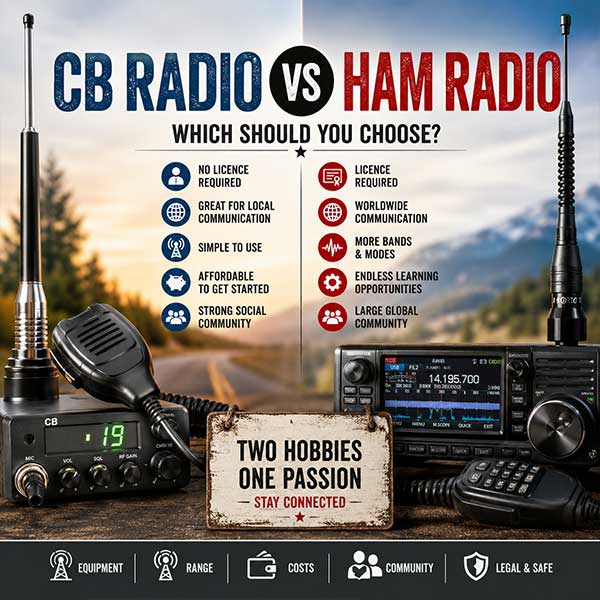
For anyone interested in two-way radio, one of the first questions that inevitably arises is whether to choose CB radio or amateur (ham) radio. At first glance they can appear remarkably similar. Both allow people to communicate over the air without relying on mobile phone networks or the internet. Both have enthusiastic communities, decades of history and the potential to connect people across towns, countries and, under the right conditions, even continents.
Look a little closer, however, and the differences become much more significant. CB radio was designed to provide a simple, licence-free communications service that almost anyone can use. Amateur radio, by contrast, is a licensed hobby that offers access to a huge range of frequencies, operating modes and technical experimentation opportunities.
Neither hobby is objectively better than the other. They simply appeal to different people for different reasons. Some operators enjoy the straightforward, social nature of CB radio, while others relish the technical challenges and worldwide communication possibilities offered by amateur radio. Many enthusiasts eventually discover there is no need to choose at all—they enjoy both.
This guide compares every important aspect of the two hobbies, including licensing, equipment, frequencies, operating range, costs, antennas, legal requirements, emergency communications and community culture. Whether you're buying your very first radio or wondering whether it's worth progressing to an amateur licence, this article will help you make an informed decision.
What Is CB Radio?
Citizens' Band radio, usually shortened to CB radio, is a short-range two-way radio service intended for personal communications. In the United Kingdom it operates on the 27 MHz band, commonly referred to as the 11-metre band.
Unlike amateur radio, CB radio is designed to be accessible to everyone. There are no examinations to pass, no licences to purchase and no callsigns allocated by the regulator. As long as you use approved equipment within the legal operating conditions, you are free to get on the air.
Modern CB radio supports several operating modes including FM, AM and Single Sideband (SSB), depending on the equipment being used. This versatility allows operators to enjoy local conversations, participate in organised radio nets and, when propagation conditions are favourable, make surprisingly long-distance contacts using natural atmospheric phenomena.
What Can You Use CB Radio For?
Although many people still associate CB radio exclusively with truck drivers, the hobby has evolved considerably over the last few decades. Today's operators come from many different backgrounds and enjoy CB for a wide variety of reasons.
- Talking to local operators.
- Keeping in touch during road trips or convoys.
- Camping and off-road communication.
- Green-laning and 4x4 events.
- Agricultural and rural communication.
- Participating in scheduled radio nets.
- DX (long-distance) contacts using atmospheric propagation.
- Learning basic radio operating skills.
- Emergency backup communications when mobile networks fail.
Many operators also enjoy recording their contacts, comparing station performance and meeting fellow enthusiasts. Platforms such as CB Radio Logbook make it easier to log QSOs, discover organised nets, earn operating badges and connect with other operators throughout the UK and beyond.
Why CB Radio Remains Popular
CB radio has experienced several waves of popularity since its introduction. While the huge boom of the early 1980s is often remembered most fondly, the hobby has never truly disappeared.
Recent years have seen renewed interest driven by several factors:
- Affordable modern equipment.
- The legalisation of AM and SSB in the UK.
- Growing interest in preparedness and resilient communications.
- The popularity of overlanding and off-road adventures.
- The social aspect of talking to people without relying on the internet.
- Online communities introducing new people to the hobby.
Unlike many forms of modern communication, CB conversations happen in real time with whoever happens to be listening. Every contact feels a little different, and that unpredictability is part of the hobby's enduring appeal.
What Is Ham (Amateur) Radio?
Amateur radio—often called ham radio—is a licensed radio service intended for self-training, technical investigation, experimentation and international goodwill. It offers operators access to a far wider range of frequencies than CB radio, along with significantly greater flexibility in how those frequencies can be used.
To become a licensed amateur radio operator in the UK, applicants must pass an examination and receive a licence issued by Ofcom. This demonstrates an understanding of radio theory, operating practices, safety and the legal responsibilities associated with transmitting on the amateur bands.
Once licensed, operators gain access to numerous frequency allocations stretching from long-wave bands through to microwave frequencies. Depending on their licence level, they may also use higher transmitter powers, build their own equipment and experiment with a wide range of communication techniques.
What Do Amateur Radio Operators Do?
The amateur radio hobby encompasses an enormous range of interests. While some operators simply enjoy chatting with local stations, others spend years specialising in particular aspects of the hobby.
- Worldwide DX communication.
- Portable hilltop operating.
- Satellite communication.
- Morse code.
- Digital voice modes.
- Digital data communications.
- Emergency communication exercises.
- Contesting.
- Antenna experimentation.
- Home-built transmitters and receivers.
- Space communication projects.
- Propagation research.
This diversity is one of amateur radio's greatest strengths. Two licensed operators may share the same hobby while enjoying completely different activities.
Why Is It Called "Ham Radio"?
The exact origin of the word "ham" remains uncertain and has been debated for decades. One popular theory suggests it began as a light-hearted term used by professional telegraph operators to describe amateur enthusiasts before eventually being adopted by the amateur community itself.
Today the term is used affectionately around the world, and "ham radio" has become synonymous with amateur radio in many countries, although "amateur radio" remains the formal name of the licensed service.
The History of CB and Amateur Radio
Although both services involve two-way radio communication, they were created for very different purposes.
Amateur radio has the longer history. Experimental wireless enthusiasts were transmitting long before governments established formal licensing systems. Throughout the early twentieth century, amateur operators played an important role in developing radio technology, antenna design and long-distance communication techniques. Many innovations later adopted commercially were first explored by radio amateurs.
CB radio arrived much later as a simplified personal communications service. Rather than encouraging technical experimentation, its purpose was to provide an easy-to-use radio service for ordinary members of the public and businesses.
In the United Kingdom, CB radio exploded in popularity during the early 1980s. Enthusiasts fitted radios to cars, vans and home stations, creating vibrant local communities that often continued long after the initial craze faded.
Amateur radio followed a different path. Although generally smaller in numbers, the hobby steadily expanded through clubs, technical societies, emergency communications groups and international organisations. Today it remains one of the world's most diverse technical hobbies, embracing everything from traditional Morse code through to digital networking and satellite communications.
Despite their different origins, both hobbies continue to thrive because they offer something increasingly rare in the digital age: direct person-to-person communication without depending on commercial infrastructure.
```htmlThe Key Differences at a Glance
Before diving into the finer details, it helps to understand the fundamental differences between CB radio and amateur radio. While both involve transmitting and receiving radio signals, they were created with different objectives and are governed by different regulations.
CB radio prioritises accessibility. Anyone can purchase a compliant radio, install an antenna and begin communicating without studying for an examination or applying for a licence. Amateur radio, on the other hand, rewards additional knowledge by granting access to many more frequency bands, higher power limits and a far wider range of operating modes.
Neither approach is inherently superior. Some people simply want an easy way to talk to nearby operators while travelling or enjoying the outdoors. Others are fascinated by radio theory, antenna design, propagation and worldwide communications. Many eventually find themselves enjoying both hobbies side by side.
| Feature | CB Radio | Ham (Amateur) Radio |
|---|---|---|
| Licence Required? | No (UK licence exempt) | Yes |
| Typical Equipment Cost | £70–£300+ | £30–£1,000+ |
| Operating Frequencies | 27 MHz (11 metres) | Multiple HF, VHF, UHF and microwave bands |
| Legal Power Limits | Up to 4W AM/FM, 12W PEP SSB (UK) | Varies by licence level |
| Typical Local Range | 3–20 miles | Varies greatly depending on band and equipment |
| Worldwide Contacts | Possible using SSB during favourable propagation | Common on many HF bands |
| Mobile Operation | Excellent | Excellent |
| Base Stations | Common | Very common |
| Ease of Getting Started | Very Easy | Moderate |
| Technical Knowledge Required | Minimal | Moderate to Advanced |
| Community Focus | Social conversations, local contacts and DX | Technical experimentation, DX, public service and specialist activities |
| Best Suited For | Beginners, motorists, outdoor users and casual operators | Enthusiasts seeking technical depth and worldwide communication |
Licensing
One of the biggest differences between CB radio and amateur radio is how each service is regulated.
The licensing requirements shape almost every aspect of the hobby, from transmitter power and operating frequencies through to the responsibilities placed upon operators. Understanding these differences is essential before deciding which path is right for you.
Why Is CB Radio Licence Exempt?
CB radio was designed to be a public communications service that almost anyone could use safely. Over the years, improvements in equipment standards and radio regulation allowed the UK to move away from individual licensing.
Today, CB radio is licence exempt in the United Kingdom. This means you do not need to apply to Ofcom, pay an annual fee or sit an examination before transmitting.
Instead, users simply need to:
- Use equipment that complies with current UK regulations.
- Operate on authorised CB frequencies.
- Stay within the permitted transmitter power limits.
- Avoid causing harmful interference.
This simplicity is one of CB radio's greatest strengths. A newcomer can purchase a radio, install an antenna correctly and be making contacts the very same day.
Why Does Amateur Radio Require a Licence?
Amateur radio provides considerably greater privileges than CB radio.
Licensed operators gain access to dozens of frequency allocations, higher transmitter powers, specialist operating modes and the ability to experiment with equipment in ways that would not be appropriate on licence-free services.
Because of these additional privileges, regulators require operators to demonstrate an understanding of:
- Radio theory.
- Operating procedures.
- Electrical safety.
- Electromagnetic compatibility.
- Licence conditions.
- Responsible spectrum use.
The licensing system helps ensure that amateur bands remain organised and interference is minimised while allowing operators considerable technical freedom.
UK Amateur Radio Licence Levels
The UK currently offers three progressive amateur radio licence levels. Each builds upon the previous one and grants increasing operating privileges.
Foundation Licence
The Foundation Licence is intended for newcomers and provides an accessible introduction to amateur radio. The syllabus covers essential radio theory, safe operating practices and the legal responsibilities of transmitting.
Many operators begin here before later progressing to higher licence classes.
Intermediate Licence
The Intermediate Licence introduces more technical subjects, including electronics, antenna systems and station construction. Operators gain access to additional privileges and greater transmitter power.
Full Licence
The Full Licence represents the highest UK amateur qualification.
Operators are expected to possess a deeper understanding of radio engineering, propagation, operating procedures and regulatory requirements. This licence provides the widest operating privileges available within the UK amateur service.
Is the Amateur Radio Exam Difficult?
Many beginners worry that the amateur radio examination will be extremely challenging. In reality, most people who spend time studying the official training material find the Foundation examination very achievable.
You do not need a degree in electronics, nor do you need to memorise complex mathematical formulae.
The emphasis is on understanding:
- How radios work.
- Safe station operation.
- Basic electronics.
- Operating etiquette.
- Licence conditions.
Many amateur radio clubs actively encourage newcomers by providing training evenings, practical demonstrations and mentoring throughout the learning process.
Why Many Operators Enjoy Studying
One of the unexpected benefits of gaining an amateur licence is the learning journey itself.
Studying helps operators understand why antennas behave differently, how radio waves travel, why certain bands perform better at different times of day and how equipment can be optimised.
Even operators who began on CB often discover that studying for an amateur licence improves their understanding of radio generally, making them better operators regardless of which service they use most often.
Frequencies Used by CB and Ham Radio
Although both hobbies involve radio communication, they occupy very different parts of the radio spectrum.
CB Radio Frequencies
UK CB radio operates on the 27 MHz Citizens' Band allocation, commonly known as the 11-metre band.
Modern UK operators have access to both the original UK-specific channels and the CEPT (European) channels, depending on their equipment. Radios supporting FM, AM and SSB provide even greater flexibility while remaining within current UK regulations.
Because every CB operator shares the same relatively small group of channels, activity naturally concentrates on recognised calling channels and popular meeting frequencies.
Amateur Radio Bands
Amateur radio operators have access to many different frequency bands spanning an enormous range of the radio spectrum.
Popular amateur allocations include:
- 160 metres
- 80 metres
- 60 metres
- 40 metres
- 30 metres
- 20 metres
- 17 metres
- 15 metres
- 12 metres
- 10 metres
- 6 metres
- 2 metres
- 70 centimetres
- Higher microwave allocations
Each band behaves differently depending upon frequency, antenna design, time of day, season and solar activity. This variety is one of amateur radio's greatest attractions because operators can choose the most suitable band for local conversations, regional communication or worldwide DX.
Can CB and Ham Radios Talk to Each Other?
No—not directly.
CB radios are designed specifically for the Citizens' Band frequencies around 27 MHz, while amateur radios are intended to operate only on the amateur bands authorised by the operator's licence.
Even if two radios appear physically similar, transmitting outside the frequencies permitted for the equipment or licence would generally be unlawful.
Some amateur transceivers are technically capable of operating near the CB band after modification, but transmitting on frequencies for which the equipment or operator is not authorised should always be avoided.
Legal Power Limits
Power output is another area where CB radio and amateur radio differ significantly.
CB Radio Power Limits
Current UK regulations permit compliant CB equipment to transmit using:
- 4 watts carrier power on FM.
- 4 watts carrier power on AM.
- 12 watts PEP on Single Sideband.
Although these figures may sound modest, efficient antennas, good installation practices and favourable propagation conditions often have a far greater effect on communication range than transmitter power alone.
Many experienced CB operators would rather improve their antenna system than increase transmitter power, as antenna performance usually provides much greater gains in real-world communication.
Amateur Radio Power Limits
Amateur radio operators may use considerably higher transmitter powers, depending upon their licence level and the band being used.
However, higher power does not automatically guarantee better communication.
A well-designed antenna, low-loss feedline, quiet receiving location and a good understanding of propagation frequently contribute more to successful contacts than simply transmitting more watts.
Experienced amateur operators often say that effective operating technique is every bit as important as transmitter power, especially when attempting long-distance contacts.
```htmlRange Comparison
Perhaps the most common question asked by newcomers is, "Which has the greater range: CB radio or ham radio?" The honest answer is that it depends entirely on the equipment being used, the antennas installed, the frequencies involved and, most importantly, current propagation conditions.
Neither hobby has a single fixed range. Radio waves behave differently depending on terrain, weather, solar activity, surrounding buildings and even the time of day. A station that reaches only a few miles one afternoon may make contacts hundreds or even thousands of miles away on another day without changing any equipment.
Rather than chasing maximum distance, experienced operators focus on building the best station they can. A quality antenna, correctly installed and properly tuned, almost always delivers a greater improvement than simply buying a more powerful radio.
Typical CB Radio Range
Under normal local conditions, a legal UK CB radio installation typically provides the following ranges.
| Station Type | Typical Range |
|---|---|
| Handheld to handheld | 0.5–3 miles |
| Mobile to mobile | 3–15 miles |
| Mobile to well-sited base station | 10–25 miles |
| Two elevated base stations | 20–50+ miles (terrain dependent) |
These figures are realistic rather than optimistic. Hills, forests, dense urban environments and poor antenna installations can reduce range significantly, while elevated locations and efficient antennas can increase it.
Mobile-to-Mobile Communication
One of CB radio's greatest strengths is vehicle-to-vehicle communication.
Whether travelling in a convoy, exploring green lanes, driving agricultural machinery or touring with friends, CB provides instant communication without relying on mobile phone coverage.
A pair of properly installed mobile stations fitted with quality antennas can often maintain reliable communication over several miles, even in rolling countryside.
This simplicity explains why CB remains popular with:
- 4x4 enthusiasts.
- Car clubs.
- Motorhome owners.
- Camping groups.
- Farmers.
- Road users.
Home Base Stations
A home base station generally outperforms a mobile installation because the antenna can be mounted much higher above ground.
Height is one of the most valuable assets in radio communications. Raising an antenna above nearby buildings and trees often improves both transmit and receive performance dramatically.
Many experienced CB operators invest more time improving antenna placement than upgrading their radios.
SSB DX on CB Radio
Single Sideband has transformed long-distance CB operation.
During periods of favourable propagation—particularly when the ionosphere reflects signals effectively—operators using SSB regularly make contacts across mainland Europe.
At times of high solar activity, even more distant contacts become possible, including North America, South America, Africa and parts of Asia.
These contacts rely entirely on atmospheric conditions and should never be considered guaranteed. Some days the band appears almost silent, while on others dozens of countries may be audible.
This unpredictability is one of the reasons many operators become fascinated with 11-metre DXing.
Amateur Radio Range
Amateur radio offers considerably more flexibility because operators have access to numerous frequency bands, each behaving differently.
Instead of asking, "How far does amateur radio reach?", it is more useful to ask, "Which amateur band are we using?"
HF Bands
The HF (High Frequency) amateur bands are well known for long-distance communication.
Depending upon propagation, operators routinely communicate across Europe and frequently work stations on other continents using legal power levels and relatively modest equipment.
Worldwide communication is a normal part of amateur radio, although propagation still determines which parts of the world are available at any given time.
VHF and UHF
The VHF and UHF bands generally provide more predictable local and regional communication.
Most contacts are line-of-sight, making antenna height particularly important.
Repeaters positioned on hills and tall buildings can significantly extend communication range by receiving and retransmitting signals over a much larger area.
Portable operators also benefit from operating from elevated locations such as hills and mountains, where surprisingly long contacts are often possible.
Worldwide Communication
One of amateur radio's biggest attractions is the ability to communicate around the globe using many different techniques.
Operators may achieve international contacts using:
- HF voice communication.
- Morse code.
- Digital modes.
- Satellites.
- Moonbounce (Earth-Moon-Earth communication).
- Internet-linked repeaters.
Each method requires different equipment and operating skills, contributing to the hobby's enormous variety.
The Importance of Propagation
Regardless of whether you choose CB or amateur radio, understanding propagation is far more valuable than chasing bigger transmitters.
Radio waves rarely travel in perfectly straight lines over long distances. They are influenced by:
- Solar activity.
- The ionosphere.
- Time of day.
- Season.
- Weather systems.
- Terrain.
- Antenna height.
Experienced operators learn to recognise changing conditions and adapt accordingly. This knowledge often leads to greater success than expensive equipment upgrades.
Equipment Comparison
Both hobbies offer equipment suitable for beginners through to highly experienced operators, although the range of available products is considerably broader within amateur radio.
CB Mobile Radios
Most people begin their CB journey with a mobile radio installed in a car, van, 4x4 or motorhome.
Modern mobile CB radios are compact, reliable and relatively affordable. Many include:
- FM.
- AM.
- Single Sideband.
- Automatic squelch.
- Noise reduction.
- Weather-resistant microphones.
- Multi-standard operation.
Entry-level models typically start around £70–£120, while feature-rich SSB radios generally cost between £180 and £350.
CB Handheld Radios
Portable CB handhelds are available but are generally less common than mobile installations.
The 27 MHz wavelength requires relatively long antennas, making handheld units larger and less convenient than handheld amateur radios operating on VHF or UHF.
Nevertheless, handheld CB sets can be useful for:
- Camping.
- Events.
- Vehicle marshalling.
- Short-range communication.
CB Base Stations
A CB base station is often simply a mobile radio powered by a mains power supply and connected to a larger external antenna.
Although purpose-built base radios still exist, many operators successfully use standard mobile equipment from home with excellent results.
The real performance improvement usually comes from installing a quality outdoor antenna at a good height rather than purchasing a different radio.
Amateur Radio Equipment
Amateur radio equipment ranges from inexpensive handhelds costing less than £30 to sophisticated transceivers costing several thousand pounds.
Available equipment includes:
- Dual-band handheld radios.
- Mobile transceivers.
- HF base stations.
- Portable QRP radios.
- Digital communication interfaces.
- Satellite tracking systems.
- Software-defined radios (SDRs).
This enormous variety reflects the broad nature of the amateur hobby itself.
Installation Complexity
Installing a CB radio is usually straightforward.
A typical installation involves:
- Mounting the radio securely.
- Connecting fused power.
- Installing an antenna.
- Checking the Standing Wave Ratio (SWR).
- Making your first contact.
Many newcomers complete the entire installation in a single afternoon.
Amateur radio installations can be equally simple or considerably more involved depending upon the operator's ambitions. A handheld VHF radio may require almost no installation, whereas an HF home station with multiple antennas, rotators and digital interfaces can become a substantial project.
Typical Beginner Costs
| Item | CB Radio | Amateur Radio |
|---|---|---|
| Entry-level handheld | £80–£180 | £30–£150 |
| Mobile radio | £70–£300 | £150–£500+ |
| Base station setup | £250–£600+ | £500–£2,000+ |
| External antenna | £50–£250 | £30–£600+ |
It's worth remembering that both hobbies can become as affordable or as expensive as you choose. Plenty of operators enjoy years of successful operation using modest equipment, proving that experience and good operating practices often outweigh the size of your budget.
```htmlAntennas Compared
If there is one lesson that both CB and amateur radio operators learn sooner or later, it is this: the antenna is often more important than the radio itself.
Beginners frequently spend hundreds of pounds upgrading their transceiver while continuing to use a compromised antenna installation. Experienced operators usually take the opposite approach, investing first in a high-quality antenna, good coaxial cable and careful installation.
A modest radio connected to an efficient antenna will often outperform an expensive radio connected to a poor one.
CB Radio Antennas
Because CB radio operates on the 11-metre band (27 MHz), antennas are physically much larger than those used on higher amateur frequencies.
Popular CB antenna types include:
- Magnetic mount antennas.
- Roof-mounted mobile antennas.
- Boot-lid and gutter mounts.
- Fibreglass whips.
- Half-wave vertical antennas.
- 5/8-wave base antennas.
Vehicle installations benefit greatly from mounting the antenna as close to the centre of the roof as possible, allowing the vehicle body to act as an effective ground plane.
Home stations often use full-size vertical antennas mounted on masts above roof level, helping maximise local coverage and DX potential.
Amateur Radio Antennas
Amateur radio operators have access to many different frequency bands, meaning there is no single "standard" antenna.
Common amateur antenna designs include:
- Dipoles.
- Vertical antennas.
- Yagi beam antennas.
- Log periodic arrays.
- End-fed wire antennas.
- Loop antennas.
- Portable telescopic antennas.
Some operators maintain several antennas and select the most suitable one depending on the band or operating mode they intend to use.
Which Is Easier?
For most beginners, CB antenna installation is usually simpler because there is only one operating band to consider.
Amateur operators often need antennas covering several different frequency ranges, particularly if they intend to operate on HF, VHF and UHF. This can make station planning more involved, although many commercial multi-band antennas help simplify the process.
Mobile vs Base Station Operation
Both CB and amateur radio work extremely well as mobile or fixed stations, but each has its own strengths.
Mobile CB Radio
CB radio has always been closely associated with mobile communication.
Its straightforward operation, dedicated channels and robust equipment make it ideal for:
- Daily commuting.
- Road trips.
- Off-roading.
- Agricultural work.
- Construction sites.
- Camping and overlanding.
Once installed, a mobile CB station requires very little adjustment. Simply select a channel and begin listening.
Mobile Amateur Radio
Mobile amateur stations are equally popular but offer much greater flexibility.
A licensed operator may have access to local FM repeaters, simplex channels, digital voice networks and even HF mobile operation, depending on their equipment.
However, this flexibility also means there are more operating choices to learn and understand.
Home Base Stations
A fixed home station provides greater opportunities for both hobbies.
Permanent antennas can usually be installed higher above ground, improving both transmission and reception. Operators also benefit from mains power, more comfortable operating positions and the ability to install larger equipment.
Whether operating CB or amateur radio, many enthusiasts eventually develop a dedicated radio room or "shack" where equipment can remain permanently connected.
Available Modes
Modern radio equipment offers far more than simple FM voice communication.
Different modes provide different advantages depending upon operating conditions and the type of communication being attempted.
FM
Frequency Modulation (FM) is the most common voice mode used by UK CB operators.
Its advantages include:
- Clear audio quality.
- Good resistance to electrical noise.
- Simple operation.
- Excellent suitability for local contacts.
FM is also widely used on amateur VHF and UHF bands, particularly for local repeaters and mobile communication.
AM
Amplitude Modulation (AM) has a long history within CB radio and remains popular with many operators.
Since becoming legal again in the UK, AM has seen renewed interest, particularly among enthusiasts using classic equipment or communicating internationally.
Single Sideband (SSB)
Single Sideband is widely regarded as the most efficient voice mode available to both CB and amateur operators.
Compared with conventional AM, SSB concentrates transmitter power into a much narrower signal, allowing greater communication distances without increasing legal power output.
This makes SSB particularly popular for:
- DX contacts.
- Weak signal operation.
- Long-distance communication.
- International contacts.
Many serious CB enthusiasts choose an SSB-capable radio because it significantly expands the opportunities available when propagation conditions are favourable.
Digital Modes
This is one area where amateur radio offers considerably greater variety.
Licensed operators have access to numerous digital communication modes including:
- FT8.
- FT4.
- PSK31.
- RTTY.
- Packet Radio.
- D-STAR.
- DMR.
- System Fusion.
Some digital modes are capable of successfully decoding signals that are almost impossible to hear by ear, making them extremely popular for weak-signal DX.
DX Opportunities
Long-distance communication, commonly known as DX, attracts many operators to both hobbies.
CB DX
During periods of strong propagation, CB operators regularly contact stations across Europe using legal SSB equipment.
At solar maximum, operators may also hear and work stations from:
- North America.
- South America.
- Africa.
- The Canary Islands.
- Australia (rarely).
- Asia.
No additional licence is required, provided the operator remains within UK CB regulations.
The unpredictable nature of propagation means every opening feels exciting, and many enthusiasts spend hours chasing new countries.
Amateur DX
DX forms a major part of amateur radio.
Because operators have access to multiple HF bands, there are usually opportunities to work different parts of the world throughout the day.
Many amateurs collect confirmed contacts with different countries, islands or special event stations as part of internationally recognised award programmes.
For operators who enjoy the challenge of reaching distant stations regularly, amateur radio offers significantly more opportunities throughout the year.
Emergency Communications
One of the strengths shared by both hobbies is their ability to function independently of commercial communications infrastructure.
When mobile phone networks become overloaded or unavailable, radio communication can continue, provided stations have power and suitable antennas.
CB Radio in Emergencies
CB radio has historically been used by motorists, farmers, rural communities and volunteers during adverse weather and local emergencies.
Because no licence is required, it can be deployed quickly among groups who already own compatible equipment.
Its simplicity makes it particularly valuable for local communication between vehicles or nearby locations.
Amateur Radio Emergency Communications
Amateur radio has a long history of supporting communication during disasters and public events.
Licensed operators frequently assist with:
- Community events.
- Marathons.
- Charity walks.
- Emergency preparedness exercises.
- Backup communication planning.
Their access to multiple frequency bands and operating modes enables communication over local, regional and international distances where required.
It is important to remember that emergency communication should always be carried out responsibly and in accordance with current laws and licence conditions.
Costs of Getting Started
Both hobbies are considerably more affordable than many newcomers expect.
Typical Beginner CB Budget
- Entry-level radio: £80–£120
- Quality antenna: £50–£100
- Mount and coax: £30–£60
- SWR meter (optional): £20–£40
For around £200–£300, many beginners can assemble an excellent mobile station capable of providing years of enjoyment.
Typical Beginner Amateur Budget
- Foundation training and exam.
- Entry-level handheld: £30–£150
- Mobile transceiver: £180–£400+
- HF station: £700 upwards
The initial cost of amateur radio varies enormously depending on which bands the operator wishes to use. Many people begin with an inexpensive handheld before gradually expanding their station over several years.
Neither hobby demands an unlimited budget. Some of the most enjoyable contacts are still made using modest equipment operated by knowledgeable enthusiasts.
```htmlCommunity and Social Aspects
Although equipment and operating privileges often receive most of the attention, it is the people behind the microphones that keep both hobbies alive. Whether you choose CB radio or amateur radio, you'll quickly discover that the community is one of the most rewarding aspects of getting on the air.
Both hobbies encourage friendships that often extend far beyond radio itself. Operators regularly meet at rallies, exhibitions, club nights, field days, camping weekends and informal social gatherings. Many lifelong friendships have started with nothing more than a brief conversation over the air.
The CB Radio Community
CB radio has always been known for its relaxed, friendly atmosphere. There is no expectation that operators possess technical knowledge or expensive equipment. Instead, conversations tend to revolve around everyday life, local events, road conditions, radio equipment and shared interests.
Many operators adopt memorable handles rather than using their real names, adding to the informal character of the hobby. While some people still use traditional CB terminology such as "breaker", "73", "QSL" and "copy", modern operators generally communicate naturally without worrying too much about procedure.
Popular CB activities include:
- Local rag-chews.
- Evening chat sessions.
- Vehicle convoys.
- Green-laning groups.
- 4x4 events.
- Camping weekends.
- DX hunting.
- Scheduled radio nets.
One of the biggest changes in recent years has been the growth of online communities that complement on-air activity. Platforms such as CB Radio Logbook allow operators to record contacts, discover local and national nets, view operator locations, earn achievement badges and connect with other enthusiasts away from the microphone.
The Amateur Radio Community
The amateur radio community is equally welcoming, although its interests are generally broader and often more technical.
Some licensed operators spend their time discussing antenna design and propagation, while others rarely mention technical topics at all, preferring to chat with friends around the world or participate in organised events.
Because amateur radio covers so many different disciplines, communities often develop around particular interests, including:
- HF DXing.
- Portable operating.
- Summits on the Air (SOTA).
- Parks on the Air (POTA).
- Contesting.
- Satellite communication.
- Digital modes.
- Home construction projects.
Local amateur radio clubs also play an important role by providing training, mentoring and opportunities to meet other operators in person.
Radio Nets
Both CB and amateur radio make extensive use of organised radio nets.
A net is simply a scheduled on-air gathering where operators meet on a particular frequency at an agreed time.
Nets may focus on:
- General conversation.
- Regional check-ins.
- Technical discussions.
- New operator support.
- DX opportunities.
- Emergency preparedness.
For beginners, joining a net is one of the easiest ways to become active and meet experienced operators willing to offer advice.
Logging Contacts
Keeping a record of contacts has long been part of radio culture.
CB operators increasingly use digital platforms such as CB Radio Logbook to record QSOs, monitor personal statistics and build a history of their operating achievements.
Licensed amateur operators often use dedicated logging software capable of tracking awards, confirming contacts electronically and integrating with contest logging systems.
Regardless of which hobby you choose, maintaining a log provides an enjoyable record of your progress and memorable contacts over the years.
Which Hobby Is Easier for Beginners?
If your primary goal is to get on the air quickly with the minimum amount of cost and complexity, CB radio is almost certainly the easiest place to begin.
Because it is licence exempt, there are very few barriers to entry. Purchase a compliant radio, install an antenna correctly and you are ready to start listening and making contacts.
Many newcomers are making their first QSO within hours of buying their equipment.
Amateur radio requires a greater investment of time initially because the Foundation Licence examination must be completed before transmitting. However, many people find this learning process enjoyable rather than daunting, and the additional privileges gained after qualifying are substantial.
For someone with an interest in electronics, propagation or radio engineering, amateur radio may actually be the more satisfying long-term choice.
Can You Own Both?
Absolutely—and many enthusiasts do.
Owning a CB radio does not prevent you from becoming a licensed amateur radio operator, and holding an amateur licence does not stop you enjoying CB radio.
In fact, there is considerable overlap between the two communities.
Many amateur operators first discovered radio through CB during the 1980s or more recent revivals. Likewise, many current CB enthusiasts eventually decide to obtain an amateur licence after developing a deeper interest in radio communication.
Having access to both services offers several advantages:
- Simple local communication on CB.
- Worldwide opportunities on amateur HF bands.
- Participation in two active communities.
- More equipment choices.
- Greater operating flexibility.
There is no requirement to choose one hobby exclusively, and many operators enjoy moving between them depending on conditions and personal interests.
Pros and Cons
Advantages of CB Radio
- No licence required.
- Simple to learn.
- Affordable equipment.
- Excellent for vehicle installations.
- Strong social atmosphere.
- Legal SSB provides exciting DX opportunities.
- Minimal setup for beginners.
Disadvantages of CB Radio
- Limited number of channels.
- Lower legal power limits.
- Fewer operating modes than amateur radio.
- Activity varies considerably depending on location.
Advantages of Amateur Radio
- Large selection of frequency bands.
- Worldwide communication opportunities.
- Numerous digital modes.
- Higher legal power allowances.
- Technical experimentation.
- Large international community.
- Wide choice of specialist activities.
Disadvantages of Amateur Radio
- Licence required.
- Learning curve for beginners.
- Equipment can become expensive.
- Greater technical complexity.
Common Misconceptions
"Ham Radio Is Only for Engineers"
This is one of the biggest myths surrounding amateur radio.
While many licensed operators enjoy the technical side of the hobby, countless others simply enjoy chatting, travelling, portable operating or making international contacts. A background in engineering is not required to become a successful amateur operator.
"CB Radio Is Dead"
Far from it.
Although activity is not as intense as during the famous CB boom of the early 1980s, thousands of operators remain active throughout the UK and Europe.
The introduction of legal AM and SSB, combined with online communities and modern logging platforms, has helped introduce a new generation to the hobby.
"Ham Radio Has Unlimited Power"
No.
Licensed operators must always operate within the limits specified by their licence conditions. The permitted power depends upon licence class and the frequency band being used.
Higher power should never be viewed as a substitute for good operating practice or an efficient antenna.
"CB Radio Is Only Used by Truck Drivers"
While truck drivers helped make CB famous, today's community is far more diverse.
Operators include:
- Families.
- Retirees.
- 4x4 enthusiasts.
- Motorhome owners.
- Campers.
- Farmers.
- Emergency preparedness enthusiasts.
- Radio hobbyists.
"You Need Expensive Equipment to Get Started"
You don't.
Both CB and amateur radio can be enjoyed using modest equipment.
Many experienced operators continue to make excellent contacts using radios purchased years ago, proving that operating skill, antenna quality and favourable propagation are usually more important than owning the latest transceiver.
```htmlWhich Radio Is Right for You?
The answer depends less on which hobby is "better" and more on what you hope to achieve.
If your primary goal is straightforward communication with local operators, friends travelling in other vehicles or fellow enthusiasts nearby, CB radio is difficult to beat. It is inexpensive, easy to understand and can have you making contacts within a few hours of opening the box.
If, however, you're fascinated by radio technology, enjoy learning new skills and would like the opportunity to communicate around the world using many different frequency bands and operating modes, amateur radio offers almost limitless opportunities to expand your knowledge.
Neither hobby should be viewed as a stepping stone to the other. They are complementary services with different purposes, different communities and different strengths.
A Simple Decision Guide
| If you want to... | Best Choice |
|---|---|
| Start using a radio today without taking an exam | CB Radio |
| Keep in touch with friends while travelling | CB Radio |
| Communicate during camping or off-road trips | CB Radio |
| Learn about radio theory and electronics | Amateur Radio |
| Regularly work stations around the world | Amateur Radio |
| Experiment with digital communication modes | Amateur Radio |
| Enjoy a relaxed social hobby | Either |
| Build antennas and experiment with equipment | Amateur Radio |
| Meet local operators and join radio nets | Both |
| Enjoy the widest possible range of operating opportunities | Both |
Practical Buying Advice for Newcomers
If you're completely new to two-way radio, resist the temptation to buy the most expensive equipment immediately.
Start by deciding how you realistically intend to use your radio. A high-end base station capable of covering multiple amateur bands may be unnecessary if your main interest is chatting to nearby operators from your vehicle. Likewise, an entry-level CB radio may not satisfy someone whose ambition is to explore digital modes, satellites and worldwide HF communication.
For most newcomers, the following approach works well:
- Choose the hobby that best matches your interests.
- Buy reliable, reputable equipment rather than the cheapest available.
- Invest in the best antenna your budget and location allow.
- Spend time learning good operating practices.
- Upgrade only after gaining experience.
Remember that the quality of your antenna installation will usually have a greater impact on performance than spending a little more on the radio itself.
Frequently Asked Questions
Is CB radio better than ham radio?
Neither is objectively better. CB radio is simpler and licence exempt, making it ideal for beginners and local communication. Amateur radio offers greater flexibility, more frequency bands and worldwide operating opportunities but requires a licence.
Can I use a CB radio without a licence in the UK?
Yes. CB radio is licence exempt in the UK provided you use compliant equipment and operate within current regulations.
Do I need a licence for amateur radio?
Yes. Anyone wishing to transmit on amateur radio frequencies in the UK must hold an appropriate amateur radio licence issued by Ofcom.
Can CB radios talk to ham radios?
No. CB radios and amateur radios operate on different frequency allocations. They cannot normally communicate directly with one another.
Which has the greatest range?
Amateur radio generally offers greater communication possibilities because of the number of available frequency bands and operating modes. However, both services are capable of impressive long-distance contacts when propagation conditions are favourable.
Is CB radio still popular?
Yes. While not as busy as during the 1980s, CB radio remains active throughout the UK and Europe, with renewed interest driven by SSB, outdoor pursuits, preparedness and online communities.
Is amateur radio difficult to learn?
Most newcomers find the Foundation Licence very achievable with some study. Many amateur radio clubs actively help beginners prepare for the examination.
Can I own both CB and amateur radios?
Absolutely. Many enthusiasts enjoy both hobbies, using CB for informal local communication and amateur radio for technical experimentation and worldwide contacts.
Which hobby is cheaper?
CB radio is generally less expensive to begin with because no licence is required and equipment costs are typically lower. Amateur radio costs vary depending on the equipment and bands you wish to operate.
Should I start with CB or amateur radio?
If you want to get on the air quickly and easily, CB radio is an excellent starting point. If you're particularly interested in electronics, experimentation and worldwide communication, you may prefer to begin studying for an amateur licence straight away.
Related articles
Join the CB Radio Logbook
Track every QSO, map your contacts, and connect with operators near you. Create your free account and get on the air.
Create your account