What Are QSL Cards? The Tradition That Still Connects CB Radio Operators Today
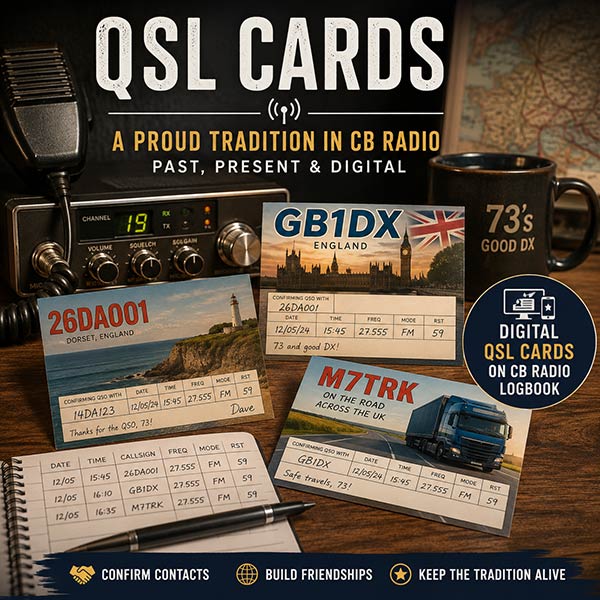
For generations of radio enthusiasts, receiving a QSL card in the post has been one of the most rewarding moments in the hobby.
Long before social media, instant messaging and digital logbooks, operators would proudly exchange personalised cards to confirm their radio contacts, build friendships and create lasting memories of conversations held across towns, countries and even continents.
While technology has changed the way we communicate, the tradition of QSL cards remains very much alive. That is why we are excited to introduce Digital QSL Cards on CB Radio Logbook — giving today’s operators a modern way to celebrate every memorable contact while honouring one of radio’s oldest traditions.
What Is a QSL Card?
A QSL card is a confirmation that two radio operators successfully made contact with each other.
The term QSL comes from the international Q Code used by radio operators. It simply means:
“I confirm receipt of your transmission.”
Traditionally, once two operators completed a QSO, or radio conversation, one or both would send a printed postcard containing the details of that contact.
These cards would usually include:
- Callsigns or operator handles
- Date and time of the contact
- Frequency or channel used
- Mode, such as FM, AM or SSB
- Signal report, if given
- Operator location
- A personalised photograph, logo or design
Some cards were simple and practical. Others became miniature works of art, featuring vehicles, antennas, local landmarks, cartoons, station photographs or bold custom designs.
A Brief History of QSL Cards
The tradition of QSL cards dates back more than a century.
During the early days of radio in the 1910s and 1920s, broadcasters wanted to know how far their signals were travelling. Listeners would send written reception reports by post, explaining what they had heard and where they had heard it from.
Rather than replying with handwritten letters every time, many stations began sending printed postcards confirming the reception. These became known as QSL cards, and radio amateurs soon adopted the idea for confirming two-way contacts.
As amateur radio grew, the exchange of QSL cards became an important part of the hobby. Later, as CB radio exploded in popularity, the same tradition found a natural home among CB operators.
The Golden Age of CB QSL Cards
If you were around during the CB boom of the late 1970s and 1980s, you may remember colourful QSL cards arriving through the letterbox.
Many operators designed their own unique cards featuring:
- Their CB handle
- Their home town or region
- Their favourite vehicle
- A family crest or nickname
- Custom illustrations
- Humorous slogans
- Radio equipment
- Local scenery
After making a memorable contact, operators would often exchange postal addresses and send each other their cards.
Over time, many enthusiasts built collections containing hundreds, and sometimes thousands, of QSL cards from around the UK, Europe and beyond.
For many operators, those collections became a personal history of their life on the air.
Why QSL Cards Matter
At first glance, a QSL card might seem like nothing more than a confirmation of a contact.
In reality, it is much more than that.
Each card tells a story.
It represents the excitement of hearing a distant station through the noise, making that first contact into another country, speaking to someone during exceptional skip conditions or simply having a memorable conversation with another operator.
Unlike a plain logbook entry, a QSL card adds personality to the contact.
Years later, many operators can look through their collection and instantly remember where they were, what conditions were like and who they spoke to.
From Paper QSL Cards to Digital QSL Cards
Many operators still enjoy collecting traditional printed QSL cards, and that part of the hobby is unlikely to disappear completely.
There is something special about receiving a physical card through the post, especially after making a rare or memorable contact.
However, the internet has opened the door to faster and easier alternatives.
Digital QSL cards allow operators to create and share confirmations without waiting days or weeks for the post. They are easier to organise, easier to store and simple to share online.
Most importantly, they keep the spirit of the tradition alive while making it more accessible for today’s operators.
Introducing Digital QSL Cards on CB Radio Logbook
One of the features available on CB Radio Logbook is the ability to create and share Digital QSL Cards.
Instead of designing cards manually or relying on separate services, operators can generate a personalised digital card directly from their logged contacts.
Whether you have just completed your first local QSO or worked impressive DX during strong skip conditions, a digital QSL card gives you a simple way to celebrate that contact and preserve the memory.
It is a modern take on a classic CB radio tradition.
Why We Added QSL Cards to CB Radio Logbook
CB Radio Logbook has always been about more than simply recording contacts.
The aim is to give operators a place where they can:
- Record their QSOs
- Discover other operators
- Build friendships
- Share memorable contacts
- Celebrate achievements
- Preserve the history of their operating
Digital QSL Cards fit naturally into that idea.
They add personality to every contact and encourage operators to interact with one another beyond simply logging a QSO.
Are Printed QSL Cards Still Worth Having?
Absolutely.
Printed QSL cards still have a charm that digital versions cannot completely replace.
For some operators, collecting physical cards is part of the magic of radio. A printed card can be kept in a folder, displayed in a shack or passed down as part of a personal collection.
Digital QSL cards are not intended to replace that tradition entirely. Instead, they make it easier for more operators to enjoy the experience.
There is room for both.
One celebrates the heritage of radio. The other brings that heritage into the modern era.
Join the Tradition
Whether you are new to CB radio or returning after decades away from the hobby, QSL cards remain one of the most enjoyable parts of operating.
They are more than just confirmations.
They are memories.
They are achievements.
They are a snapshot of every conversation shared across the airwaves.
With Digital QSL Cards available on CB Radio Logbook, it has never been easier to keep that tradition alive.
So next time you log a contact, why not create a QSL card and start building your own collection?
The airwaves may have changed over the years, but the spirit of radio friendship remains exactly the same.
73, and we’ll hear you on the air!
Related articles
Join the CB Radio Logbook
Track every QSO, map your contacts, and connect with operators near you. Create your free account and get on the air.
Create your account